
The Democratization of the Grid: How NYC Renters Are Building a Virtual Power Plant from Their Living Rooms
By turning window air conditioners into grid assets, the startup Every Electric is rewriting the rules of summer demand response, proving that urban climate resilience doesn't have to mean sweating it out.

For generations, participating in a utility demand response program in New York City has meant one thing: sacrifice. When a summer heat dome drives daytime temperatures into the triple digits and the electrical grid groans under the weight of millions of air conditioners, utility companies like Con Edison ask residents to reduce their energy consumption. For most households, this has traditionally meant carefully precooling an apartment in the morning, switching off the window units by mid-afternoon, and enduring hours of oppressive, stagnant heat.
But this summer, a quiet revolution took place in living rooms and bedrooms across the five boroughs. Instead of sweating it out, hundreds of households kept their air conditioners humming at full blast, entirely disconnected from the strained grid. The secret? Two unobtrusive household batteries tucked away in the corners of their apartments, seamlessly taking over the heavy lifting.
These households are part of a rapidly growing initiative by Every Electric, a New York City-based startup that is fundamentally reimagining urban energy resilience. By deploying residential batteries to create a decentralized "virtual power plant" (VPP), the company is proving that everyday consumers can actively stabilize the electrical grid without sacrificing their own comfort.
The Virtual Power Plant in a Box
The concept of a virtual power plant is not entirely new; utilities have long explored ways to aggregate distributed energy resources to manage peak demand. However, Every Electric has pioneered a uniquely accessible, renter-friendly model. Founded in 2023 by Columbia University postdoctoral researchers Andrew Wang and Richard May under the name Standard Potential Co., the company initially focused on commercializing sodium-ion battery chemistry. Recognizing a more immediate and scalable opportunity, they pivoted in 2026, rebranding as Every Electric to focus on deploying residential energy storage across the city’s dense housing stock.
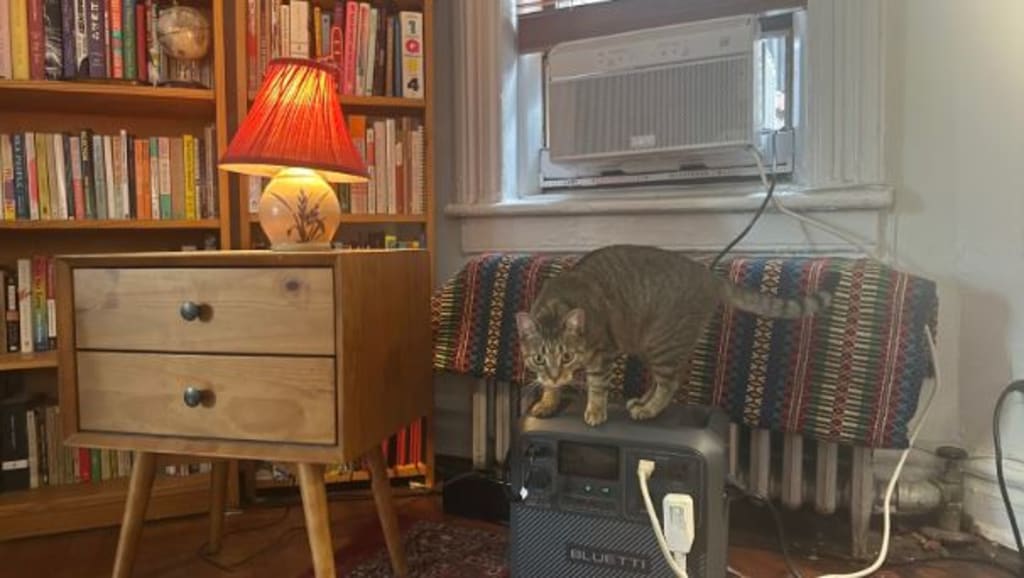
The hardware at the heart of this operation is the Bluetti Elite 200 V2, a compact lithium iron phosphate (LiFePO4) battery capable of storing 2 kilowatt-hours (kWh) of energy. The setup is deliberately frictionless: the battery is drop-shipped to the resident, plugged into a standard wall outlet, and the window air conditioner is plugged directly into the battery.
Once connected to the home’s Wi-Fi, the system operates autonomously. Every Electric’s software remotely manages the battery cycles, charging the unit during low-demand, low-cost overnight hours, and seamlessly discharging that stored energy to power the air conditioner during peak afternoon demand. To the resident, the air conditioner never stops running. To the grid, the apartment’s energy demand has effectively dropped to zero.
A Business Model Built on Accessibility
What truly sets Every Electric apart is its commitment to accessibility, a crucial factor in a city where more than 2 million housing units are rentals and over 80 percent of buildings are more than 50 years old. Historically, home battery systems have been the domain of wealthy homeowners with the capital to invest in expensive, permanently installed solar-plus-storage setups. Every Electric dismantles this barrier.
The company offers the batteries on a loan basis for a temporary, fully refundable deposit, which has been strategically reduced from $50 to just $30 per unit. For those who prefer ownership, the batteries can be purchased outright for $650.
The financial incentive is equally compelling. Every Electric operates as an official program partner with Con Edison’s Smart Usage Rewards initiative. The utility pays Every Electric for the aggregated load reduction, and the startup splits those earnings with the residents. The company estimates that households can earn approximately $150 per year for each air conditioner kept off the grid during peak events.
“There’s a business model innovation here where you make household batteries as easy and as accessible as possible, you get them as far and wide as possible, and then you essentially share in the value that you provide to the grid,” CEO Andrew Wang explained. By distributing the financial benefit, Every Electric aligns the incentives of the utility, the startup, and the consumer.
Navigating the Realities of Pre-War Infrastructure
Of course, deploying cutting-edge energy technology into New York City’s aging infrastructure is not without its hurdles. The city’s iconic pre-war buildings were not designed with modern, high-draw electrical loads in mind. During extreme heat events, when Con Edison is forced to implement voltage reductions to protect grid equipment, the sudden shift in power dynamics can be jarring for local electrical systems.
Early in the program, this manifested as a recurring issue: the power draw from the batteries, combined with the quirks of old building wiring, occasionally tripped apartment circuit breakers. Rather than viewing this as a hardware failure, Every Electric treated it as a software optimization challenge.
The company’s engineering team responded by continuously updating the battery firmware. These updates allow the system to dynamically manage discharge rates, accounting for both the macro-level voltage fluctuations from Con Edison and the micro-level electrical resistance and losses within the specific walls of each individual apartment. By fine-tuning the power banks to operate safely within the unique parameters of each household, Every Electric has steadily minimized these disruptions, turning a potential dealbreaker into a testament to the adaptability of its software.
Scaling Up and Looking Beyond the Five Boroughs
The results of this innovative approach speak for themselves. After a successful initial test run in the summer of 2025, which deployed 100 batteries across 65 households, Every Electric scaled aggressively. By the summer of 2026, the network had grown to 2,000 batteries across approximately 1,000 households.
While 2 kWh per battery may sound modest, the aggregate impact is substantial. Two thousand batteries provide a total of four megawatt-hours (MWh) of distributed energy storage. As Wang pointed out, this is the exact equivalent of one massive, containerized utility-scale battery block, but broken into 1,000 resilient, geographically dispersed pieces. This decentralization makes the grid inherently more robust, as it is not reliant on a single point of failure.
The demand for this service is exploding. This past summer, the company’s waitlist swelled to over 15,000 requests. Every Electric is now aiming to deploy more than 10,000 batteries by 2027. While the program initially targeted apartment dwellers, it has organically expanded to include single-family homeowners in Queens and Brooklyn, some of whom are now pairing the batteries with plug-in solar panels to create fully off-grid-capable micro-hubs.
Beyond keeping air conditioners running, the batteries provide invaluable secondary benefits. They serve as emergency backup power for Wi-Fi routers and refrigerators during outages, offer USB-A and USB-C ports for charging electronics, and even feature a 12V DC outlet. (As a charming, unintended bonus, Wang noted that the batteries run slightly warm, making them a favorite resting spot for the feline residents of participating households.)
A Blueprint for the Future of Urban Energy
Every Electric’s success in New York City is drawing attention far beyond the five boroughs. The startup is currently in discussions with new utility territories that are eager to replicate this model. The ability to "drop-ship literal megawatt-hours" to customers as a turnkey grid solution is a highly attractive proposition for utilities nationwide grappling with climate-induced extreme weather and aging infrastructure.
The traditional paradigm of the electrical grid is a one-way street: utilities generate power, and consumers passively draw it. Every Electric is helping to build a new paradigm, transforming passive consumers into active, compensated participants in grid stability. By proving that climate resilience and everyday comfort are not mutually exclusive, this unassuming battery in the corner of a New York apartment is quietly powering the future of urban energy.
About the Creator
Mark Lim
Hi I am mark an automotive student and a car, tech and food enthusiast ! Im gonna try and post daily & hope you enjoy what I write and do share my page with people you know. I would gladly appreciate it! Cheers
Enjoyed the story? Support the Creator.
Subscribe for free to receive all their stories in your feed.
Comments
There are no comments for this story
Be the first to respond and start the conversation.