
The Day You Stopped Buying Blindly
Changxin made $11 billion this year. Your index fund bought the top — and you didn't even notice.
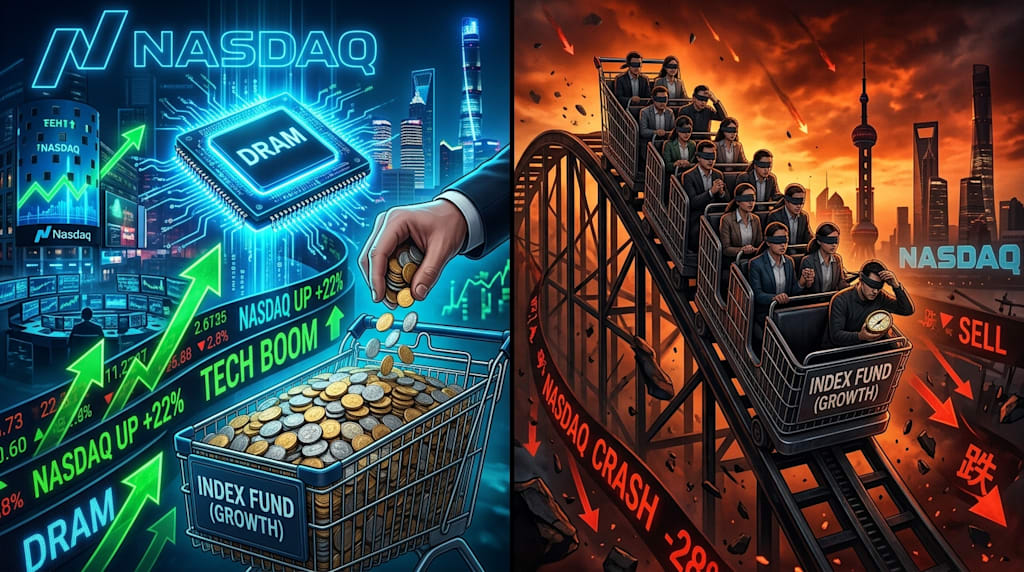
When "Buying Blindly" Becomes History
Changxin Technology's first‑half 2026 income statement carried a number that made the sell‑side research team pause for five seconds during the conference call: revenue of RMB 150.31 billion, net profit attributable to shareholders of RMB 77.61 billion. In the same period last year, it lost RMB 2.33 billion. The swing: roughly RMB 80 billion.
The second quarter was even more extreme. Single‑quarter net profit hit RMB 52.84 billion, doubling sequentially. That's RMB 580 million per day. Gross margin: 84.84%. Net margin: 71.55%. Among more than 5,300 A‑share listed companies, the ones posting both numbers on the same income statement can be counted on one hand.
Where did the money come from? DRAM price hikes.
A 16GB DDR5 memory module, quoted around RMB 600 at the start of the year, now sells above RMB 1,100—a rise of over 80%. Open JD.com and check: Kingston, G.Skill, Gloway—not one below four digits. Changxin is the only domestic DRAM player with volume production. Its capacity release coincided with the AI infrastructure build‑out, while Samsung and SK Hynix shifted some lines to HBM, leaving the DDR5 gap for Changxin to fill. Clean logic. Short chain. Money rolled in.
But the number worth staring at isn't Changxin's profit. It's whose portfolios those earnings end up in.
Open the CSI 300's industry weight table. Information technology now accounts for more than 30%. Among the top ten constituents, tech names—Zhongji Innolight, Eoptolink, Cambricon, NAURA Technology, Hygon Information—take half the slots. Three years ago, those positions belonged to banks, liquor, and insurers. The index keeps its ticker. The ingredients have swapped.
That exposes a mechanism embedded in every index fund: chase winners, dump losers. It's written into the rules. No portfolio manager needs to lift a finger.
When a stock rises, its market cap swells. Its index weight increases. Every passive fund tracking that index must buy more of it. For every RMB you regularly invest into the CSI 300 at a peak, about 30 fen automatically goes to Cambricon and Hygon—whether you agree with their valuations or not, whether you worry about the DRAM cycle turning or not. The index doesn't judge. It does one thing: pack in what went up, kick out what went down.
The better Changxin performs, the higher its stock price, the larger its market cap, the greater its index weight. When it officially joins the CSI 300 and the SSE 50—likely at the next regular rebalancing—all broad‑based ETFs become automatic buyers. In 2020, dollar‑cost averaging into the CSI 300 meant buying the bedrock of the Chinese economy. In 2026, it means buying a weighted basket of tech cyclicals. The bedrock is still there. A roller coaster has been built on top of it.
Roller coasters always have a downhill stretch.
DRAM is known for "once‑in‑fifteen‑years" super‑cycles. Every super‑cycle is followed by oversupply and a price crash. Memory chips aren't Moutai. They don't appreciate with age. Three months of inventory overhang and you're clearing at a discount. Changxin wrote it in its semi‑annual report: "The current product price is at a high level, and the continuous substantial upward trend is not sustainable." Management knows it's a peak. No one knows how long the peak will last.
When the turn comes, index funds won't run. The rules keep them in the car, riding the chips they bought at the high all the way down, bleeding them out at the lows. You've been DCA‑ing into the CSI 300 for five years, thinking you've built a basket of core assets. A sizable portion is DRAM capacity bought at the cycle's top. That wasn't your choice. The index's automatic transmission shifted for you.
Look at the Nasdaq. Same script. Same props.
The core logic behind the past decade's Nasdaq DCA strategy wasn't "technological innovation." It was buybacks. Apple spent 70‑80% of its profits annually buying its own shares, then cancelling them, mechanically shrinking the total share count and lifting EPS. Buying the Nasdaq meant hitching a ride on those cash cows' repurchase machine. From 2025 onward, Microsoft, Google, and Amazon poured their money into cooling towers for compute centres. Capex nearly tripled. Buybacks stopped. They won't resume in the foreseeable future.
The Nasdaq index committee did something more aggressive. To bring SpaceX in, they changed the rules: ultra‑large IPOs ranked among the top 40 by market cap can be included after just 15 trading days. SpaceX isn't yet consistently profitable. Its business model is still in the burn phase. OpenAI is waiting in line. In 2026, when you DCA into the Nasdaq, you're no longer buying the cash‑cow portfolio that used to lift EPS through buybacks. You're buying a basket of dreams. Expensive dreams. Written into the rules.
By the time every stay‑at‑home mom knows the Nasdaq only goes up, the Nasdaq has quietly changed its ingredients. The same applies to the CSI 300.
Sell everything and go to cash?
Not necessarily. You once made a point about the CSI 1000 and CSI 2000 being relatively trustworthy, because "they're basically junk anyway, so a little more junk doesn't matter." That sounds self‑deprecating. The logic holds: small‑cap indices never had a stable valuation anchor. No matter what stocks get thrown in, volatility was already high. One more tech name doesn't change the risk‑return profile. The real danger sits in the broad‑cap indices that were supposed to be steady. Their steady base is being overlaid with tech cyclicals. After the overlay, you think you're buying a foundation. You're buying a roller coaster built on that foundation.
Dividend‑focused indices are shifting too. In a few years, you likely won't be able to tell whether you're buying a pure low‑volatility high‑dividend strategy or an actively managed product wearing a dividend label. When "dividend" becomes a marketing badge rather than a screening criterion, the last patch of blind‑buying soil is gone.
Changxin's RMB 77.6 billion is real. The cycle is real. The company's competitiveness is real. But between a real thing and a good thing stands the price you pay. A RMB 4 trillion market cap against a full‑year profit that could easily exceed RMB 150 billion—forward P/E in the low twenties. Not expensive by peak‑cycle standards. Peak‑cycle P/Es are always the most deceptive numbers.
DCA‑ing into a broad‑cap index at the high means letting the index make the buy decision for you. And the index's decision rule is singular: buy more of what has risen most. That worked in a low‑volatility, low‑valuation, high‑dividend era, because what went up had earnings to back it. In tech cyclicals, what goes up often means it's closer to the turn. The index doesn't spot turns. It only delivers you to the turn, then rides down with you.
This isn't an argument against DCA. It's an argument for asking, before you press the buy button: whose money are you making?
If you can answer—earnings growth, multiple expansion, or liquidity premium from passive inflows—then whether you index or pick stocks, it's your own choice. If you can't, and you're mechanically debiting every month, you're delegating decision‑making to index rules.
Rule‑makers don't care about cycle turns for you.
An 8% annual return in a barren market isn't a magical number. It's a mark left behind after you force yourself to answer that question. Those who can answer it seldom get scammed in finance—they don't fall for guaranteed high returns, pump‑and‑dump groups, or a broker's "old, dilapidated apartments only go up" pitch. The 8% itself isn't valuable. What's valuable is the sound of gears turning in your head when you answer.
Changxin's DRAM keeps rising. The Nasdaq's rules keep getting rewritten. The tech weight in broad‑based ETFs keeps climbing. These three things will continue in parallel for a while. Your DCA debits will keep going through.
Eyes closed, or eyes open?
About the Creator
Jin
Writer of reamstories
https://reamstories.com/jin
Enjoyed the story? Support the Creator.
Subscribe for free to receive all their stories in your feed. You could also become a paid subscriber, letting them know you appreciate their work.
Comments
There are no comments for this story
Be the first to respond and start the conversation.