
The Day the Code Stopped
When a single ban pushed China’s developers from 3x productivity back to a blank screen.
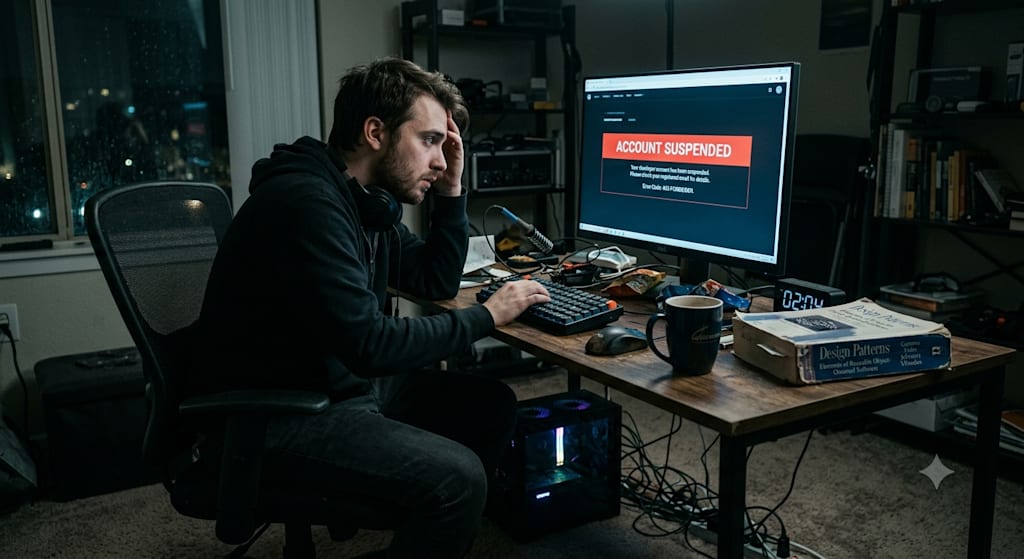
At two in the morning on July 2, 2026, Zhou Xu, a back‑end engineer at an internet company in Hangzhou, pasted his thirty‑seventh error log into the Claude Code dialog box. A red line flashed in the upper right corner of his screen: "Account suspended. Please contact support." He refreshed three times, switched to a different network, and logged in again. The page didn't change. At that same moment, in Beijing, Shenzhen, Shanghai, Chengdu—dozens of other developers in a dozen cities doing the exact same thing saw the exact same red line. No prior notice. The support channel opened to a blank white page. The annual Pro subscription fees they had prepaid, along with thousands of saved conversation records stored in the cloud, vanished like a recycle bin emptied in one click, no trace left behind.
The scheduled launch date was one week away.
I
It did not take long for this to escalate beyond the scale of "one unlucky team stepping on a landmine." A reporter from 36Kr set up a shared spreadsheet in a Telegram group. In less than a day, more than seven hundred entries filled column C—company name, subscription tier, number of banned accounts. "Our group at Alibaba Cloud, all eight of us are gone." "ByteDance side, our group of twelve, not a single one left." "Startup, just three accounts, all suspended." "Our boss's personal account is still alive, but all the API Keys are banned, so it's useless." The list kept growing.
The final entry read: "Individual, no company, renewed my annual subscription in April. No one replies to support tickets."
The reverse engineers moved fast. On July 4, someone uploaded a decompiled log to GitHub. The post was deleted three hours later, but the screenshots had already spread across developer communities. What they revealed made many people's skin crawl: the Claude Code client contained a set of identification mechanisms that went far beyond routine user authentication; it was more like a silent door behind the security gate. It would read your system timezone—if you were using Asia/Shanghai or Asia/Urumqi, that was one mark. It would check whether your ANTHROPIC_BASE_URL environment variable pointed to a non‑official gateway, which for most domestic developers was the only way to connect at all. Then it compared your proxy domain against a built‑in blocklist of 147 entries—Alibaba Cloud, Tencent Cloud, ByteDance AI Lab, DeepSeek, Zhipu AI, Moonshot AI—all of them on the list. If both conditions were met, the client would hide a marker in the system prompt using steganography, carrying your identity, device fingerprint, and usage patterns back to Anthropic's servers.
Anthropic engineers later acknowledged the mechanism in a technical blog post, calling it an "experimental abuse‑prevention measure." But they did not explain why accounts from the same organization were banned together, why prepaid users received no advance warning, or who compiled that 147‑domain list.
That afternoon, someone screenshotted a message Zhou Xu posted in a DingTalk group: "Right now I feel like someone has taken the toolset I've been welding with for more than two years, thrown it all away, and told me—'But you do know how to weld, don't you?'" Over seventy people in the group gave him a thumbs‑up.
II
The phrase "the fall of a genius programmer" first appeared around 3 a.m. on July 3, when someone posted on Jike: "Claude is gone. I instantly fell from genius programmer to ancient‑style welder. #fall." Within four hours it had been reposted over a thousand times. The curious thing was that no one took it as pure banter; everyone who picked up the meme carried a tone of "I want to laugh but I can't quite manage it," because what followed it was real.
Over the past two years, the act of programming had been redefined. In a typical mid‑sized internet team, the entire development pipeline—code generation, unit test writing, bug localization, code review, refactoring suggestions, log analysis—ran on AI. Claude 3.7 Sonnet's coding ability was widely regarded as the industry ceiling in these scenarios. There were no precise industry‑wide statistics, but the numbers developers shared across communities consistently corroborated each other: AI‑assisted coding boosted productivity by a factor of three to five, and locating an obscure bug shrank from two hours to under twenty minutes. These figures were not wall‑mounted "productivity metrics." They translated directly into how many story points a specific person could finish before 3 p.m., or whether an emergency patch could be merged before the test environment freeze on Thursday evening.
Once the underlying tool was pulled out, the entire pipeline built on top of it collapsed. The AI‑generated comments and suggestions in code reviews disappeared. The intelligent checks mounted in CI scripts vanished. The commit‑message summaries produced with AI assistance were gone; all of which seemed minor individually, but together represented an entire layer of cognitive load that had been internalized and outsourced.
"Ancient‑style programming" suddenly became a literal operating procedure: open a browser, scroll through three pages of Stack Overflow threads, read the error log line by line, dig out similar code written in the past, compare and revise, commit, wait for CI to finish, read the logs again if it failed, and start over. This was not "slower"; it was operating on an entirely different dimension of work.
Zhou Xu later described his first day after the ban: he sat in front of his workstation for a full forty minutes without touching the keyboard. "It wasn't that I didn't know what to write; it was that I didn't know how to start writing. Before, I'd drop a comment block in, let Claude generate the interface definition and basic implementation, then I'd modify it. Now I had to start from a blank file myself. It felt like driving automatic for two years, then being thrown back into a manual—and the clutch engagement point was different."
Junior developers fared even worse. Their "growth path" had itself been built on AI assistance: learning conventions by observing Claude‑generated code, understanding edge cases by iterating prompts, mastering debugging logic through AI‑based error interpretation. In this learning model, AI served as both teacher and tool. When the tool left, the teacher left too.
III
The policy response came faster than the industry had anticipated.
On July 8, Alibaba issued an internal notice: all overseas AI tools involved in code generation were to be suspended immediately, and existing data would undergo desensitization and migration. Tencent issued a nearly identical notice on the same day. On July 12, the Ministry of Industry and Information Technology released a brief risk advisory; it did not name any specific product, but the phrase "operators of critical information infrastructure should give priority to domestically produced tools that have passed security assessments" was unambiguous in its intent. Within a week, the technical platform departments of several major tech firms had all pivoted.
The response from domestic model vendors was almost a beachhead rush.
Tongyi Qianwen's Qwen3‑Coder released multiple benchmark reports in the same month, and the numbers showed its gap with Claude had been compressed to single digits. Alibaba also rolled out Qoder, an enterprise‑grade programming tool whose key selling point was "private deployment + data never leaves your domain." To companies that had just been burned by an overseas tool, that pitch carried more weight than any performance metric. Moonshot AI moved up the launch of Kimi K3 by two weeks, highlighting front‑end code generation and complex reasoning. Zhipu AI's GLM 5.2 added a deliberate line in its release announcement: "Stable operation, zero risk of account bans." The comment section flooded with "we all know what that means." DeepSeek formed a dedicated business unit to benchmark Claude Code's interaction experience, and Xiaomi's MiMo Code chose an open‑source path, releasing its code directly.
But whether these products could actually catch the developer base that Claude left behind was not a matter of isolated capabilities; those had already been benchmarked to death. The real question was: how did Claude Code actually work? When handed a code repository, it first read the entire project directory structure, understood the dependency relationships between modules, then parsed the commit history to infer which features were stable and which were experimental, and finally broke down development tasks, generated patches, and output code that could be applied with one click. This was not an "autocomplete tool"—it was a collaborative system that understood context and performed a mini‑refactoring on your behalf.
Domestic tools were currently stuck at this layer. On the third day of testing Qoder, Zhou Xu posted on WeChat Moments: "Single‑file generation is already good enough. But I gave it a twenty‑file microservice module and asked it to change an interface definition; it modified files A and B, but missed the dependency references in files C and D, and I spent half an hour manually patching them." He didn't say "it's not as good as Claude," but everyone reading it understood.
The gap lay in "repository‑level understanding" and "multi‑file coordinated modification." This was not a capability that could be quickly closed by throwing more compute at it; it depended on the model's long‑term memory of full engineering contexts and multi‑level reasoning. It would take time.
IV
A new direction began to emerge in developer community discussions: they were no longer just complaining and comparing; they were drawing up "tool disaster‑recovery plans."
Someone created a repo on GitHub called "llm‑fallback‑strategies," which organized access methods and switching thresholds for various AI coding tools. "If Claude's error rate exceeds 5%, automatically switch to GPT‑4o; if GPT also fails, fall back to a local DeepSeek‑Coder deployment; if the local model can't handle it, degrade further to pure hand‑coding." The README at the top of the repo stated: "This plan is not about 'the best experience'; it's about 'the least likely to shut down completely.'" It garnered over 4,000 stars within two weeks.
Another direction was local deployment. Downloads of open‑source versions of CodeLlama and DeepSeek‑Coder spiked after the ban. There was still a noticeable performance gap between cloud models and local open‑source options, but the weight of the phrase "my data runs on my own machine" suddenly became enormous. Someone in the community did the math: the cost of two A100 GPUs was roughly equivalent to one month's salary for two senior engineers. If this local deployment could last a year, the ROI already surpassed relying on cloud subscriptions, and there was no risk of being shut off.
At a deeper level, changes were happening in mindset. Before the ban, the industry's default "best practice" was to offload as many coding tasks as possible to AI, with engineers responsible only for validation and integration. After the ban, some began to pull back: instead of treating AI as a "ghostwriter," they used it as a "second screen"—for cross‑checking, edge‑case testing, alternative enumeration—but kept core logic and architectural decisions in their own hands.
A senior architect with twelve years of experience wrote a passage in an internal post‑mortem document that was anonymously forwarded across the internet: "AI made me three times faster, but it also made me forget how to build a system's foundation from scratch on a blank sheet. Now I think there must be at least a period every day when I write without AI assistance—not for the sake of slowness, but to preserve the reserve capacity to start from zero."
That passage was reposted repeatedly in three or four different group chats. No one commented on it, but the forwarding itself was a statement.
V
In the early morning of August 1, Zhou Xu sent me a message on DingTalk—exactly one month after his account was banned.
"I tried four domestic tools afterward, and eventually settled back into a mix of local DeepSeek‑Coder and hand‑writing. Efficiency is roughly back to sixty percent of what it was before the ban. Sixty percent is good enough. But that feeling of 'good enough' is different now—before, it was 'this thing is done by AI and I just need to review it.' Now it's 'I know why every line of code is written this way, and AI just helps me type a little faster.'"
He attached a screenshot: his workstation at 2 a.m. On the screen, a locally deployed, offline programming assistant; beside the monitor, a cup of cold coffee and a dog‑eared copy of Design Patterns in print.
"Not the fall of a genius," he typed at last. "It's that I realized I was never as brilliant as I thought—but also not as useless as AI made me feel."
Outside, the hottest part of summer had passed, and dawn was creeping later. The cursor on the screen was still blinking. The machine on his desk carried no overseas API keys; all code and inference ran on the local GPU. If Anthropic upgraded its detection mechanisms again, or if domestic tools released new versions, or if the open‑source community brought out better models—all of that would happen. Versions would iterate. Tools would change. But the person sitting in front of the screen at 2 a.m., reading the error log for the third time, would remain the same.
AI tools can be banned, can go down, can be updated and replaced. Programmers, back at a blank page, still have to type out that first line.
So they type it.
About the Creator
Jin
Writer of reamstories
https://reamstories.com/jin
Enjoyed the story? Support the Creator.
Subscribe for free to receive all their stories in your feed. You could also become a paid subscriber, letting them know you appreciate their work.
Comments
There are no comments for this story
Be the first to respond and start the conversation.