
The Day Tesla’s Driverless Taxi Met the Regulator
How a car without a steering wheel, a federal investigation, and a 6% stock drop collided on the same morning — and what it means for the future of autonomous driving.
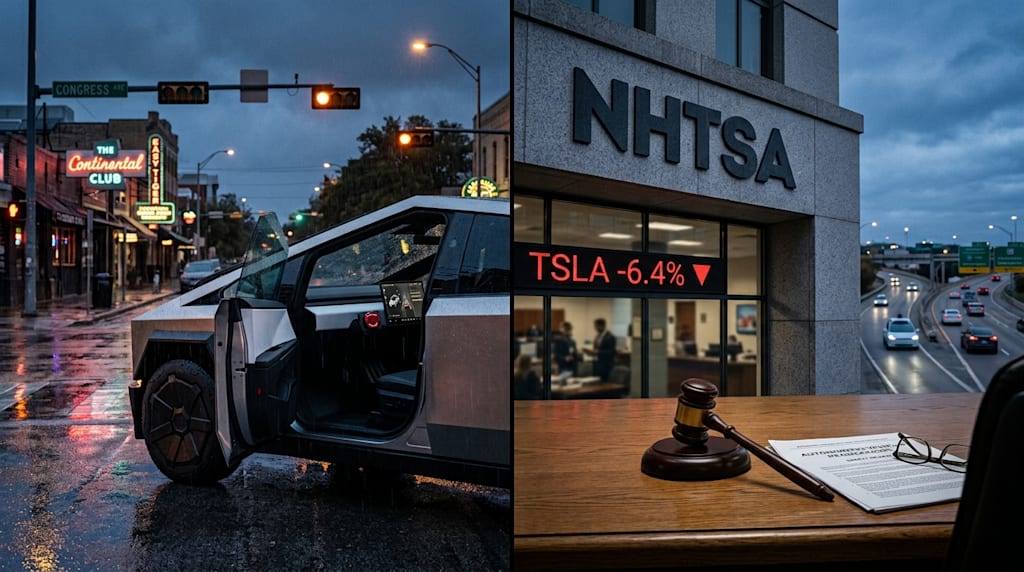
When a driverless taxi met a regulator on its first day
On September 3, 2026, Tesla started running Cybercab taxis in Austin, Texas. These are the first L4 autonomous vehicles sold to the public that have no steering wheel, no brake pedal, no accelerator, and no mirrors. No driver sits inside. Only passengers, a screen, and software.
The next morning, the National Highway Traffic Safety Administration opened an investigation into how Tesla certified the Cybercab as meeting federal safety standards. That same day, Tesla’s stock fell nearly 6%.
The timing was not accidental. It marked a direct collision between a radical product launch and a regulatory system built for a different era.
This piece looks at three things: what the Cybercab actually is, why NHTSA acted so quickly, and what investors saw that spooked them.
I. What Cybercab is — and why it matters
Cybercab removes every physical control that a driver would use. Inside: a touchscreen, an emergency stop button, and a Starlink antenna for remote communication. The passenger is no longer a driver. The car is no longer a machine you operate — it is a box that moves you.
Under the hood, Tesla uses its pure‑vision system: eight cameras, no lidar, no pre‑loaded maps. Musk’s reasoning is simple: humans drive with two eyes, so software should be able to do the same with eight cameras. That logic is clean in theory, but in safety engineering it is aggressive.
The business case is ambitious. Musk has said Cybercab will become Tesla’s main revenue source. The math: build each car for under $30,000, run it at under $0.20 per mile, and let owners put their own cars on the network to earn money. In this model, a car turns from a cost into a money‑making asset. That is the core of Tesla’s valuation story.
II. Why NHTSA stepped in on day one
The U.S. safety system relies on self‑certification. NHTSA writes the rules; automakers check their own vehicles against those rules and sell them. The regulator audits later.
But the current Federal Motor Vehicle Safety Standards were written for cars with human drivers. They require steering wheels, brake pedals, and mirrors. Cybercab has none of those. So Tesla did something unusual: it decided on its own that some of those standards don’t apply to its car because the car has no driver in the first place.
That is a legal argument, not a technical one. NHTSA is now asking whether that argument holds up. The investigation is not about a specific crash — none had occurred — but about the process Tesla used to claim compliance.
The timing is telling. NHTSA opened the probe on the very day Cybercab started carrying passengers. That suggests the agency had been waiting for this moment. Its administrator, Jonathan Morrison, put it plainly: “We fully support autonomous vehicles. But we have to make sure the law is followed.”
III. Three real problems with a driverless car
First: no physical backup. Waymo and other autonomous fleets keep steering wheels and pedals even at L4. If the software fails, a human or remote operator can take over. Cybercab has no such fallback. If the system gets confused, it tries to pull over on its own. If that fails, it calls a remote operator via Starlink. That call takes time. At highway speed, a two‑second delay can kill. Traditional cars have dual brake circuits and mechanical steering links. Cybercab puts everything on one software stack.
Second: who pays when something goes wrong? Traffic law is built around a driver. No driver means no clear liable party. Tesla has said it will take responsibility, but that is not law. If a serious accident happens, courts could spend years arguing whether the manufacturer, the software developer, the fleet operator, or an insurer should pay. Even worse: if the software’s decision causes harm, is that a product defect or a service failure? The legal answer changes everything.
Third: passengers get scared. People feel safer when they know they can grab the wheel if needed. That knowledge is a psychological anchor. Cybercab cuts that anchor. On a normal ride, passengers feel curious. When the car hesitates or does something unexpected, anxiety rises. In a sudden emergency, fear takes over. That shift from curiosity to fear happens in seconds, and it is hard to undo. Trust takes years to build and one crash can break it.
IV. Two paths, two trade‑offs
Tesla and Waymo have chosen different routes.
Tesla relies on cameras alone, targets a vehicle cost under $30,000, and aims for per‑mile operating costs below $0.20. Its Cybercab fleet currently numbers 45 vehicles, and its total autonomous miles driven stand at roughly 380,000.
Waymo uses lidar, cameras, and radar together. Its vehicles cost $107,000 to $112,000 each, and its per‑mile operating cost is around $2 to $3. Waymo operates more than 4,000 vehicles and has logged over 220 million autonomous miles.
Tesla's advantage is cost. Waymo's advantage is safety data and regulatory trust. Waymo's senior VP for autonomous software said publicly: "Cameras are excellent, but cameras alone are not enough."
The mileage gap is stark: 220 million miles versus 380,000 — a factor of nearly 600. That gives Waymo statistically much stronger evidence of safety.
And regulators are watching. New Jersey has proposed a law that would force L3 and L4 vehicles to use multiple sensor types. If other states follow, Tesla's pure‑vision approach could face a compliance wall. That would not be a technology failure — it would be a regulatory one.
V. What investors saw on September 4
Two things hit the stock on the same day.
First, the launch event was thin. No livestream. No Musk. No numbers on production, timelines, or order volume.
Second, NHTSA opened its investigation. Regulatory risk went from a distant worry to a live event.
Analysts reacted accordingly.
Evercore ISI called the event "light on details" and said it would watch whether Tesla's operating metrics catch up to Waymo's. Wells Fargo said the event failed to meet expectations and offered no new catalysts. Barclays expressed "some disappointment" over the lack of direct communication. JPMorgan projected a near‑term pullback and said it sees only about 9,000 Cybercabs by the end of 2027. RBC took a longer view, arguing that the long‑term potential remains intact and that the slow start looks like a deliberate strategy rather than a technology limit.
The price drop was not just about one disappointing event. It revealed three underlying concerns.
First, regulatory uncertainty had not been priced in. NHTSA could potentially block Cybercab's certification entirely.
Second, the market had overestimated how fast Cybercab would scale. Starting with 45 cars and reaching 9,000 by 2027 is a very different story from "the golden age of transport."
Third, Tesla's valuation relies heavily on Robotaxi optimism. Without near‑term proof, that optimism becomes fragile.
A hard question now hangs over the stock: if Cybercab is 18 to 24 months behind what the market assumed, how much should Tesla's value fall? The September 4 move suggests investors are trying to answer that.
VI. The deeper institutional tension
Cybercab exposes a classic lag: law moves slower than technology.
The Federal Motor Vehicle Safety Standards were written decades ago, for cars driven by people. When an L4 car appears, those standards break — they either don't fit or need reinterpretation. Tesla chose to reinterpret them on its own. NHTSA chose to investigate that reinterpretation.
In February 2026, the House passed the Autonomous Vehicle Act, which relaxed federal restrictions on cars without steering wheels and pedals. That gave Tesla a legislative green light. But a law from Congress does not force NHTSA to accept a manufacturer's safety claim. The agency still has its own authority.
That split — legislative permissiveness versus administrative caution — creates a gray zone. The law says "you may go on the road"; the regulator says "I need to check how you got there." Those two statements are not contradictory, but they create friction.
Tesla's playbook is familiar from the tech world: launch first, then negotiate compliance later. Uber and Airbnb used that strategy. But automotive safety is different. A crash has physical consequences that cannot be patched away. NHTSA's investigation is effectively a declaration that the automotive industry does not accept that playbook.
VII. The road ahead
Musk called this "the golden age of transportation."
On September 3, Cybercab hit the street. On September 4, NHTSA launched an investigation. On the same day, the stock dropped 6%.
Those three facts together are a reminder: a golden age needs technology, money, and institutions to move together. If one lags, the gold turns to brass.
Whether Cybercab truly opens a new era for robotaxis does not depend on one event, one sensor choice, or one stock move. It depends on a simpler question: can Tesla operate these cars safely enough, under a regulator's eye, with the public's trust, for long enough that the system becomes routine?
That may take longer than Musk has suggested.
About the Creator
Jin
Writer of reamstories
https://reamstories.com/jin
Enjoyed the story? Support the Creator.
Subscribe for free to receive all their stories in your feed. You could also become a paid subscriber, letting them know you appreciate their work.
Comments
There are no comments for this story
Be the first to respond and start the conversation.