
The Day a Single Stock Swallowed 122 Billion Yuan: Inside Changxin Technology’s 3.66 Trillion Market Cap Debut
Nine million investors fought for a ticket, lottery winners sold at 48, and a Chinese DRAM maker just became the world’s most valuable memory company—on its first day of trading.
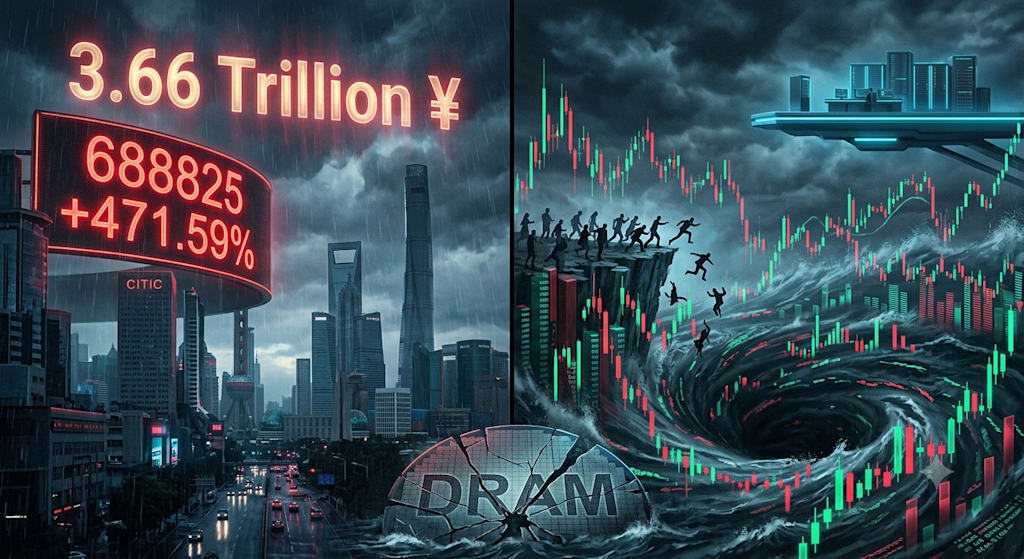
July 27, 2026, 9:30 AM.
Changxin Technology (688825) opened at 49.5 yuan, a 471.59% premium to its IPO price of 8.66 yuan, giving it a market cap of 3.31 trillion yuan. At that same moment, Industrial and Commercial Bank of China sat at 3.28 trillion. The A‑share “No. 1” had a new name.
During the session, the stock touched 55.03 yuan, up 535.45%, pushing its market cap to 3.66 trillion yuan. That figure surpassed Intel’s $46.57 billion closing market cap on July 24, which translated to roughly 3.15 trillion yuan at that day’s exchange rate. By the midday close, the stock settled at 54.65 yuan, with trading volume of 122.1 billion yuan and a turnover rate of 58.06%.
Half a day. One stock. 122 billion yuan.
Online subscription accounts reached 9.4288 million, the highest in the STAR Market’s seven‑year history. The final allotment rate was 0.4714%.
This was not a “good start.” This was ripping the entire front door off its hinges and slamming it onto the table.
I. The Lottery Winners Who Sold at 48
One subscriber held 1,000 shares, with a cost basis of just over 8,000 yuan. He placed a flash order and sold at 48 yuan, netting a profit of about 40,000 yuan. The opening price was 49.5 yuan—he sold 1.5 yuan below the open.
“Price volatility was too high right after the open, and institutions were piling into hedges, so it was hard to nail down a good price.” His exact words.
That’s not called “missing out.” That’s called “locking in.” The theoretical profit per lot (500 shares) was about 20,000 yuan, hitting the upper end of what institutions had projected earlier. The “neutral estimate of 13,000 to 20,000 yuan per lot” was validated within the first three minutes of trading—then the price surged to 55, and pulled back to 54.65. The spike in between was barely long enough to take a sip of water.
Retail investors were selling. Quants were buying. Retail covered their positions, while institutional hedging orders carpeted the order book. The tape was violently choppy, and bids at every price level were being chewed through.
II. The Numbers Speak for Themselves
Changxin’s debut figures need no adjectives:
Opening gain: 471.59%
Opening market cap: 3.31 trillion yuan
Intraday peak market cap: 3.66 trillion yuan
Half‑day turnover: 122.1 billion yuan
Half‑day turnover rate: 58.06%
Online subscription accounts: 9.4288 million
Final allotment rate: 0.4714%
Every single line is a record for the STAR Market or the entire A‑share market. But the real question is straightforward: what are those records worth?
A useful comparison sits in the closing market caps of global memory leaders on July 24: Samsung at roughly 2.8 trillion yuan, SK Hynix at about 2.2 trillion, and Micron at approximately 1.8 trillion. Changxin’s midday close of 3.66 trillion put it above all three.
The fundamental picture backing this valuation looks like this:
Full‑year 2025 net profit: 1.875 billion yuan
IPO P/E ratio: 309×
H1 2026 projected revenue: 110–120 billion yuan
H1 2026 projected net profit attributable: 50–57 billion yuan
YoY revenue growth: over 600%
YoY profit growth: 2,200% (vs. a −2.332 billion loss in the prior‑year period)
2026E dynamic P/E at opening cap (linear extrapolation): roughly 30×
Steady‑state P/E range for overseas memory leaders: 8–12×
Sector cyclical premium cap (institutional estimates): 16×
The gap between the two columns of numbers is where the disputes lie.
III. Dispute One: Is the Cycle Still There?
The DRAM industry’s historical pattern is not long, but it is hard: one cycle every three to four years. The chain “demand heats up → prices rise → capacity expands → oversupply → prices crash” has never broken.
2023 was the last trough, with DRAM prices falling to the point where the entire industry bled red. Then AI server procurement exploded, and prices multiplied tenfold from the bottom. Now, standing in mid‑2026, the industry sits near the top of the up‑cycle—that is an objective positioning on the timeline, not an opinion.
Samsung, SK Hynix, and Micron have already started large‑scale capacity expansions in tandem, with new supply expected to hit the market in 2027. That is something already happening, not a forecast.
Changxin’s projected 2026 revenue of 100 billion yuan and profit of 50 billion yuan are entirely built on current DRAM price levels. Price is the multiplier. Change the multiplier, and every number moves with it. A 30× dynamic P/E can become 60×, 100×, or no multiple at all—because profits vanish—within a single quarter.
The market’s current pricing embeds an implicit assumption: this time the cycle won’t come, or if it does, it won’t affect Changxin. Or perhaps AI demand will absorb all new capacity, and the end of expansion is not oversupply.
Whether that assumption holds will be seen in two years. But right now, placing 3.66 trillion yuan on top of it is a bet that the cycle breaks on this company’s doorstep.
IV. Dispute Two: Is It the Static Expensiveness or the Dynamic Cheapness That Counts?
First, the static view. A 1.875 billion yuan profit against a 3.66 trillion yuan market cap gives a static P/E of 1,952×. The market is not pricing “past earnings”—it is doing something else.
Now, the dynamic view. A half‑year profit of 50–57 billion yuan, extrapolated annually, gives a dynamic P/E of roughly 30× at 3.66 trillion yuan. That is the bull case’s valuation anchor.
But “dynamic cheapness” carries a premise: you must value the company as if its projected performance is already realized, and you must also accept that 30× itself is three times the steady‑state range of overseas leaders.
The 8–12× P/E on overseas memory leaders is not pulled from thin air. It is the long‑term pricing range that the market has assigned to a strongly cyclical industry after going through three full memory cycles. “Cyclical” means low P/E in good years, high P/E—or losses—in bad years. This is a good year: DRAM prices are high, and industry profits are at their fattest. The current P/E ratios on Samsung and Micron are both in single digits. Changxin’s 30× is triple that, even in the good year.
The bull case logic runs: Changxin is not Samsung. It is China’s only large‑scale DRAM producer, and the domestic substitution runway gives it a structural premium. How much that premium is worth cannot be calculated; it can only be bet on.
The bear case is simple: SMIC was also awarded a “unicity premium” when it listed in 2020. Five years later, that premium was gradually ground down by the twin pressures of capacity ramps and external restrictions. Uniqueness does not guarantee a straight path upward.
V. Dispute Three: The HBM Money Is Not Yet on the Table
The fattest profit pool in memory chips right now is called HBM (High Bandwidth Memory). AI training needs HBM. Nvidia’s GPUs ship with HBM. Samsung and SK Hynix together hold over 90% of the global HBM market.
Changxin’s HBM has not yet entered mass production.
That is not criticism. That is a fact. Yield ramp, equipment procurement, customer qualification—every single step takes time. In terms of process technology, Changxin still lags behind global leaders by roughly two generations. In the memory industry, two generations translate into a catch‑up window of three to five years.
The domestic substitution space does exist. China’s DRAM market consumes about 30% of global capacity each year, and Changxin is the only local supplier. But substitution is not a toggle switch; it is year‑by‑year penetration. How much penetration has been priced into the stock is not precisely measurable, but the expectation baked into a 3.66 trillion yuan cap is “already very high”—that judgment does not require precise numbers to support.
VI. A Detail on the Tape
At the start of trading, the free float stood at 4.503 billion shares, or 6.73% of total outstanding shares. The remaining 93% is locked up.
No price limits apply during the first five trading days. An extremely small float combined with unlimited volatility is the standard playground for quantitative strategies. In today’s tape, the price impact of a single large order already exceeded the full‑day volatility of most large‑cap A‑shares.
Half‑day turnover hit 58.06%. More than half the free float changed hands in half a day. The average cost basis for incoming funds was above 50 yuan. In the afternoon, whether the morning’s money stays depends on whether enough new money arrives to bid it higher.
In three months, Changxin is expected to be included in major ETF indices. Passive money will systematically buy into that window—that is three months away. During the earnings vacuum over the next three months, the stock will be driven by two things: the selling willingness of existing holders and the buying willingness of those on the sidelines. The balance changes every day.
VII. Two Things
The original poster said two things at the end of his discussion.
First:
“If you really want to participate, the right side or waiting a day won’t hurt—let the chart settle.”
That is not advice. That is what someone who has spent time in the market says. It means: every number you see on the current price—3.66 trillion, 471%, 58% turnover, 122 billion in volume—is an emotion gauge, not a valuation tool. Emotion gauges swing too far in both directions. Wait for the swings to narrow, wait for turnover to drop from 58% back to single digits, wait for the first‑day money to decide whether to stay or go, and then look again.
Second:
“Feelings are feelings, and reality is reality.”
Changxin Technology is a milestone for China’s semiconductor industry. The A‑share market finally has a pure‑play DRAM manufacturer—and the world’s fourth company capable of mass‑producing mainstream DRAM. That fact alone is worth an announcement, a news story, an editorial—but it is not worth a blindly entered price.
Stock price and significance are two different things. Price moves; significance does not. The people who keep them separate are the ones who stay in the market long.
About the Creator
Jin
Writer of reamstories
https://reamstories.com/jin
Enjoyed the story? Support the Creator.
Subscribe for free to receive all their stories in your feed. You could also become a paid subscriber, letting them know you appreciate their work.
Comments
There are no comments for this story
Be the first to respond and start the conversation.