
The “Crippled” China iPhone Is Not What You Think
UWB works. Satellite hardware exists. mmWave is missing. Wireless charging is capped. Apple Intelligence is late. Five differences, five causes, and one bad label.
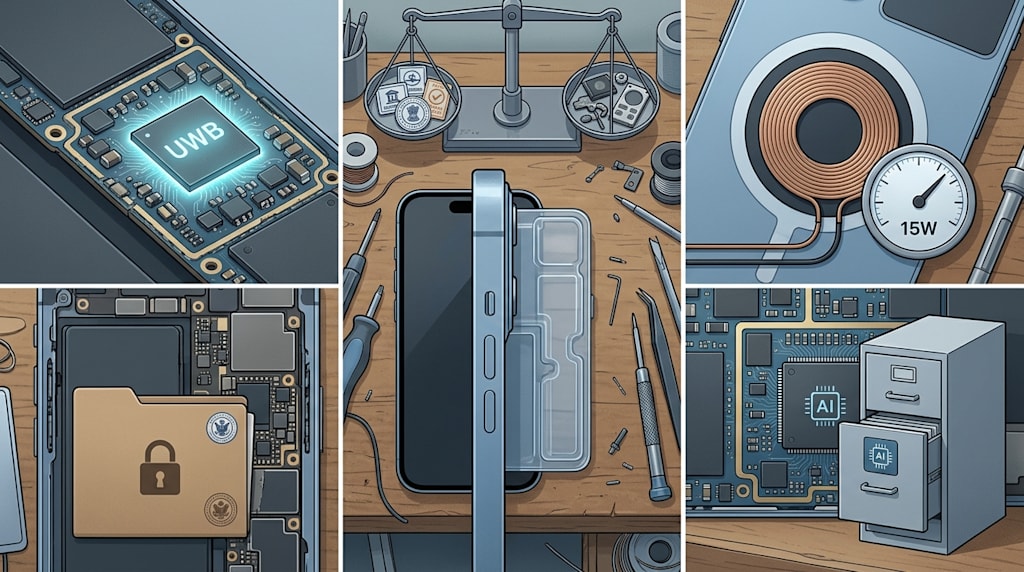
Start with the conclusion: China-market iPhones differ from overseas versions. But “different” does not mean “crippled,” and it does not mean Apple set out to annoy Chinese users. Teardown images, spec sheets, and regulatory filings show at least five kinds of difference. Each has a separate cause. Lumping them together produces anger, not accuracy. Separating them shows which gaps you have to accept, which you can push Apple to explain, and which are misreadings.
UWB: The China Version Has Not Cut It
In teardown videos of the China-market iPhone Duo motherboard, the UWB chip and antenna are both there. Apple China’s official spec page also states it clearly: second-generation ultra-wideband chip, supports precision finding. Car keys, item tracking, and spatial awareness work the same way.
The “list of countries where UWB is unavailable” circulating online includes Armenia, Azerbaijan, Belarus, Kazakhstan, Kyrgyzstan, Russia, Tajikistan, Turkmenistan, Ukraine, and Uzbekistan. That list comes from Apple’s official support documentation. It has nothing to do with the China-market version. Someone screenshots the list, adds a line saying “the China version might be in trouble too,” and the comments section starts boiling. This is a case of stitching facts from different contexts together to manufacture anxiety.
UWB deserves to be discussed first because it is a counterexample. The China-market version does not cut every feature whenever it can. Features that are restricted usually have specific regulatory or commercial reasons. “Apple thinks Chinese users do not deserve it” is not one of them.
Satellite Communication: Hardware Present, Service Not Approved
When teardown bloggers see that the China version is missing a large chip and a set of antenna modules, bullet comments flood with “satellite communication has been crippled.” The more accurate picture is this: the satellite communication hardware module exists in the China-market iPhone Duo, but the relevant service has not received approval or been activated. Hardware pre-installation and service availability are two different things.
Satellite communication does not work just by stuffing a chip into a phone. It involves radio frequency licenses, ground gateway construction, carrier cooperation, emergency rescue system integration, and regulatory approval. When Apple promoted satellite emergency SOS in the United States, it had to make the service work with local satellite operators, regulators, and rescue systems. In China, the hardware is present but the service is not approved, so from the user’s side it is unavailable. That difference is real. Describing it as “Apple gouged out the hardware” compresses a complex compliance problem into an emotional accusation.
5G mmWave: The Empty Space Is Not a Mysterious Cut
The empty area on the China-market motherboard is widely said to point to the 5G mmWave module. US versions carry the module and antenna to adapt to US carriers’ mmWave 5G networks. The China version does not have them, and the empty space is filled with a plastic placeholder.
This difference sits at the hardware level, but it is not the same thing as “Apple reducing specs for Chinese users.” China’s 5G mainly uses the Sub-6GHz band, and mmWave deployment is limited. For most users, the absence of the mmWave module has almost no impact on daily experience. When Apple makes global models, it makes SKU differences according to regional network environments. If the US needs mmWave, Apple includes it. If China does not use it, Apple does not add cost, space, and complexity for it.
Apple should not get a free pass here. Users are not angry about mmWave itself. They are angry that versions of the same phone differ so much by region. mmWave is a symbol. It makes the hardware gap easy to see, so all the emotion lands on that empty space. The plastic placeholder is cheap. The signal behind it is not: the device in your hand is not an exact copy of the machine sold in another market.
15W Wireless Charging: Frequency Rules Set the Ceiling
US versions of MagSafe and Qi2 can reach 25W. The China version tops out at 15W. This gap is easy to write as “the China version even cripples charging,” but the cause is frequency regulation. The 360kHz band used by MagSafe and Qi2 belongs in China to a protected aeronautical radio navigation service band, and power is restricted. Apple can only lower the power to the permitted range if it wants to sell compliantly in China.
Slower wireless charging on the China version is not a secret hardware swap. It is not Apple withholding 10W for fun. The product has to meet local spectrum management rules. Users can feel the difference between 15W and 25W, especially heavy users. But writing this as “Apple discriminates against the China version” ignores the regulatory variable.
A concrete detail makes the gap easier to see: you put the phone on MagSafe, take a shower, and come back. How much battery did it gain? The difference between 15W and 25W lands in moments like that, not in a spec table.
Apple Intelligence: Filing Is the Threshold, Lateness Is the Reality
The Apple Intelligence large model has completed its filing, and the China-market launch now has a timetable. That information is accurate. Related features have been rolling out overseas for a long time, and China-market users are only now seeing a launch plan. The felt experience is “several years late.”
Two layers need to be separated. First, the slow rollout of China-market AI features has real causes: data compliance, content security, localization, and service filing. Second, users’ dissatisfaction is also real. It is the same iPhone. Why do features others have used for a long time require China-market users to wait? The first batch of features is often limited to translation, writing, and photo editing, and it still lags behind the full overseas form.
Do not say “Apple does not value Chinese users.” Do not say “it is all compliance, nothing can be done.” A more accurate statement is this: compliance is a hard constraint, but Apple’s communication and pace management also have problems. A late feature can be explained. A long-term lack of clear expectations makes dissatisfaction worse. Users are not afraid of waiting. They are afraid of not knowing how long they will wait and whether the version that arrives will be complete.
Five Kinds of Difference, Five Kinds of Cause
The first kind is genuine hardware absence. The 5G mmWave module is the example. The cause is insufficient local network demand, plus differences in cost and model definition.
The second kind is hardware present but service not open. Satellite communication is the example. The cause is that frequency, operations, approval, and rescue systems have not been worked out.
The third kind is regulation limiting parameters. 15W wireless charging is the example. The cause is frequency protection and power restrictions.
The fourth kind is a difference in feature rollout pace. Apple Intelligence is the example. The cause is filing, data compliance, and localization.
The fifth kind is pure misreading. UWB is the example. The China version supports it. It is simply unavailable in some countries, and the two facts have been conflated.
None of these five categories comes from “Apple held a meeting one day and decided to cut the China version.” They are compromises made by a global product under local regulation, spectrum allocation, service approval, carrier cooperation, and cost structures. A global model has never been “the same phone sold everywhere.” It is “the same product name, different configurations in different regions.” Cars, game consoles, and communication equipment work the same way.
Users’ dissatisfaction is not unreasonable. China-market users face real feature gaps. Satellite communication is unavailable. Wireless charging is slower. AI features arrive later. Some hardware versions differ. If Apple explains everything with “compliance” and does not clearly explain which features will come, when they will come, and why they are not here, then the word “crippled” will keep circulating.
Criticism Should Aim at the Right Target
The China-market iPhone is not an exact copy of the overseas version. It has hardware differences, service differences, power restrictions, and rollout-pace differences. Calling all of these “crippling” expresses emotion, but it hides the real problem.
A more accurate summary is this: UWB has not been crippled. Satellite communication has the hardware but not the approved service. mmWave was not included because China does not use it. 15W wireless charging is a frequency-regulation limit. Apple Intelligence is late because of filing and localization. The “special treatment” of the China-market iPhone comes half from regulation, half from product strategy, and partly from opaque communication.
The question that deserves criticism is not “why the China version is not the US version.” It is this: under compliance constraints, has Apple done the best it can for the China-market user experience? Has it explained feature expectations clearly? Has it synchronized things where synchronization is possible? Those questions are harder than a slogan, and they are the ones that matter.
About the Creator
Jin
Writer of reamstories
https://reamstories.com/jin
Enjoyed the story? Support the Creator.
Subscribe for free to receive all their stories in your feed. You could also become a paid subscriber, letting them know you appreciate their work.
Comments
There are no comments for this story
Be the first to respond and start the conversation.