
The Coup Story Around Jensen Huang Is Cleaner Than the Evidence
A scandal, a capital loop, and a political fight all landed on one man. That does not prove a plot.
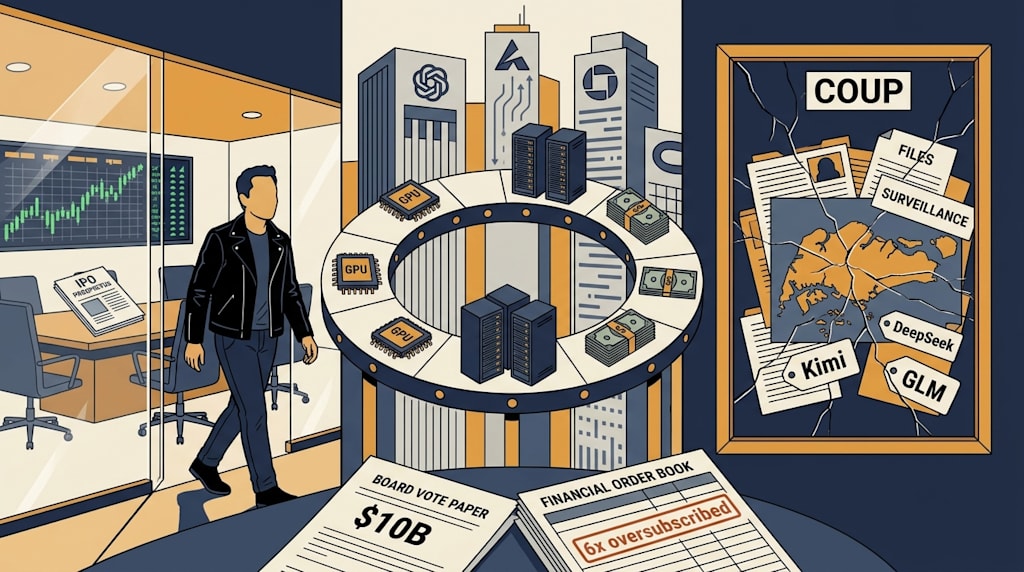
On November 12, 2026, Nvidia’s website carried a few lines of an announcement: Jensen Huang had resigned as president, chief executive officer, and board member, effective immediately. No warning. No transition period. No “personal reasons” phrasing. Four days earlier, he had told employees about an extramarital affair. Three days earlier, the board had announced an independent investigation into whether he had “become a target of a foreign intelligence service.” Anthropic’s IPO was set for November 19, at a valuation near $1.4 trillion. Nvidia had agreed to subscribe to roughly $10 billion of Anthropic shares in a concurrent private placement.
That sequence produced a seductive story: the application layer, meaning OpenAI, Anthropic, the cloud giants behind them, and the investors waiting for IPO proceeds, had grown tired of being whipped by its lowest-level supplier. So they used an intelligence operation to remove Huang personally and seize control of the industry. The story captures a real tension. It also compresses three different things into a causal chain that is smoother than the evidence: a personal scandal, a structural crisis in the capital loop, and a fight over where power sits in the AI stack.
The cracks show up where the story is most decisive.
1. The scandal: “spy” is an allegation, not a finding
The affair happened. Huang admitted it in an internal letter and apologized to his family and the board. The woman’s identity is known: Alice Huang, also known as Huang Le, had been chief executive and chair of Megaspeed, a Singapore data-center company and a significant Nvidia cloud customer in Southeast Asia. Reports said Megaspeed imported billions of dollars of Nvidia equipment over roughly two years.
The “Chinese spy” label is far less settled. U.S. intelligence reportedly concluded, based on about a year of electronic monitoring, that Huang Le had been recruited by China’s Ministry of State Security, that her tasks included collecting AI-chip intelligence, and that she may have tried to influence Huang’s lobbying of the White House on export controls. Singapore’s investigation reached a different result. Huang Le was investigated over suspected false declarations tied to her company role, not espionage. In February 2026, Singapore police, after consulting the Attorney-General’s Chambers, found existing evidence insufficient to prove the relevant offenses. She was ultimately barred from entry because she had given inaccurate information during the investigation to play down her role at Megaspeed. Megaspeed itself was investigated over whether servers were transshipped through Singapore to Malaysia and then onward, contrary to declarations. That is an export-control compliance case. It is not a spy case.
The U.S. “spy” conclusion rests on an intelligence assessment, not judicial evidence. BBC reported that the allegations could not be independently verified. China’s foreign ministry called the reports groundless. None of this clears Megaspeed or Huang Le of compliance problems. The export-control cloud is substantive. Congressional committees demanding closed-door briefings from Huang show that national-security concern was not invented. But the narrative takes an intelligence suspicion and treats it as a settled premise, then builds the coup chain on top. That is the first crack.
2. The capital loop: the whipped mule was also being fed
The strongest intuition in the coup narrative is that Nvidia, as the bottom-layer supplier, whipped the application layer. That intuition points to a structural feature. Every dollar Nvidia puts into OpenAI or Anthropic equity corresponds to roughly $3.50 of downstream chip purchases. Nvidia committed up to $100 billion to OpenAI. OpenAI buys Nvidia chips, builds data centers through Oracle, and Oracle orders GPUs from Nvidia. Nvidia put $10 billion into Anthropic. Anthropic deploys on Microsoft Azure, and Azure buys Nvidia compute systems. Money moves in a circle, revenue gets recognized several times, and the numbers expand at each layer. In 2026, the four major cloud providers’ combined AI capital expenditure was around $720 billion to $745 billion. Stable operating cash flow from consumers and real-economy customers was not enough to cover compute depreciation and interest costs.
The loop’s fragility is straightforward: it depends on continued financial transfusion. If credit tightens or expectations reset, the investment-to-purchase multiplier runs in reverse and pulls valuations back down layer by layer. Bloomberg had already mapped the “AI circular deals” network in January 2026. Seaport Research’s model had been public. By the time Huang left, the capital market had known for more than a year that the loop could not continue indefinitely.
Inside that structure, Nvidia plays two roles. It benefits from every round because investment eventually returns as chip revenue. It is also a node because its equity checks keep the chain turning. Calling it the whipper is fair. The whipped firms were also being fed. Anthropic’s prospectus showed it used Nvidia, AMD, Google, and Amazon chips. Google and AMD each agreed to subscribe to roughly $10 billion and $2.5 billion in the private placement. The relationship looks less like a dictator supplier and a rebellious application layer than a multilateral bet in which every major player is embedded, every player is hedging across several directions, and no single player can stop the game alone.
3. Why Huang: capital logic and political logic arrived at the same person
The coup narrative explains Huang’s exit as an intentional victory for the application layer. Another explanation fits the same texts: a structural clearing. When a loop cannot last, capital faces a choice. It can wait for the bubble to break and everyone to stampede. Or it can detonate early, make one person carry the responsibility, cut risk, redistribute assets, and reset the rules. Huang was the most visible personal symbol inside that loop, the most tightly bound to its logic, and the most broadly exposed. He had locked in roughly 60% of TSMC’s CoWoS priority capacity early. He had locked in HBM memory through take-or-pay agreements. His investment reach extended into CoreWeave and xAI. He became the cost. That does not require a room full of people planning to eliminate him. The system needed a node visible enough, isolated enough, and assignable enough. The scandal made that node removable overnight.
Political logic is also present, and it did not have to point in the same direction as capital logic to converge on the same man in the same window. Huang was the loudest Silicon Valley voice against chip export controls. His argument was that cutting ties would only push China to build its own alternatives faster, and events supported him. Semafor reported that his public attacks on “China hawks” had made him many enemies in politics, and that people inside and around the company saw this as central to his isolation. A semiconductor analyst described his departure as removing “the most influential voice against U.S. chip export controls.” The “super AI cartel” analysis drew the same terrain from another direction: Anthropic and OpenAI boards and executive teams were stocked with people from the same Obama-Biden establishment network, with a clear revolving door from CSET to the National Security Council to Anthropic’s national-security policy chief. After OpenAI’s 2023 board crisis, a former NSA director, a Goldman Sachs executive, and Obama economic-team figures moved into governance roles. That analysis argued that the establishment had embedded itself in the model layer and saw Nvidia as the last piece of the “super AI cartel.” Huang’s personal scandal gave it an operating window: an independent investigation and governance reform could weaken founder power.
A political network converging, a capital loop needing a clearing event, and a scandal breaking in the same window do not prove a coordinated coup. The “super AI cartel” piece is a commentary with a thesis. It offers a reading of personnel networks and governance moves. It does not prove coordinated intent. The capital-clearing explanation admits that the system did not need a conspiracy. It needed a visible, isolated, assignable node. Merging the two into “the application layer and politicians used intelligence to bring down Huang” packages structure and contingency in the grammar of conspiracy.
4. What the coup narrative obscures
The narrative’s strongest move is its refusal to treat Huang’s exit as a simple personal scandal. It insists on placing the exit inside a longer fight over industry power. That instinct is right. The cost is that it underestimates three things.
First, the Nvidia-application relationship is more complicated than oppressor and rebel. Nvidia’s $12.9 billion acquisition of Hugging Face, announced in September 2026, is under Justice Department antitrust review. That shows state competition regulators resisting Nvidia’s effort to control the open-source distribution node. The resistance did not come only from application-layer rebellion. Nvidia’s $10 billion commitment to Anthropic may be reassessed by the board after Huang’s resignation. A supplier that dictated terms would not need to inject tens of billions of dollars of equity into the firms it supposedly whips. The two layers are bound in mutual dependence.
Second, Chinese dominance in open-source models is a structural fact, and its political consequences do not run in one direction for the coup story. U.S. enterprise spending on open-source models sent 89% to Chinese models: Kimi 61%, DeepSeek 15%, Zhipu GLM 11%. That is a geopolitical soft spot for Nvidia’s open-source support. Huang’s departure does not change the structure. If anything, losing the most prominent critic of export controls makes tighter restrictions more likely. Tighter restrictions hit first the application-layer firms that depend on open models and external compute, not Nvidia’s replacement. The narrative treats open source as proof that Nvidia carried a double-edged sword. It ignores where the sword turns after Huang leaves.
Third, Anthropic’s IPO did not need a coup to get done. Its order book reached six times the available shares. Google and AMD’s parallel subscriptions provided alternative funding signals. The IPO stayed on schedule after his resignation. If the application layer’s goal was to secure IPO proceeds, the market mechanism already provided redundancy. Tying the IPO’s success to one CEO’s presence overestimates what a CEO can do to a company already embedded in a multilateral capital network.
What the evidence supports
Huang is out. One of the industry’s most visible leaders left the center of power in a way that was not dignified. That fact does not need the coup narrative to make it consequential. But if we stay inside what the evidence supports, the picture is this: a capital structure built on circular deals and expectation multipliers had reached a point in 2026 where it needed a clearing node. A CEO who had fought Washington hawks over export controls had accumulated enough political enemies. An affair involving a foreign-intelligence cloud was exposed in a precise window, giving the board, Congress, and capital a reason to act at the same time. Those three lines did not need a planner to produce the appearance of a coup.
Political networks exist. Capital-clearing pressure exists. The bargaining tension between the application layer and the infrastructure layer exists. The coup narrative describes a struggle, but it turns the struggle into one intention and obscures what will decide the industry’s direction: whether the circular deals can soft-land, which way the export-control pendulum swings, how the geopolitics of the open-source system gets repriced, and whether a post-Huang Nvidia is still willing, or still able, to use open source and multi-cloud support to balance any single application-layer giant.
Huang’s personal story may have reached its last page. The fight over AI leadership is not a chess game that ends when one person is removed. It is a multiplayer game without a referee. Every player is betting, and every player is being pushed by structure. No one knows who won yet. Narrating what happened as a coup that “succeeded more than half way” satisfies the desire for closure. It does not satisfy the evidence. The order book still shows six times oversubscription. The board still has to vote on the $10 billion.
About the Creator
Jin
Writer of reamstories
https://reamstories.com/jin
Enjoyed the story? Support the Creator.
Subscribe for free to receive all their stories in your feed. You could also become a paid subscriber, letting them know you appreciate their work.
Comments
There are no comments for this story
Be the first to respond and start the conversation.