
The Compute Chasm That Doesn’t Exist: How Kimi K3 Is Out‑Engineering Silicon Valley’s Billion‑Dollar Labs
Moonshot AI just proved that flat teams, MFU squeezing, and the refusal to pay the “uncertainty tax” can beat a hundred thousand GPUs.
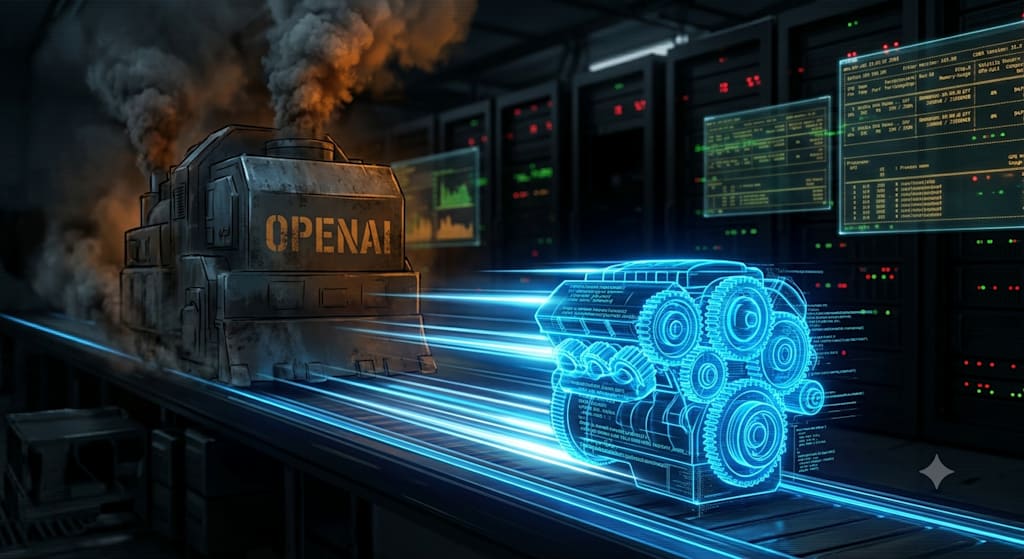
I. The Pathfinder Burns 70% of Its Compute. The Follower Burns 0.
Chinese and U.S. AI labs sit in different ecological niches. This isn't just about money. It's about cost structure.
OpenAI and Google DeepMind are pathfinders. The bulk of their compute bill isn't “training models.” It's “verifying whether this path even works.” Where is the ceiling for MoE architectures? At what scale does RLHF start to produce emergent capabilities? What is the mathematical core of CoT reasoning chains? These questions have no pre-written answers. Every dead end they verify burns millions of dollars in electricity.
A rough industry consensus: pathfinder labs burn 70% of their compute on trial and error. Call it the “uncertainty tax.”
Kimi and DeepSeek don't pay that tax.
The Scaling Law roadmap for Transformers has already been drawn. The question they need to answer is not “does this road lead anywhere?” but “given this road, how do I run the farthest with the least resources?”
Lambert's exact phrasing: “Chinese labs raise far less capital than their U.S. counterparts (OpenAI, Anthropic, Google, Meta), yet approach or even locally surpass them on public metrics. The core reason is a sharper focus on ‘catching up’ rather than ‘inventing new paradigms.’”
Translation: when the path is clear, engineering extremists outrun scientific imaginations.
K3's training budget went 100% into engineering implementation and compute extraction. Zero dollars were spent on “star-gazing.” This is not a moral judgment. It's a financial structure.
II. Musk Named the Name. It Points Straight at OpenAI's Hierarchy.
A few days ago, someone in a discussion thread made an observation:
“Chinese AI labs keep winning because of flat organizational structures and culture. The same people rotate between algorithms, data, and infrastructure. Some U.S. tech elites have decided that only ‘researcher’ is a high-status title, and infra work is what nobody wants to do.”
Musk replied directly: “Some for-profit companies call themselves ‘labs’ and artificially create a caste-like divide between ‘researchers’ and engineers, when in reality they're at best just engineers anyway.”
He didn't name names, but the profile fits OpenAI most closely.
Inside some U.S. closed-source giants, Research Scientists sit well above ML Engineers and Infra teams. Researchers write paper-grade pseudocode and mathematical derivations. Engineers are tasked with “translating” these into running distributed systems. Between them sit two layers of loss: one technical, one organizational.
A researcher proposes a theoretically elegant sparse matrix scheme. The infra team evaluates it, decides “too long a cycle, too high a risk,” and kills it. This is not news in Silicon Valley.
Kimi and DeepSeek invert the model. Core members don't distinguish between “researcher” and “engineer.” The same people write papers, write CUDA kernels, tune communication primitives, and modify loss functions. The decision chain is two to three links shorter. They examine model architecture at the granularity of memory read/write cycles, line by line, stripping redundant computation.
This flattening doesn't produce “more effort.” It makes end-to-end optimization possible. While U.S. researchers debate paper titles over coffee, Chinese engineers are in server rooms staring at nvidia-smi telemetry, adjusting a communication mask to push MFU up by two percentage points.
III. K3's Engineering Ledger: Three Concrete Moves
K3 didn't emerge because they were “smarter.” It emerged because they did three specific technical things that top U.S. labs are either unwilling or structurally unable to do.
Move one: MFU squeezing.
GPU theoretical peak flops are one number. Actual MFU (Model FLOPs Utilization) is another. Industry average hovers between 40% and 45%. The rest is wasted on memory bandwidth bottlenecks and communication latency.
The Kimi team built custom distributed communication masking and compute-communication overlap for K3's training run. The result: MFU pushed above 60%.
Rough math: if OpenAI runs 100,000 cards and gets 100 units of effective compute, Kimi runs 50,000 cards and, through MFU optimization, delivers 70–80% of that effective output.
This isn't stacking cards. This is squeezing every card dry.
Move two: aggressive MoE pruning.
U.S. giants talk about MoE, but they carry the baggage of “generality.” They hesitate to aggressively sparsify routing mechanisms for fear of compromising general capabilities.
K3 carries no such baggage. To pack more parameters into constrained compute, they walked a tightrope on routing algorithms and load balancing, making aggressive trade-offs. Combined with KV Cache compression for ultra-long contexts, K3's per-token compute cost for long-text processing drops exponentially, bypassing the brute-force inefficiency of dense models.
Move three: survival-driven cost reduction.
DeepSeek had already demonstrated the Chinese team's ability to control training costs to a degree that shocks outsiders. K3 continues that lineage. Under the hard constraint of limited compute, they cut every non-essential experimental module and focused exclusively on the lowest-level optimizations that directly affect loss convergence.
This isn't a “choice.” It's a “have-to.” And “have-to” is almost always more efficient than “could-choose-to.”
IV. After Domestic Compute Fills In, the Gap Curve Steepens
K3's current success still rests on “dancing in shackles.” Human agency can compensate for compute gaps, but only up to a point.
What is changing is the compute supply structure.
Huawei's Atlas 950 supernode. Alibaba's Lingjun Zhenwu M890 supernode. Both are iterating. Zhipu AI announced plans to build its own largest compute center entirely on domestic chips. Single-card performance still lags behind H100, but two variables are worth isolating:
First, Chinese teams have spent the past two years precisely on “inferior hardware” honing the strongest tuning capabilities in the world. They are used to writing code under bandwidth-constrained and memory-constrained conditions. Once domestic compute closes the single-card performance gap, that tuning capability translates immediately into a “software-hardware synergy dividend,” no retraining of the team required.
Second, ECI (Effective Compute Index) estimates currently place the gap between top-tier Chinese and U.S. models at roughly 1.22 to 6.08 months. By lab: Moonshot is projected to reach the “Fable”-class ECI of 161 on December 23, 2026. Z AI follows on December 31.
But this is a linear extrapolation. Domestic compute addresses the “whether we have it” question, the quantity side. Once quantity is filled, the quality advantage that Chinese teams have already proven in engineering efficiency will turn the catch-up curve from linear to non-linear.
At that point, U.S. giants will face not a “survivor scrambling in the cracks,” but an opponent with comparable firepower, better marksmanship, and leaner logistics.
V. This Is Not Catching Up. This Is Changing the Track.
Lambert called K3 a “watershed.” Not because Chinese models suddenly got strong.
It's because the race is shifting from “who has more cards” to “who can squeeze more out of each card.”
OpenAI defined the rule that “more is better.” Kimi and DeepSeek are proving that “lean is fast.” Raw compute still matters, but per-compute-unit engineering output is becoming an independent competitive dimension.
While some in Silicon Valley still obsess over the rank-ordering of “researcher” versus “engineer,” engineers in Beijing are rewriting CUDA kernels line by line in the din of server rooms.
Musk put it bluntly. But they are, indeed, engineers.
About the Creator
Jin
Writer of reamstories
https://reamstories.com/jin
Enjoyed the story? Support the Creator.
Subscribe for free to receive all their stories in your feed. You could also become a paid subscriber, letting them know you appreciate their work.
Comments
There are no comments for this story
Be the first to respond and start the conversation.