
The Complete Guide to Power BI for Business Leaders
Transform Data into Confident Business Decisions


In today’s fast-moving digital economy, business leaders can’t really lean on guesswork or those late reports anymore. Every single decision needs to be supported by real time dependable data , not just vibes. And that’s basically where modern analytics tool(s) start showing up and doing the job.
Among them, Microsoft Power BI has become one of the most powerful solutions for turning raw data into meaningful insights or perhaps even just clear viewpoints. It’s sort of that product you use when everything feels a bit messy, and you want the numbers to start, making sense.
This guide explains Power BI in plain terms, and shows how it helps leaders make faster, smarter, and more confident choices for the business.
Why Data-Driven Leadership Matters in Today’s Business World
Business leadership has changed dramatically, over the last decade. In the earlier days decisions were often based on experience, intuition, or those rather static reports, you know the kind. But now that isn’t enough anymore , like not even close.
Markets shift quickly. Customers behave unpredictably. Competition evolves daily. In this environment, data becomes the backbone of leadership.
- Data-driven leadership matters because it:
- Reduces guesswork in decision-making
- Improves accuracy in forecasting
- Helps identify risks before they grow
- Enables faster response to market changes
Markets shift pretty quickly, customers act in ways you don’t quite expect. Competition keeps evolving, like every day. In all of that, data turns into the backbone of leadership and guidance, really, you know.
The Role of Business Intelligence in Modern Enterprises
Business Intelligence (BI) is basically about the technologies and the strategies that people use to analyze business data, and then somehow turn that data into actionable insights, like you know “real answers” for decision makers.
In modern enterprises, BI plays a central role in:
- Tracking performance in real time
- Identifying growth opportunities
- Monitoring operational efficiency
- Supporting strategic planning
Without BI, a lot of organizations end up operating sort of in silos, where different departments use disconnected data systems, and the view gets blurry or just incomplete. With BI it’s like everything turns more unified , and suddenly there is visibility across the whole process.
About Microsoft Power BI
Understanding Power BI
At its core, Power BI is a kind of data visualization, and analytics tool, that basically helps you take raw data and turn it into dashboards and reports you can interact with.
Rather than staring at endless spreadsheets, business leaders can spot subtle visual insights such as charts, graphs, and KPIs in one place, without the usual hassle, which is kind of, the whole point.
Key Components of the Power BI Ecosystem
Power BI consists of:
- Power BI Desktop (report creation tool)
- Power BI Service (cloud-based sharing platform)
- Power BI Mobile (on-the-go access)
- Data gateways (for connecting on-premise data)
Together, these components create a complete analytics ecosystem.
How Power BI Drives Business Growth
Power BI supports growth by:
- Making data easy to understand
- Helping leaders track performance instantly
- Identifying trends and patterns
- Supporting predictive decision-making
When used effectively, it becomes more than a tool—it becomes a decision-making engine.
Why Business Leaders Need Power BI
Making Faster and Smarter Decisions
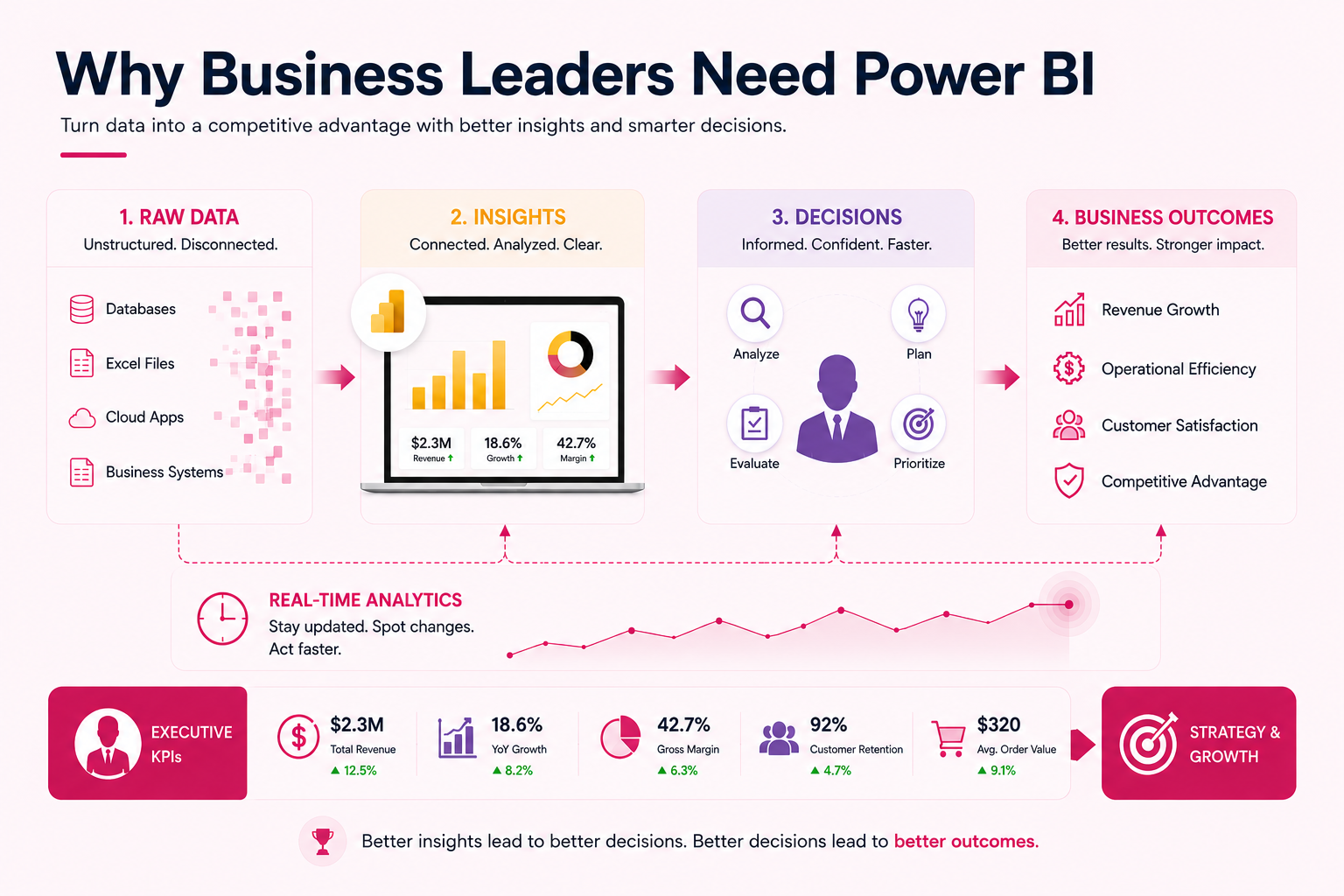
In leadership, time is kind of critical, power BI removes those delays from manual reporting, and then it brings real time dashboards that refresh on their own, like automatically.
Gaining Real-Time Business Visibility
With Power BI, leaders can monitor:
- Sales performance
- Revenue trends
- Customer behavior
- Operational metrics
All in real time, from a single dashboard.
Aligning Teams with Unified Data Insights
One of the biggest challenges in organizations is misalignment. Different teams often work with different numbers.
Power BI solves this by providing a single source of truth, ensuring everyone works with the same data.
Key Business Challenges Power BI Helps Solve
Power BI is not just a reporting tool—it’s a problem solver.
- Fragmented Data Across Multiple Systems : many organizations store data in separate kinds of places, like CRM tools, ERP systems and even spreadsheets, and it is kind of messy sometimes. But getting Power BI brings it all together into one place.
- Delayed Reporting and Outdated Insights: getting reports through traditional methods is very much outdated, but having power BI can give real time updates without any delays.
- Limited Access to Real-Time Business Metrics: Leaders don't really have to wait around for those weekly reports anymore, they can get to live dashboards anytime, like right there and then.
- Difficulty Identifying Performance Bottlenecks : In Power BI, it somehow highlights underperforming areas instantly, so you can more easily take corrective action.
- Poor Visibility into Cross-Department Operations : It kind of connects those departments, like sales , finance and operations, into one unified view, sort of like a single picture.
How Power BI Works
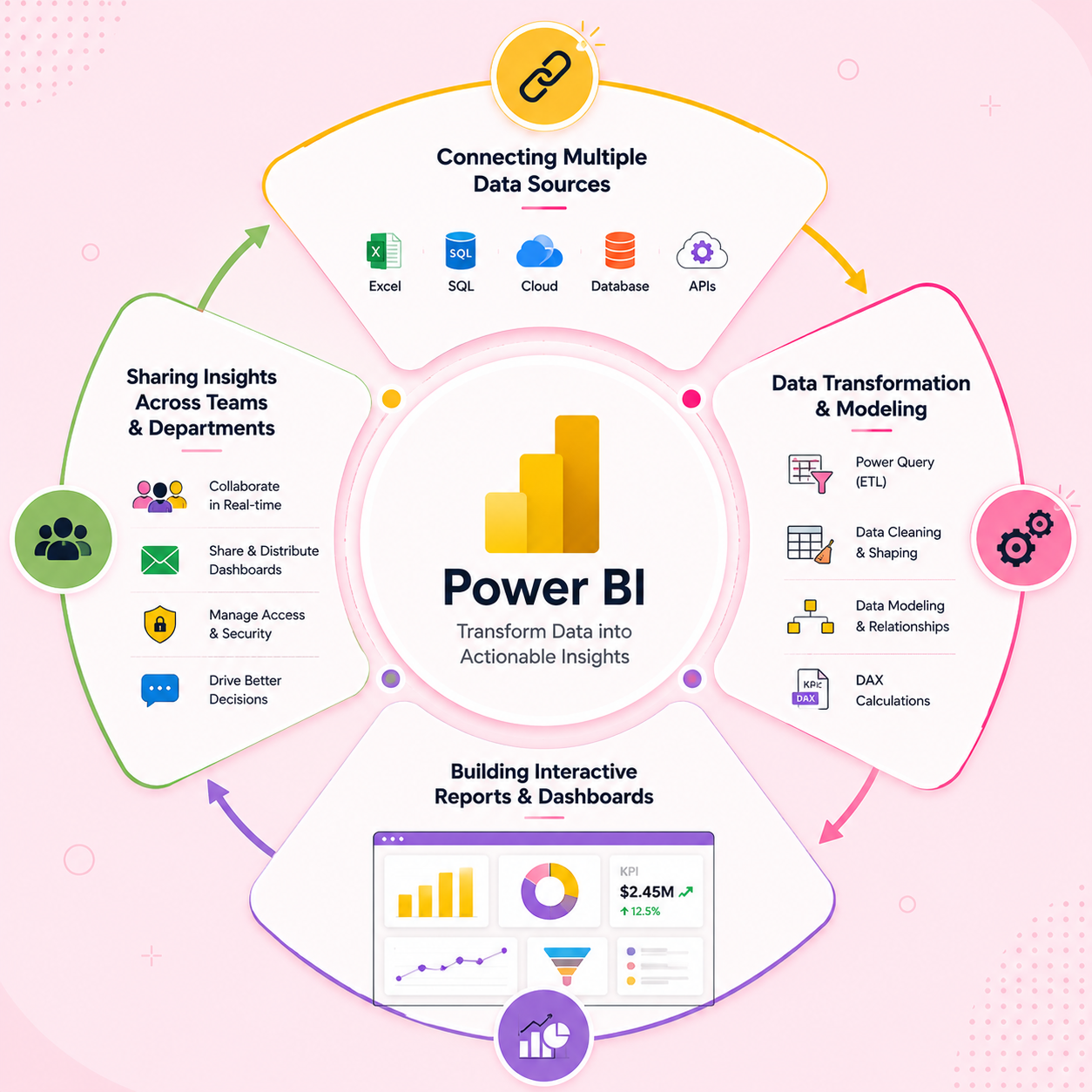
- Connecting Multiple Data Sources : Power BI connects with a bunch of different platforms like Excel, cloud databases , and some enterprise systems. For example, Microsoft Excel data can be directly brought in, and then it is transformed into dashboards , not just displayed.
- Data Transformation and Modeling: Once data is connected , Power BI cleans it and structures it with built-in transformation tools, so everything stays accurate and consistent.
- Building Interactive Reports and Dashboards: Users can make these kinds of dynamic dashboards, with slicers , charts and KPI counts that will refresh on their own when the data shifts.
- Sharing Insights Across Teams and Departments : Reports can be shared securely, via the cloud system, so collaboration stays smooth between departments, even if people don’t always line up at the same time.
Power BI Dashboards Every Business Leader Should Track
- Executive Performance Dashboard : It gives a kind of big picture view of overall business health, like revenue, profit, and those KPIs too
- Sales and Revenue Dashboard : It kind of tracks sales performance, conversion rates and pipeline growth,
- Financial Analytics Dashboard: It helps keep an eye on budgets , track expenses , and manage finances
- Customer Insights Dashboard: Analyzes customer behavior, satisfaction, and retention trends.
- Operational Performance Dashboard: Monitors internal processes, efficiency, and productivity metrics.
Integrating Power BI with Microsoft Ecosystem
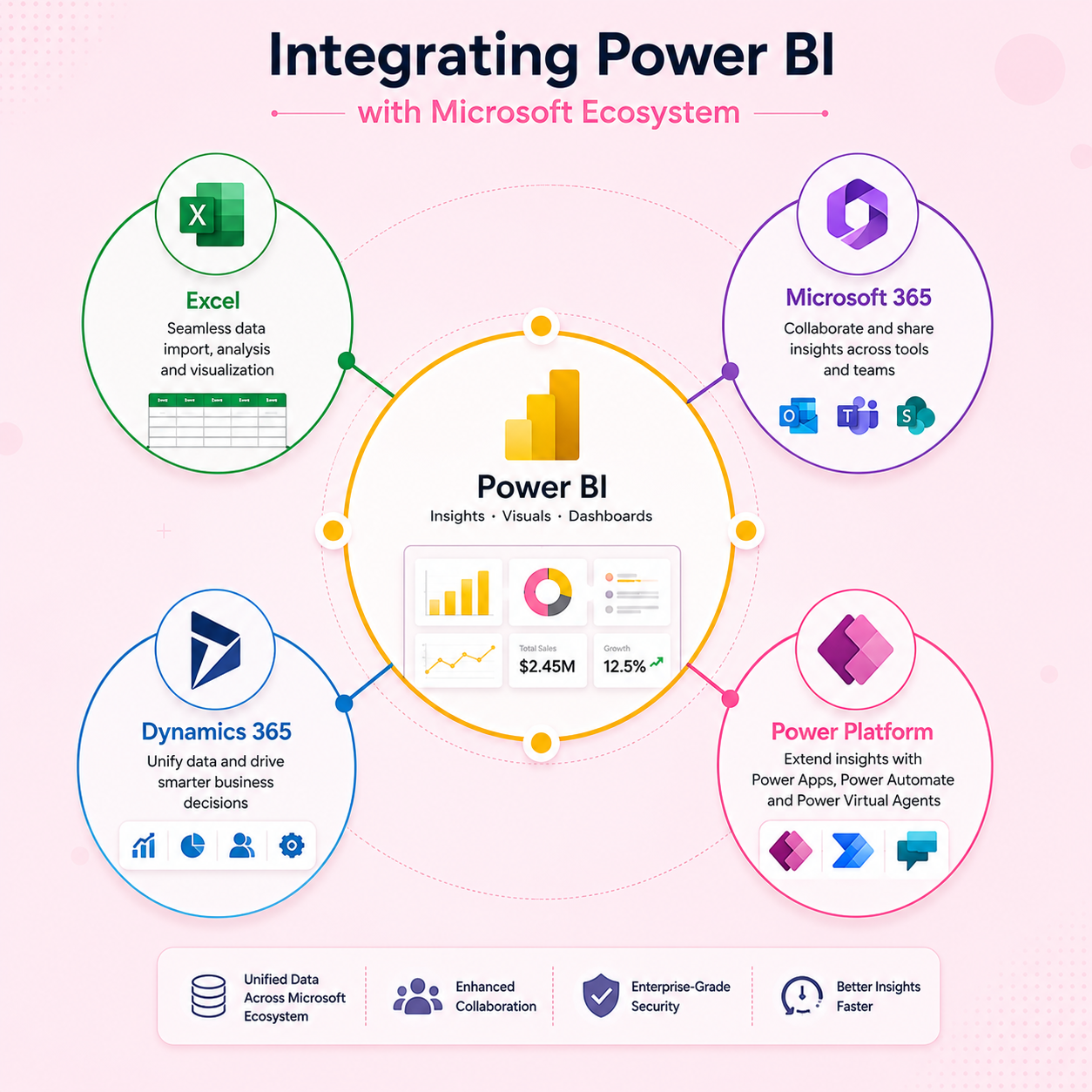
One of Power BI’s biggest advantages is its seamless integration with Microsoft tools.
- Power BI and Excel: Since many businesses already use Microsoft Excel, Power BI makes it easy to upgrade from static sheets to dynamic dashboards.
- Power BI and Microsoft 365 : With Microsoft 365, teams can collaborate, share reports, and access insights from anywhere.
- Power BI and Dynamics 365: Integration with Microsoft Dynamics 365 enables deeper insights into customer relationships and business operations.
- Power Platform Integration: Power BI is part of the broader Microsoft Power Platform ecosystem, which includes Power Apps and Power Automate, enabling end-to-end business automation.
Enhancing Business Collaboration Through Data
Power BI doesn’t just analyze data—it improves teamwork.
- Shared dashboards ensure everyone sees the same insights
- Unified KPIs align departments toward common goals
- Communication gaps are reduced through visual reporting
- Transparency improves accountability across teams
When data becomes accessible to everyone, collaboration becomes natural and efficient.
Power BI Security and Data Governance Overview
Security is a top priority for any business intelligence platform.
- Role-Based Access Control: Users only see data relevant to their role, ensuring secure access.
- Data Privacy and Compliance Management: Power BI supports compliance standards required in enterprise environments.
- Secure Sharing of Dashboards: Reports can be shared securely within and outside the organization with controlled permissions.
- Governance Policies for Enterprise Data: Organizations can enforce rules to ensure data consistency and quality across all reports.
The Future of AI-Powered Analytics in Power BI
The future of analytics is becoming more intelligent, and Power BI is evolving with it.
- Copilot and AI Integration : AI assistants help users generate reports, summaries, and insights automatically.
- Natural Language Data Queries: Users can simply ask questions like “What were last quarter’s sales?” and get instant answers.
- Automated Insights Generation: Power BI can automatically detect patterns and highlight anomalies in data.
- Intelligent Business Recommendations: Instead of just showing data, it will suggest actions based on trends and predictions.
Conclusion
Modern business leadership is no longer about reacting to reports—it’s about acting on real-time intelligence. Microsoft Power BI empowers leaders to see the full picture of their organization and make decisions with confidence.
From finance to operations, from sales to customer experience, Power BI brings everything together into one unified view.
In a world where data is the new currency, Power BI is the system that helps business leaders spend it wisely.
About the Creator
Darshil Barot
Helping businesses innovate with Power Apps, Power BI, Microsoft Copilot and Power Platform. I share insights on low-code, automation, BI and AI-driven productivity with practical use cases for digital transformation.
Enjoyed the story? Support the Creator.
Subscribe for free to receive all their stories in your feed.
Comments
There are no comments for this story
Be the first to respond and start the conversation.