
The Climate Change Side effects
The sky over the coastal city of Aethelgard was no longer the brilliant, piercing blue that the elders remembered from their youth. Instead, it was a heavy, bruised violet,
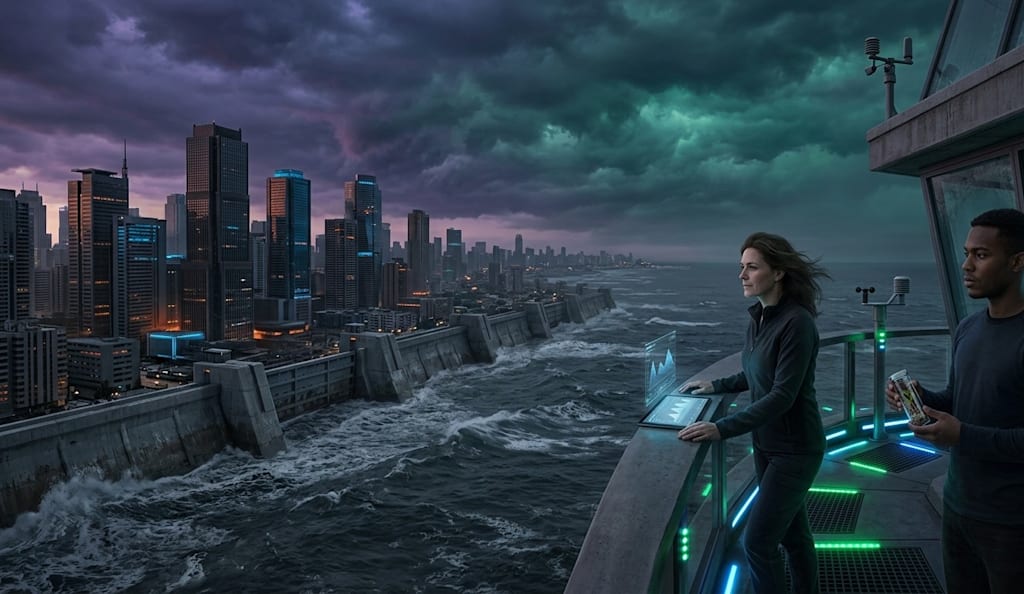
The sky over the coastal city of Aethelgard was no longer the brilliant, piercing blue that the elders remembered from their youth. Instead, it was a heavy, bruised violet, thick with the humidity of a sea that refused to stay within its ancient boundaries. For Clara, a climatologist who had spent two decades watching the data points shift like sand in an hourglass, the atmosphere didn't just feel heavy; it felt like a physical weight on her chest. The Great Unsettling The shift hadn't happened with a single explosion or a cinematic tidal wave. It had arrived in increments—the "Great Unsettling," as the local papers called it. It was the extra two degrees in a summer heatwave that turned a discomfort into a health crisis. It was the "once-in-a-century" storm that started happening every three years. Clara stood on the balcony of the Global Observatory, looking out at the sprawling city. Below, the sea walls had been raised for the third time in a decade. They looked like gray scars against the shoreline. The salt spray was a constant companion now, eating away at the ironwork of the old buildings, a slow-motion digestion of the civilization that had built them. The Data of Disruption Inside the Observatory, the holographic displays hummed with the pulse of a changing world. Clara swiped through the latest projections, her heart sinking with every gesture. The Thermal Feedback: The arctic ice, once a vast white mirror reflecting the sun’s fury back into space, had thinned to a translucent shell. The dark water beneath was drinking the heat, accelerating a cycle that felt increasingly impossible to break. The Migratory Silence: The sensors in the northern forests reported a haunting quiet. The birds that used to signal the change of seasons were gone, their biological clocks shattered by winters that never quite arrived and springs that came with a scorching intensity. The Agricultural Shift: To the west, the once-fertile plains were becoming dust bowls. The rain still fell, but it fell all at once, in violent deluges that washed the topsoil into the rivers rather than soaking into the parched earth. "It’s not just a change in weather," Clara whispered to her assistant, Leo, who was cross-referencing crop yields from the southern hemisphere. "It’s a change in the fundamental rhythm of the planet." The Human Cost Leo didn't look up from his screen. His family had been displaced from a low-lying island chain three years prior. For him, the data wasn't an abstract scientific pursuit; it was the obituary of his heritage. "My grandfather used to say the wind told stories," Leo said, his voice flat. "Now the wind just screams. It’s the sound of a system trying to find a new equilibrium while we’re still standing in the middle of it." The social fabric of Aethelgard was fraying under the strain. Resources were tight, and the "Climate Lotteries" determined who would receive subsidies for air filtration or water reclamation. The divide between those who could afford to adapt and those who were left to weather the storm was widening into a chasm. In the markets, the price of a simple apple had tripled; the orchards were failing, victims of a new fungus that thrived in the stagnant, warming air. The Turning Point That evening, a storm moved in—not a natural occurrence, but a "super-cell" fueled by the excess energy trapped in the atmosphere. The sky turned a terrifying shade of emerald, and the wind began to howl through the skyscrapers like a wounded animal. Clara watched the tide gauges. The water was rising, pushing against the reinforced gates with a ferocity that seemed personal. She realized that for centuries, humanity had treated the Earth as a backdrop—a static stage for their dramas. Now, the stage was moving. The backdrop was pushing back. As the rain began to lash against the reinforced glass of the Observatory, Clara didn't feel despair. She felt a strange, cold clarity. The era of "mitigation" was over. The era of "transformation" had begun. The Seed of Resilience She walked over to a pressurized chamber in the corner of the lab. Inside were hundreds of small, glass vials—seeds from across the globe, genetically mapped to survive in higher saline environments and extreme heat. They weren't a solution to climate change, but they were a bridge to whatever came next. "We can't go back to the blue sky," Clara told Leo, gesturing toward the vials. "That world is gone. We have to learn to live in this one. We have to build cities that breathe with the tides instead of fighting them. We have to farm with the sun instead of hiding from it." The storm raged outside, shaking the very foundations of the building, but Clara began to type. She wasn't writing a warning anymore; she was writing a blueprint. The story of climate change was no longer a tragedy about what was lost; it had to become an epic about what could be saved, and how a species defined by its ingenuity would finally learn to respect the boundaries of its home. The bruised violet sky eventually broke into a grey dawn. The sea had retreated, leaving behind a layer of silt and debris. Clara stepped out into the damp air, her boots crunching on the salt-crusted pavement. She looked toward the horizon, where the first light of a new, harsher sun was beginning to rise. She took a breath, felt the weight of the air, and began to work.
About the Creator
Enjoyed the story? Support the Creator.
Subscribe for free to receive all their stories in your feed.
Comments
There are no comments for this story
Be the first to respond and start the conversation.