
The CEO With One Direct Report: Inside Anthropic’s Radical Management Experiment
Dario Amodei runs a trillion-dollar AI company by managing a single person. His sister handles operations, his wife handles the outside world, and his chief of staff controls what reaches him.
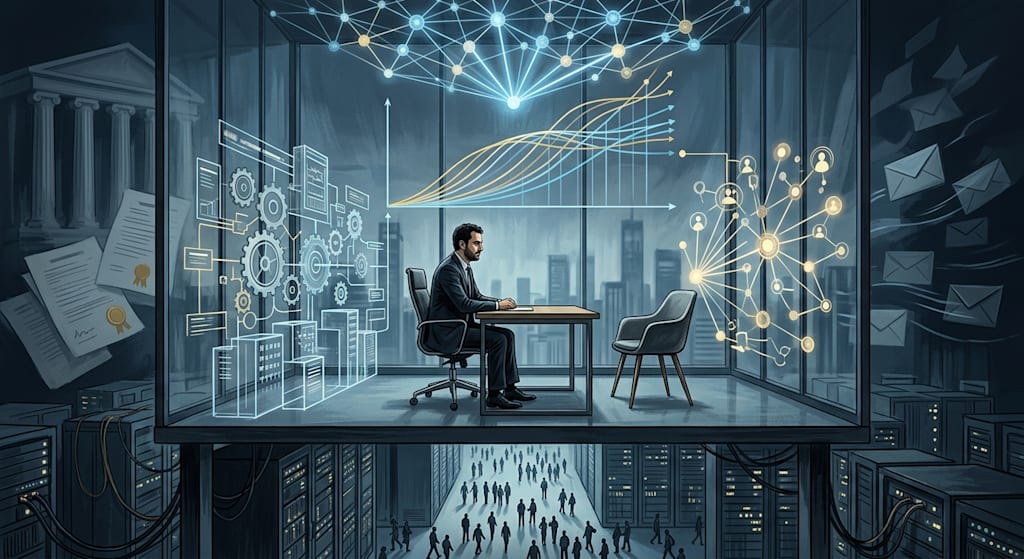
In June 2026, on Bloomberg’s The Circuit, Dario Amodei said he has one direct report. Not six. Not ten. One.
That person is Avital Balwit, his chief of staff. Every executive team member, including CFO Krishna Rao, Chief Business Officer Paul Smith, and all seven co-founder-level executives, reports to someone else: his sister, company President Daniela Amodei.
Sam Altman has about six direct reports at OpenAI. Jensen Huang manages about 60 at Nvidia, one of the widest spans among Fortune 500 CEOs. Dario went the other way.
“It feels incredibly freeing,” he told Bloomberg. “It allows me to do everything I need to do more easily than ever before.”
The freedom is designed. The structure decides how power moves, how attention is protected, and how trust gets institutionalized. It sits inside a company valued at nearly a trillion dollars and positioned at the front of the global AI race.
The splitting of the CEO function
Dario is a biophysicist by training. He got his Ph.D. at Princeton. He worked in a lab, then at Google as a senior research scientist, then at OpenAI as vice president of research. In 2021 he left OpenAI with a group of colleagues. The split came from a disagreement over AI safety.
His habits look more like a researcher’s than a CEO’s. At OpenAI, he wrote memos on a computer disconnected from Wi-Fi and the outside network, then printed them for colleagues instead of using Google Docs. He refused to travel to China because he feared being kidnapped. While OpenAI still encouraged public research sharing, he pushed for “information hazard” review and made large parts of his team’s codebase and Slack channels private.
Operations do not fit him. He says so himself. “A lot of the time, this is really the difference between focusing on details and looking at the big picture,” he told Bloomberg. “If you have countless concrete matters to deal with tomorrow, it is hard to really focus on the strategic level. So separating these two types of matters is often meaningful, because that way both can be done well.”
At Anthropic, the CEO role is split. Dario handles meaning. Daniela handles efficiency.
Dario spends about half his time talking with employees about Anthropic’s culture and how it works. Twice a month he runs an all-hands meeting. He opens a sprawling document and talks for a long time about AI, politics, war, and human society. Employees call it Dario’s Vision Quest, or DVQ. He leads through long essays and Slack messages, not one-on-one reports or operational meetings.
Daniela takes the rest. She was an early employee at Stripe and later led safety and policy at OpenAI. She has an English literature degree. She now runs most of the company’s daily operations and reports to the board.
Harvard Business School professor Raffaella Sadun has a framework for this. A company is a machine for processing problems. Lower-level employees handle routine work. Harder problems move up. If other leaders can handle their own areas, a CEO can manage many people. If the company keeps facing new, high-risk problems that need top-level judgment, the CEO may need fewer direct reports.
Anthropic faces the second kind of problem. AI safety, model limits, and regulatory fights all depend on Dario’s judgment. Spending that judgment on administration wastes it.
The only direct report
Avital Balwit is Dario’s only direct report. Her role is stranger than the title suggests.
She studied political and social thought at the University of Virginia. She won a Rhodes Scholarship and went to Oxford to study existential risk. Before Anthropic, she wrote fiction, poetry, and essays. She also published a children’s book about octopus cognition.
She is not an engineer, an operations expert, or a traditional chief of staff. Her background fits the real job: she is the interface between Dario and the executive layer. She filters information, organizes issues, and decides what reaches him. In an overloaded company, the CEO’s enemy is not bad decisions. It is decision noise. The chief of staff protects Dario’s time and his attention.
In 2024, Balwit wrote an essay called “My Last Five Years of Work.” She was 25. Her argument: as AGI gets closer, knowledge work that depends on computers and the internet will be hit first. “AI does not need to surpass the best human in the world,” she wrote. “It only needs to surpass the person the company was originally willing to hire to do the job.”
That matches Dario’s thinking. Balwit is not just an administrator. She translates his worldview into organizational action.
Her fiancé is Leopold Aschenbrenner. He was an OpenAI researcher, got fired over safety disagreements, then started a hedge fund. He turned $225 million into $5.5 billion in a year. The media called him an AI stock god. In July 2026, his fund blew up overnight. Paper losses passed $30 billion. Balwit held Anthropic private equity worth about $5 billion. That became one of his last core assets. People familiar with the matter say Aschenbrenner was ready to sell the stake to Sequoia at a discount. Balwit stopped him.
That story is not about Anthropic’s management. It does show how personal ties inside AI’s power circle run deeper than any org chart.
The hidden lines of power
Daniela is the operational glue. Dario’s wife, Cami Clark, is the social glue.
Clark has no formal role at Anthropic. The Wall Street Journal describes her as Dario’s “important listener and strategic advisor.” She does not work for the company, but she appears at Davos, the Allen & Co. Sun Valley conference, and other investor events. She went with Dario to the AI Impact Summit in New Delhi. Other executives could bring one extra person. Dario brought his wife.
Clark’s networking has results. Around 2014, she dated former Google CEO Eric Schmidt for three years. When Dario joined OpenAI in 2016, Clark was his strategic advisor. She introduced him to Schmidt. Schmidt later became an early Anthropic investor.
Her past also carries controversy. Documents show that in 2011, literary agent John Brockman introduced her to Jeffrey Epstein. She later asked Epstein to invest in her business projects. In one email, she sent him a film script. “Jeffrey! We think you and the ladies might like the scripts/treatments for our first four films, American Girls in Paris. A bit NSFW... C.” In 2012, she asked Epstein again about investing in a project with a colleague. There is no evidence Epstein invested.
The emails surfaced in August 2026, while Anthropic prepared for an IPO. A company worth nearly a trillion dollars, about to face public markets, has to answer for the CEO’s spouse’s contact with a dead sex offender. The content matters less than the questions it creates.
Clark’s role raises a larger issue. When influence comes from intimacy instead of a formal job, how is it checked? She brought Schmidt’s money to Dario. That helped. Her Epstein emails and early projects will still show up in IPO diligence. No formal role means no formal constraint. No formal constraint means no formal accountability. For a company about to go public, that is a structural risk.
How the machine works
Put the four roles together and the shape is clear.
Dario is the source of ideas. His authority comes from intellectual contribution, not management. He is one of the main advocates of Scaling Laws. The theory says model capability rises exponentially as computing scale grows. The entire large-model industry treats it as a foundation. Dario describes Scaling Laws as physics. Feed compute, data, and model scale into the reactor in the right ratios, and intelligence comes out like a chemical product. Competition becomes less about a flash of algorithmic insight and more about deterministic scale.
At Anthropic, Dario acts more like a chief philosopher than a chief operating officer. He uses DVQ, long essays, and Slack to shape how employees think. One Anthropic investor said, “Rather than saying he is a CEO, it is more accurate to say he is more like a religious leader.”
Daniela is the skeleton. She handles operations, personnel, and business coordination. Her time at Stripe and OpenAI taught her how people work inside systems, how culture gets maintained, and how policy lands. The siblings complement each other. Dario does math and grand ideas. Daniela executes and turns his “ideas circling in the universe” into action.
Balwit is the valve. She decides what reaches Dario, in what form, and when. Her power is agenda-setting, not decision-making.
Clark is the antenna. She connects Dario to investors, politics, business, and media. Without a formal title, she acts as an unofficial diplomat.
The structure frees the company’s scarcest resource: Dario’s judgment. Daniela can replace operations. Balwit can replace information filtering. Clark can replace social contact. No one can replace Dario’s read on AI routes and safety boundaries, or his sense of where civilization is heading.
Matrix Partners China summarized the logic: “Dario handed operations to his sister Daniela and focused himself on direction, culture, and external narrative. Essentially, he is protecting the company’s scarcest asset, the founder’s high-quality judgment.”
The cost of faith
The structure has cracks. The largest one sits in culture, the area Dario spends the most time on.
Anthropic’s culture has a mission flavor from birth. The company was founded by people who left OpenAI. Their core idea: stronger AI brings more catastrophic risk, so safety mechanisms must constrain speed. Employees call themselves ants. Many keep personal notebooks on internal Slack and share worries and values. Applicants face technical tests and a culture interview. One sample question: if Anthropic decides not to release a product because it cannot guarantee safety, are you willing to see your stock go to zero?
That mission drove hiring. SignalFire says Anthropic’s two-year retention rate is about 80%. OpenAI’s is 67%. Google DeepMind’s is 78%.
Expansion diluted the purity. The company now has more than 2,500 employees. In August 2026, tech blogger Brian Roemmele reported that an early Anthropic investor said morale among investors and employees had fallen. Some employees started private group chats to complain. They are stuck between protecting equity and enduring the environment.
Former employees describe DVQ in two ways. Some say debate is lively and leaders answer criticism. Others say sharp criticism stays in private chats. DVQ feels like listening to a priest.
Dario noticed the tension. In an internal meeting he asked whether new employees come for the mission or the money. The quote leaked. The reaction was blunt. “Breaking news: humans actually work for money.” Another reply: “The reason is the same as why you are unwilling to give away the model for free.”
That exposes a contradiction. Dario treats culture as the CEO’s main job and spends nearly half his time on it. The company grew from a few hundred people to several thousand. It went from an idealistic lab to a commercial entity worth nearly a trillion dollars. How many people can mission glue hold?
Dario said something else in an internal setting. Investor Gavin Baker quoted it on a podcast: “Anthropic may one day become the only private company in the world.” It sounds like a science-fiction villain’s line. If Claude and its successors take over programming, research, finance, law, healthcare, and management, other companies may keep brands and boards but become shells. Products designed by Anthropic’s models. Code written by them. Employees scheduled by them. Decisions made by them. Companies compete, but rent the same brain.
Is that a calm prediction about AI centralization or a religious leader’s vision? Either way, it points to a risk. If one person’s judgment is the scarcest asset and the system protects it, who checks that judgment?
The governance ceiling
The model worked from zero to one. Scale is the test.
At a few hundred people, Daniela could handle most operations. At 2,500 people, a near-trillion-dollar valuation, and an IPO ahead, the complexity is too large for one person. Daniela manages a full C-suite: CFO Krishna Rao, Chief Business Officer Paul Smith, and coordination with all seven co-founders. These are top people in their fields. They need a leader who can meet them as an equal, not an intermediary who helps her brother run the company.
Governance is the harder problem. In a normal company, the CEO and board check each other. At Anthropic, Dario’s only interface is his chief of staff. Daniela reports to the board. Daniela is Dario’s sister. The oversight chain is short. Daniela’s reporting line ends with Dario. The space between board and management is narrow. If the siblings split, or if outside pressure hits them both, there is no clear buffer and no succession plan.
Anthropic is moving from private to public. Public means stricter governance, more disclosure, and more shareholders. A founder with strong control faces tension in that shift. When the founder’s core circle is family and intimate partners, outside shareholders have a harder time trusting the structure.
A sample of a possibility
The experiment still teaches something. It asks a question bigger than its answers.
If the CEO’s job can be broken apart, what is irreplaceable and what can be delegated?
Dario’s answer: judgment is irreplaceable. Technology routes and safety boundaries, plus where civilization is heading. Operations and execution can be delegated, along with management and coordination.
That sounds like founder mode. It is not. Traditional founder mode means the founder controls everything. Steve Jobs micromanaged. Jensen Huang has 60 direct reports and a flat structure. Dario does the opposite. He turns not managing into a strategy.
In AI, that may matter. AI companies do not win on operational efficiency. They win on reading technology shifts and safety limits. A CEO swallowed by meetings loses sensitivity to those shifts. Dario isolates himself to make correct judgment possible.
Isolation has conditions. You need trusted people to catch what you drop. Dario has a sister who has run organizations, a chief of staff who understands his thinking, and a partner who handles the outside world. They form his external operating system. He stays the kernel.
Whether this survives an IPO depends on whether it moves from personal relationships to institutional design. Family trust cannot be copied. Intimacy cannot be institutionalized. Once Anthropic is public, investors will ask what happens if Dario and Daniela fall out, if Cami Clark’s role creates a scandal, or if Balwit leaves.
There are no answers yet.
The answers will show up in IPO filings, board minutes, and who still has a desk outside Dario’s office.
About the Creator
Jin
Writer of reamstories
https://reamstories.com/jin
Enjoyed the story? Support the Creator.
Subscribe for free to receive all their stories in your feed. You could also become a paid subscriber, letting them know you appreciate their work.
Comments
There are no comments for this story
Be the first to respond and start the conversation.