
The CEO Who Didn't Smile on IPO Day
Unitree is worth one and a half Geelys – but its founder can't sell a single share for three years. Here's why.
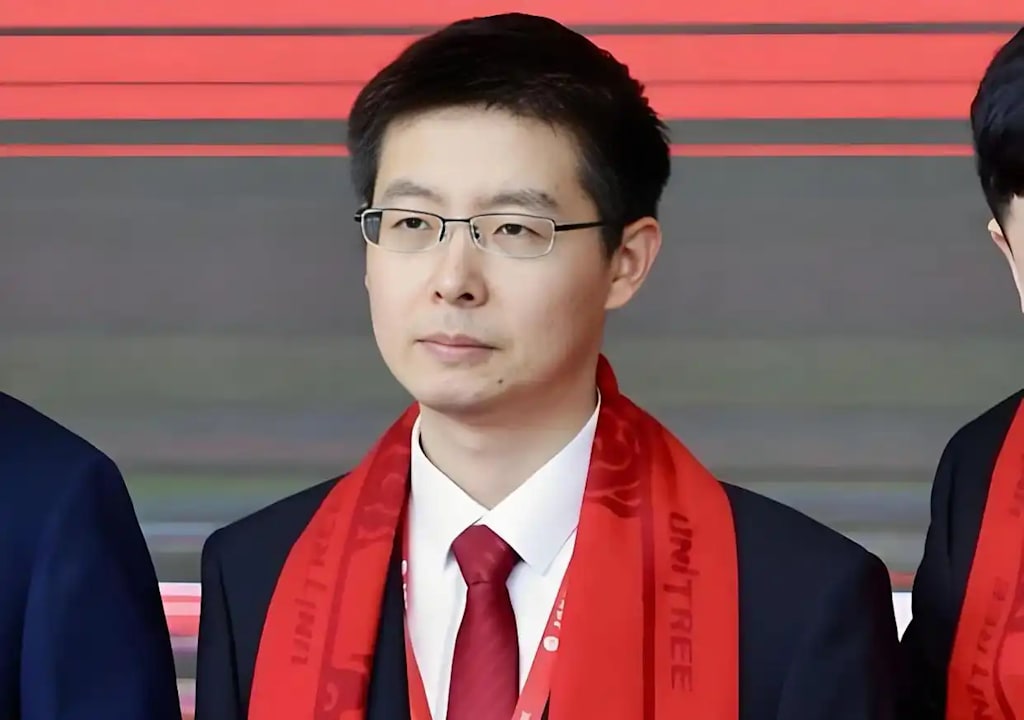
In August 2026, Unitree Robotics went public on the Hong Kong Stock Exchange.
At the moment of the bell-ringing, the camera swept across the face of founder Wang Xingxing. Dressed in a dark suit, he stood amid the crowd, his right hand hovering above the button for a brief half-second pause. Someone patted his shoulder; he nodded, but the corners of his mouth did not move.
Later, social media users tallied up the footage: among all the photos and videos that surfaced from the scene, not a single one captured him smiling.
Netizens began to joke. "His advisors must have told him to keep a straight face—can't look too happy." "It's called composure, don't you know."
But if you stretch the timeline a little, you might find that the absence of a smile was perhaps the most honest expression in that moment.
On listing day, Unitree's market capitalization briefly surged to HK$444.9 billion. It pulled back by the close, yet still settled around HK$340 billion.
What does that number mean?
On the same day, Geely Automobile's market cap stood at HK$193.3 billion. Unitree was worth roughly one and a half Geelys.
Geely employs over 70,000 people, spends RMB 17.6 billion annually on R&D, generates RMB 345.2 billion in yearly revenue, and posts RMB 16.8 billion in profit. Unitree has just over 500 employees; in 2025, it sold about RMB 1.7 billion worth of products and made a profit of around RMB 600 million—already a peak performance.
In the comment sections, someone did the math: Geely's annual R&D budget, even just a fraction of it, could poach all 500+ Unitree employees several times over.
The remark carries a teasing, almost malicious tone—but numbers themselves do not joke.
The pricing set by capital markets is never based on "what it is worth now," but on "what it might be worth in the future." Geely's valuation reflects certainty—cars are already on the road, assembly lines have been running for decades. Unitree's valuation reflects possibility—if humanoid robots truly become the next major platform, and if Unitree truly holds its ground, then today's HK$340 billion is merely a prologue.
"If" is the most expensive word in capital markets.
But Wang Xingxing probably does not care much about today's market cap. That is because his own shares are locked up for three years.
The institutional funds placed on the offering day could be sold that very same day. The original investors face lock-up periods of six months to a year. Only he must wait three full years.
Whether Unitree will still exist in three years, and what its valuation will be then—only that will truly matter to him.
This is not pessimism; it is fact. In hard-tech industries, three years can change everything. Technological paths can be disrupted, competitors can emerge overnight, and market sentiment can recede as swiftly as it arrived.
In his public remarks around the IPO, Wang mentioned "dreams" and "the future" far less often than "difficulties" and "still a long way to go." He repeatedly emphasized that the "generalization capability" of humanoid robots remains unsolved—in plain language, a robot can perform a backflip in the lab, but standing in your kitchen facing a slightly tilted cup, it has no idea how much force to use to pick it up without crushing it.
A backflip is impressive. Picking up a cup is practical. How far the impressive stands from the practical—he knows better than anyone.
Unitree also has one figure that has been repeatedly scrutinized: R&D spending accounts for only 8% of the company's total expenditure, while the industry average is 25%.
Some argue this means the company prioritizes marketing over R&D. Others counter that the hardware problems have largely been solved, and what needs fixing now is the "brain."
Part of the IPO proceeds disclosure offered a clue: the single largest allocation—RMB 2 billion—is directed toward R&D for an "embodied AI large model." In other words, Unitree itself acknowledges that the body has been trained, but the brain still lags far behind.
Yet the cost of upgrading the brain is real. In the first half of 2026, Unitree's non-recurring net profit fell 19.34% year-on-year. R&D burns cash, sales burn cash, and revenue growth has yet to catch up with the pace of spending.
Wang Xingxing cannot be unaware of these numbers. He sits in his office every day, facing exactly this reality.
So back to the question: why did he not smile on listing day?
Perhaps not because of "image management." Perhaps simply because he knows that an IPO is not the finish line. If anything, it is more like a starting pistol—not a celebration that you have finished the race, but a reminder that the race has now begun.
After the bell, someone captured a shot: Wang Xingxing walked out of the exchange, got into a car, and headed toward the company.
No champagne celebration footage leaked out. Maybe there was one, but it was not caught on camera.
He returned to the office, walked into the workspace. It was an ordinary desk—a few documents on top, a closed laptop.
He sat down.
About the Creator
Jin
Writer of reamstories
https://reamstories.com/jin
Enjoyed the story? Support the Creator.
Subscribe for free to receive all their stories in your feed. You could also become a paid subscriber, letting them know you appreciate their work.
Comments
There are no comments for this story
Be the first to respond and start the conversation.