
The CAC Problem in SaaS Is an Engineering Problem. AI Is the Fix.
Rising customer acquisition costs aren't a marketing failure. They're a signal that your platform lacks the intelligence to earn long-term user loyalty.

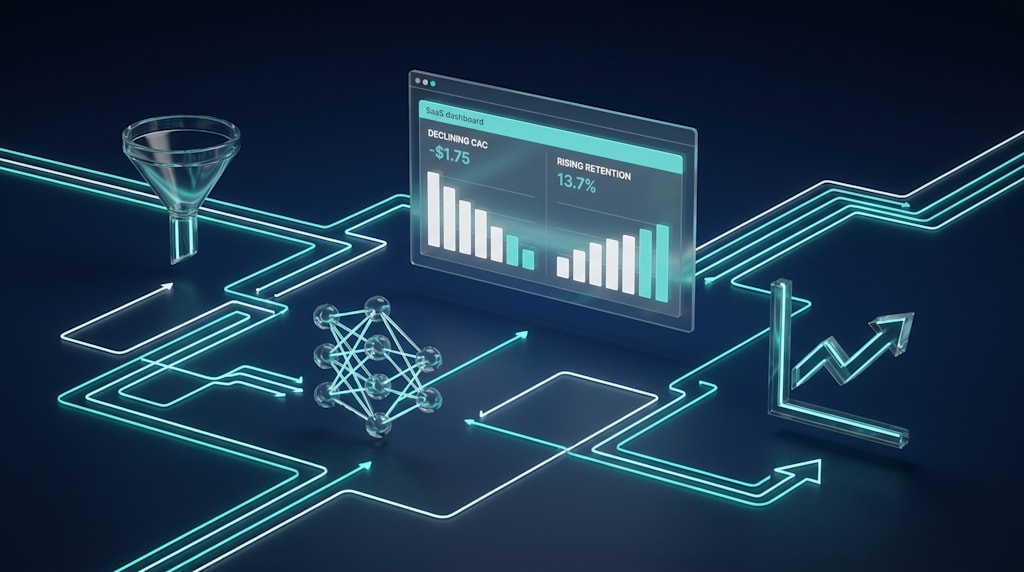
SaaS customer acquisition costs have climbed more than 60% over the last five years. The average cost per acquired customer now sits around $205. For enterprise-focused products, that figure often exceeds $500.
Most SaaS leaders treat this as a marketing problem. They increase ad budgets, hire more SDRs, and test new channels. None of that addresses the real issue.
The platforms that consistently keep CAC low share one trait: they use machine learning to understand user behavior before a user thinks about churning. They act on data before problems become cancellations. In 2026, this is the defining competitive variable in SaaS — and it starts in engineering, not in the marketing department.
Basic Analytics Stopped Working
Dashboards that show you what already happened don't help you prevent what's about to happen.
Users today expect software to adapt to them. They don't wait for quarterly business reviews to signal dissatisfaction. They simply stop logging in. Traditional product analytics tells you a user churned. Machine learning tells you which users are three weeks away from churning — and why.
That distinction determines whether you can act on the information.
McKinsey's 2025 State of AI report found that 78% of organizations now use AI in at least one business function. Companies with the highest AI maturity report marketing ROI improvements of 15% to 30% compared to conventional approaches. The gap between AI-enabled companies and their competitors is measurable in dollars per customer per quarter.
Predictive Personalization Changes the Acquisition Equation
Here is the direct relationship between machine learning and CAC.
When a new user joins a SaaS platform, the first 90 days determine whether they stay. Platforms that deliver generic onboarding lose users at a far higher rate than platforms that adapt to individual behavior.
ML-powered onboarding tracks which features a user engages with early. It identifies patterns from users with similar roles and company sizes. It then surfaces the right guidance at the right moment — without requiring a human customer success rep to intervene each time.
Companies that implement AI-driven onboarding report a 30% increase in customer retention within the first six months. Retention is a direct input to Lifetime Value. Higher LTV means a higher acceptable CAC threshold. The unit economics change entirely.
Building this type of personalization engine requires intentional choices during SaaS product engineering. It means structuring data pipelines from the start, not retrofitting them after launch. It means deciding which behavioral signals matter during the product design phase — then training models on those signals continuously.
Firms focused on custom AI solutions in SaaS approach this as a product architecture decision from day one. Early engineering choices determine what personalization is actually possible at scale. That decision point is far earlier than most SaaS founders and product leaders assume.
AI Co-Pilots Are Changing How SaaS Gets Built
The economics of AI extend beyond user-facing features. They also affect how fast and accurately SaaS products get developed.
AI co-pilots inside development environments assist engineers with code suggestions, test generation, and real-time architectural feedback. Gartner projects that 40% of enterprise applications will include task-specific AI agents by the end of 2026 — up from under 5% in 2025.
For product teams, this means shorter development cycles and fewer costly regressions. A feature that previously required two months of development and QA reaches users in weeks. Over a product's lifetime, this compound advantage is significant.
Faster development also enables faster iteration on ML models. Teams run more experiments per quarter. They identify better-performing personalization strategies sooner. This feeds directly back into retention metrics and, by extension, into lower CAC.
The LTV/CAC Ratio Is a Machine Learning Output
The metric most SaaS executives watch most closely — the LTV to CAC ratio — is increasingly a product of ML decisions made during engineering.
Data pipeline architecture determines what signals your models can access. Model structure determines how accurately you predict user intent. Feature design determines how relevant your personalization feels to the individual user.
Companies that treat ML as a core SaaS engineering component consistently outperform those that treat it as an add-on. McKinsey's research confirms that companies deploying AI across three or more business functions are the ones actually capturing measurable economic value. Isolated pilots rarely move the revenue needle.
Separately, companies using AI for marketing report a 37% reduction in acquisition costs alongside a 39% increase in revenue. Those two numbers together represent a structural improvement in unit economics — not a one-time campaign win.
What This Means for SaaS Leaders
The conversation about CAC needs to move from the marketing team to the product and engineering team.
Reducing acquisition costs is not purely a matter of finding cheaper channels or improving creative. It is a matter of building a product so well-suited to its users that they stay, expand, and refer others. Machine learning makes that possible — but only when the underlying infrastructure supports it.
The engineering decisions that enable ML — data architecture, behavioral data collection, model infrastructure — are investments made early in the product lifecycle. They pay dividends for years. CEOs and product leaders who understand this connection will make better resource allocation decisions. They will invest in AI/ML development not as a cost center, but as the mechanism that determines long-term unit economics.
The SaaS platforms that win the next phase of this market won't simply acquire users faster. They will build products that give users a reason to stay.
About the Creator
ViitorCloud Technologies
As a leading software development company, we’ve empowered 500+ startups, SMBs, and enterprises to transform their operations. Upgrade your business with our AI-First Software and Platforms that automate and scale, keeping you future-ready.
Enjoyed the story? Support the Creator.
Subscribe for free to receive all their stories in your feed.
Comments
There are no comments for this story
Be the first to respond and start the conversation.