
The Brutal Truth Your Phone Will Never Tell You About Speed
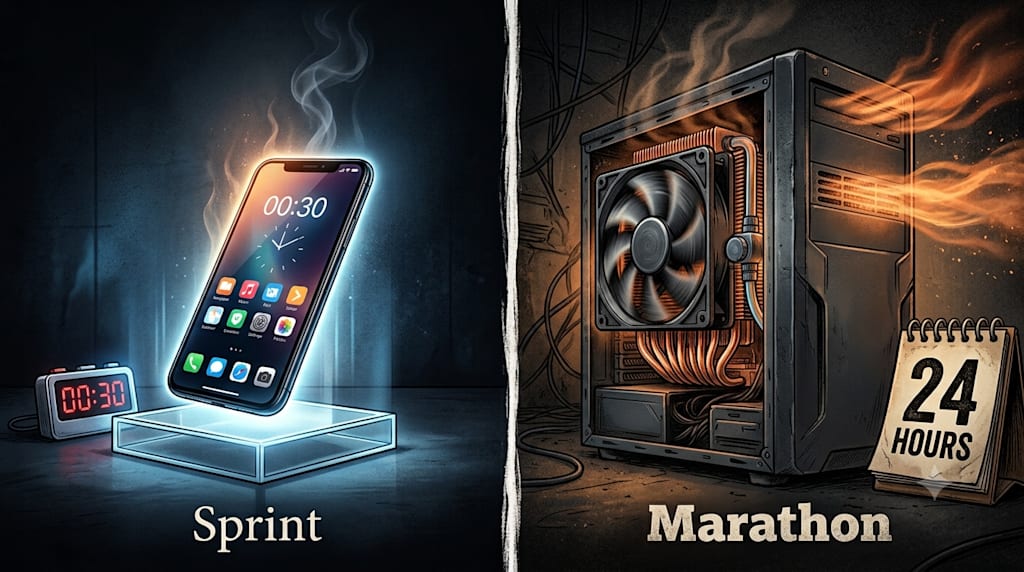
Benchmarks are a sprint. Physics is a marathon. Guess which one wins.
Ask a random person on the street: “Which is more powerful—your phone or your personal computer?” The vast majority will give you a definitive, almost dismissive answer: “The computer, obviously. Do you even need to ask?”
That answer is rapidly becoming a statistical minority.
Global PC ownership sits at about 1.5 billion units. Smartphones? Over 6.5 billion. In China’s lower‑tier cities and university dorms, a huge number of users first encountered the digital world—and still do all their computing—on a screen that measures five to seven inches. The decade‑old desktop that cost a few thousand yuan back then and now takes two full minutes to boot exists for one reason only: “occasionally open a document” or “help my parents check their stock portfolio.”
Pitted against that aging machine—still running a mechanical hard drive and 4GB of RAM—a modern phone built on a 3nm chip with UFS 4.0 storage delivers a geometrically wider performance margin when launching WeChat or scrolling through short videos. In these light‑load scenarios, the phone doesn’t just win; it dominates.
By that statistical yardstick, the group of people whose PC outperforms their phone has indeed long been a minority.
But this conclusion has a massive crack in it.
Any serious hardware reviewer will tell you: the phone numbers you see in benchmark scores are “sprinted.” Geekbench’s single‑core test runs for mere tens of seconds; the entire loop takes only a few minutes. After each sub‑test, both Android and iOS schedulers deliberately insert a millisecond‑long idle window—temperatures drop, voltages reset, and when the next task arrives, the core can once again sprint at full throttle.
This isn’t cheating. It’s a survival strategy for mobile chips. Their entire thermal design power (TDP) is locked between 5 and 8 watts. The total heat‑dissipation area is no larger than the palm of your hand. If they didn’t sprint‑and‑rest like this, the screen would become uncomfortably hot to the touch within thirty seconds.
Now consider that ten‑year‑old desktop PC—say, a budget build with an Intel i5‑2400. Its TDP is 95 watts. It has a heatsink weighing several hundred grams, made of aluminum fins, and a dedicated fan.
The difference between the two isn’t “fast” versus “slow.” It’s a fundamental difference in race type: sprint versus marathon.
Run Cinebench R23’s 10‑minute loop or multi‑core render on a phone. For the first thirty seconds, it holds its advertised peak frequency. After fifty seconds, the thermal throttle kicks in; frequency plummets to about 40% of peak. Two minutes in, performance has been cut off at the ankles. It’s not that the chip is weak—it’s that physics won’t allow passive cooling to remove sustained heat from such a tiny enclosure.
That dusty old PC is different. Its instantaneous compute might lag behind the phone’s peak, but it can run at 100% of its rated base frequency for 24 hours straight. Exporting video, decompressing large archives, compiling code—all those long tasks that make a phone stutter after three minutes—the old PC, relying on constant, unwavering endurance, often finishes faster in total wall‑clock time.
In any endurance race longer than five minutes, any mobile chip without active cooling has no business standing on the same starting line as a desktop machine—in terms of absolute physical compute.
Phone makers understand another, more insidious truth: the average user’s perception of “fast” depends on the millisecond latency between tap and response—not on absolute floating‑point throughput.
To create that buttery‑smooth feel, both iOS and Android set their scheduling policies to burst mode. The instant you touch the screen, the system ramps up the big core voltage within milliseconds, hits peak frequency, finishes the job, and goes right back to sleep. This choreography makes every fingertip gesture feel effortless.
The old PC, by contrast, loses on the periphery: mechanical hard drives have seek times measured in tens of milliseconds; Windows background processes are perpetually crowded; even opening File Explorer takes a spin. The public translates this lag, quite innocently, as “the CPU is too slow.” But that translation is wrong.
I/O response latency and sustained throughput are two different dimensions. The former handles “feel”; the latter handles “work.” The phone wins on nimbleness; the PC wins on lung capacity.
Benchmark software amplifies the phone’s burst advantage with fragmented, short‑duration tests, while masking the continuity demands of real workloads. In short‑burst tests, the CPU spends most of its time waiting for memory and scheduler feedback; the actual floating‑point units never get fully loaded. For a PC, however, a long queue means every transistor on every physical core is being squeezed continuously—every second of the benchmark is real heat generation and real work.
An even more subtle distortion comes from the user’s own cognitive habits. When someone owns both an old PC and a new phone, they naturally assign the PC to “heavy lifting that requires sustained processing”—unzipping tens of gigabytes, running pivot tables on a hundreds‑megabyte Excel sheet, exporting a ten‑minute video—while relegating the phone to “scrolling and tapping.” They never think to give those same tasks to the phone, so they never witness the phone’s humiliating drop to 40% performance under sustained load.
The PC is graded in the heavy‑load examination hall; the phone is staged in the light‑load showroom. The comparison was never fair to begin with.
Let’s circle back to the original question:
If you own only a phone, then yes, in day‑to‑day responsiveness, it does demolish that old PC sitting idle in the corner.
But if you own a desktop with a dedicated airflow path and a copper‑base heatsink—even if it’s getting on in years—it will still outperform any phone, rock‑solid, under sustained heavy loads.
Benchmark scores can fool algorithms, but the second law of thermodynamics doesn’t lie. That old PC’s heatsink gets hot under full load—because it’s moving heat away from the die. The phone also gets hot under full load—except the heat stays trapped behind the screen, in your palm.
One expels heat. The other stores it. The difference isn’t compute; it’s physics.
Next time your computer feels sluggish, check whether it has an SSD and whether its RAM is still stuck at 4GB. The CPU is usually innocent. The person who’s truly complaining is often using a phone with a 5‑watt thermal design and demanding it do the work of a 95‑watt machine.
Phones are fast‑moving consumer goods for consuming content. Computers are production tools. These two things were never meant to race on the same track.
The flame that burns steadily is rarely the loudest. And what truly generates heat is seldom what the public sees.
About the Creator
Jin
Writer of reamstories
https://reamstories.com/jin
Enjoyed the story? Support the Creator.
Subscribe for free to receive all their stories in your feed. You could also become a paid subscriber, letting them know you appreciate their work.
Comments
There are no comments for this story
Be the first to respond and start the conversation.