
The Big Car Paradox
We buy them for safety and status, but they make our cities more dangerous, cramped, and inefficient. Can we stop the cycle before the streets choke?
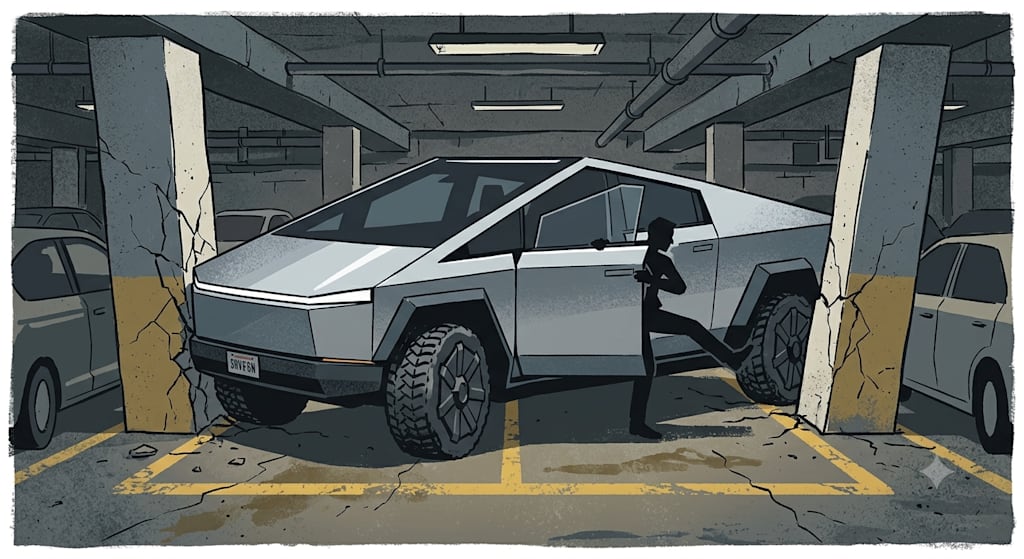
10 p.m. in an underground mall garage. A NIO ES9 is backing into a standard parking space.
The driver has been at it for two minutes. The parking sensors keep screaming. In the side mirrors, the gap between the car's flanks and the concrete pillars is thin enough to slice light.
The car is in. The door opens a crack.
He twists sideways and squeezes out, pulling himself from the crevice. Once on his feet, he shakes his numb arm, lets out a long breath, and turns back to look at the car. His face is relief and fatigue.
This isn't a performance. This is what happens in Chinese cities every day in 2026.
Five years ago, Smarts, MINIs, and Wuling Hongguang MINI EVs still lined the streets. Now they're retreating.
Data from the China Passenger Car Association: from January to May 2026, new energy A00‑class micro sedans sold 192,000 units — down 64% year‑over‑year. The Wuling Hongguang MINI EV has fallen from a peak of 50,000 monthly sales to just over 10,000. Chery's eQ1 and Chang'an's Lumin have scaled back domestic deliveries and pivoted to overseas orders. Even BYD's Seagull — once hailed as the "light of micro cars" — stretched its length from 3.78 to 4.205 meters in its latest generation, pushed its wheelbase to 2.65 meters, and walked clean out of the A00 class.
On the other side: B‑class new energy SUVs are up 11.9% in the same period. C‑class SUVs are up 98.6%.
This isn't a market "choosing." This is a market "excluding."
Building an A00‑class micro car leaves margins thinner than a razor blade. In its early days, the Wuling Hongguang MINI EV made only a few hundred yuan per unit. A C‑class SUV's gross profit is ten times that — or even dozens. Automakers aren't charities. Where to direct production lines, R&D, and marketing budgets — the arithmetic is crystal clear.
But pinning it all on money doesn't tell the whole story.
What truly pushes "big cars" to the extreme is every single person who swipes their card. You're on the elevated expressway in your Smart, and all around you — front, back, left, right — are large SUVs with bumpers that sit level with your window sills. In that moment, what you feel isn't driving pleasure. It's pressure. Like a small dog that wandered into the predators' enclosure. The next time you're buying a car, you'll think of only one thing: next time, it has to be bigger.
"Better to hit someone in a big car than be hit in a small one." No one says it out loud. But every buyer has voted with their wallet.
There's no turning back from an arms race. You lengthen by 20 centimeters, I widen by 10. Your daytime running lights span the entire front grille, so I make my tail lights one continuous strip. Your wheelbase hits three meters, I push mine to 3.2. Until standard parking spaces can no longer contain these steel beasts, until the narrow alleys of old neighborhoods are clogged beyond relief. Through it all, every buyer mutters the same thing under their breath: I can't be the one who loses out.
A more hidden force lies in the regulations.
China's latest crash safety standards raised the trolley mass for side and rear impacts from 950 kilograms and 1,100 kilograms, respectively, to 1,400 kilograms. Once the bar lifts, small cars — lighter, shorter, with less crumple zone — are at a physical disadvantage.
The standards were meant to protect people. Instead, they've effectively greenlit big cars. As testing protocols adapt to the ever‑larger "average vehicle" on the road, small cars get pushed to the margins. A closed loop locks into place: bigger cars → standards tilt toward bigger cars → small cars struggle to survive → everyone leans toward buying bigger cars.
There are no villains. Everyone is just making their own optimal choice within the system. A traffic cop once put it plainly: "From a purely rational standpoint, encouraging small cars is Pareto optimal. But people are emotional." Translation: everyone knows the logic, no one follows it.
Of course, exceptions exist.
The Leapmotor T03 — under 3.7 meters long — packs in L2‑level assisted driving, automatic parking, and facial recognition. Small cars can carry smart features. The industry just doesn't bother — or more precisely, you can't charge a premium for them on a small car.
BYD took a different route: the Seagull and Dolphin for the small end, the Qin, Tang, and Han for the middle, the Yangwang and Denza for the top. It doesn't bet on a single direction. It covers every need with a full product matrix.
These exceptions reveal one thing: the rise of big cars isn't technology‑driven. It's value‑driven. In a narrowing system of judgment, "big" has been stuffed with meanings that don't belong to it — safety, status, progress, dignity. Choosing small has become a counter‑choice that requires courage and justification.
Families with multiple kids need to go out. Long road trips require luggage space. Domestic brands are using large SUVs to break into the premium segment — these needs are real. But the replacement of small cars by large ones can't be explained by "real demand" alone.
A 5.2‑meter‑long, 2‑meter‑wide SUV needs 1.5 times the road space of an A0‑class car in city traffic. On a four‑lane road, a green light that used to clear twenty small cars now clears twelve behemoths — and the intersection is gridlocked. Standard parking spaces are 2.5 meters wide. Park a 2‑meter‑wide car in one, and you can't open your own door, and the cars on either side suffer too. The passages squeezed to a single file, the blind spots blocked by massive hoods, the narrow alleys choked by turning radii — these are the costs. Every road user bears them, no matter what they drive.
Some say "spending my own money on my own car" has nothing to do with anyone else. But in a city where public space is already tight, every oversize vehicle on the road eats away at already‑strained public resources. The line between individual freedom of choice and collective cost is blurring.
The solution doesn't lie with consumers. It lies in institutional design.
Japan offers a reference: vehicles over 4.7 meters in length and 1.85 meters in width face progressively higher taxes, and buyers must provide proof of a legal parking space. In the other direction, new energy vehicles under 4 meters get purchase‑tax exemptions, and prime commercial districts set aside dedicated micro‑car spots. Use real money to give ordinary people back their freedom of choice.
It's not just about taxes, either. Crash test weightings, parking facility design standards, the connection between public transit and private cars — the whole system needs adjustment. A healthy urban transport ecology shouldn't offer only one size option. It should accommodate the large SUV that takes the whole family out on weekends, and it should also allow a small grocery‑getter to park with dignity at the curb.
That man who squeezed himself out of the NIO ES9 probably didn't realize he was acting out a microcosm of our time.
The behemoth he spent a fortune to buy back can't even fit a standard parking space. And the expression on his face as he stood outside the door and looked back at his car — the pride was real, the exhaustion was real, the resignation was real.
It was his alone, and it wasn't.
About the Creator
Jin
Writer of reamstories
https://reamstories.com/jin
Enjoyed the story? Support the Creator.
Subscribe for free to receive all their stories in your feed. You could also become a paid subscriber, letting them know you appreciate their work.
Comments
There are no comments for this story
Be the first to respond and start the conversation.