
The Apple-CXMT Chip Deal That Washington Doesn't Want You to Know About
Why America’s tech giant is secretly courting China’s memory maker—and why this high-stakes gamble is destined to fail.
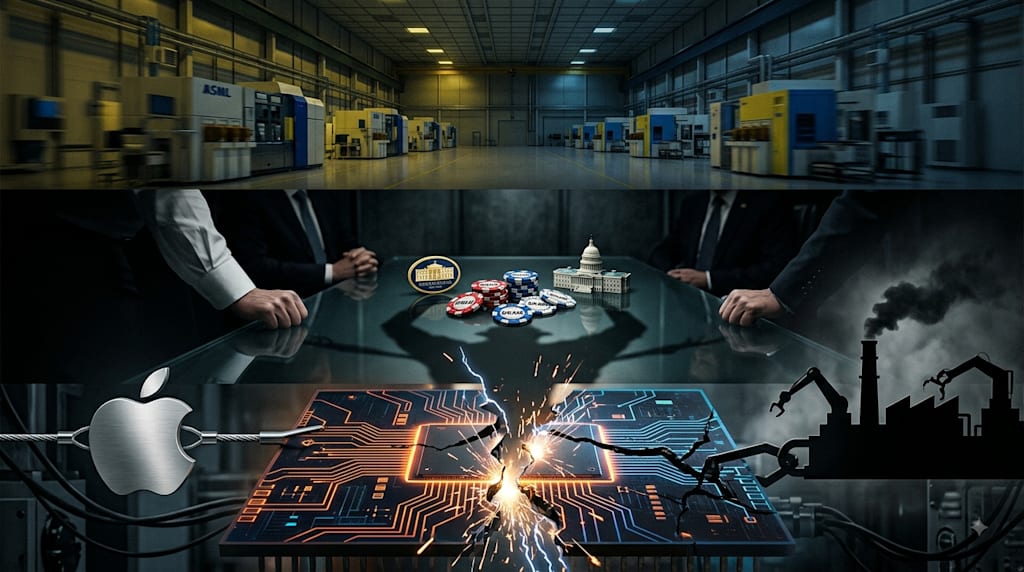
In mid‑2026, the semiconductor and consumer electronics industries were stirred by one news item. The Wall Street Journal, citing anonymous sources, reported that Apple was testing memory chips from Chinese DRAM maker ChangXin Memory Technologies (CXMT) in its iPhone and MacBook lines, and planned to use those components in devices sold in China. Soon after, South Korean outlet Digital Daily published more so‑called negotiation details, even mentioning price haggling.
Markets and tech media quickly read this as a historic breakthrough for China's memory sector. But when you set aside the headlines and look at the supply chain, U.S. export controls, and what each side actually wants, this seemingly equal partnership hits three real walls. Apple's talks with CXMT look less like a done deal and more like a complex rehearsal.
First wall: the Sword of Damocles – export controls and political risk
The U.S. Defense Department put CXMT's DRAM chips on its "1260H" military‑related list in January 2025. Legally, that does not directly stop a private company like Apple from buying them. But the industry's real fear has always been the Commerce Department's Entity List. Once a company is on that list, no U.S. firm may supply it with any product, software, or technical service that contains U.S. technology.
Apple's chip procurement usually involves deep co‑development and customisation: defining specs, setting test standards, verifying blueprints. That two‑way exchange of technical information, under the U.S. Export Administration Regulations (EAR), can easily be classed as "technology export." Export control lawyer Kevin Wolf has noted that while current rules let Apple buy off‑the‑shelf parts and negotiate prices, any custom‑specific communication would cross the regulatory line.
Apple's lobbying machine is already running. Before signing any agreement, Apple is seeking clearance from the White House. That alone shows how fragile this would be – it is no longer just a business decision. Several U.S. lawmakers have already written to the administration asking it to block such a partnership. Even with Apple's powerful lobbying, getting a long‑term, stable exemption would be very hard. Supply chains hate uncertainty, and geopolitics have injected a huge "zero‑out risk" into this engagement.
Inside CXMT's factories, the lithography machines still run. But every wafer's export path waits for a stamp that has not yet fallen.
Second wall: commercial tug‑of‑war – Apple's bargaining chip vs. CXMT's bottom line
Put politics aside and look at the table. Their commercial goals do not align.
Apple's main driver is cost. The AI boom keeps swallowing global DRAM capacity, while the three big players – Samsung, SK Hynix, and Micron – hold pricing power. By leaking its interest in CXMT, Apple's clearest aim is not to bring on a new supplier right away, but to create a "catfish effect." By showing its traditional suppliers a Chinese alternative, Apple hopes to gain extra bargaining room in the next price round. That is a classic supply‑chain balancing act.
But CXMT is not a passive player waiting for a favour. According to Korean media leaks and analyst reports, CXMT has taken a hard line in the talks, rejecting Apple's price‑cut demands and insisting on quotes no lower than – and in some cases higher than – those of the international giants.
Behind that stance lies its own arithmetic: CXMT's advanced nodes (DDR5/LPDDR5X) are still improving yields, but domestic demand already exceeds supply. Local majors like Huawei and Xiaomi have locked up most of its capacity with long‑term contracts. With capacity full and heavy investment needed during a catch‑up phase, CXMT has little reason to sacrifice margins for a high‑risk client that could be cut off by politics at any time. The "Apple halo" has lost much of its shine in the current wave of industrial self‑reliance.
Someone close to CXMT once put it: "We're not begging to get into Apple's supply chain – we're weighing whether this deal is worth it."
Third wall: the hard limit of physical capacity
Even if political clearance comes and prices are agreed, CXMT's current output cannot, for now, absorb Apple's huge demand.
Apple's orders usually run to millions of wafers, with very high requirements for stable, consistent output. Reports show that CXMT's capacity is already maxed out this year, as it focuses on serving existing customers. While CXMT is indeed considering a second factory in Beijing to expand capacity, the timeline from breaking ground to installing equipment to stable mass production usually takes two to three years. That is too far off to help today.
For now, CXMT has no spare capacity for large new orders from Apple – unless it sharply cuts supplies to its core domestic clients, which would be hard both commercially and in terms of national industrial strategy.
Also, technological fit is an invisible hurdle. Apple's high‑end models have always used the most advanced process specs. CXMT still lags behind the top tier in finer metrics like power consumption and current leakage. Even if a deal were struck, CXMT's chips might initially only go into older models or lower‑end lines, doing little to ease Apple's overall supply squeeze.
Conclusion: a "perception game" that cannot be disproven
As of today, neither Apple nor CXMT has made any substantive response to the rumours. With unresolved capacity limits, pending export licences, and technical checks still needed, a large‑scale, substantive supply deal between the two is highly unlikely.
Yet the rumour itself has already become a multi‑player information game. For Apple, it is a useful bargaining chip against the old giants; for CXMT, it is free advertising for its technical capabilities; and the supposed "negotiation deadlock" leaked by Korean media may well be a smokescreen from competitors.
Still, the rumour means more than just a potential business deal. It reflects the deep fragmentation and restructuring of the global semiconductor supply chain: caught between the hunger for AI computing power and the chill of geopolitical rivalry, even a global giant like Apple must now keep a seat at the table for "China‑made chips."
That is not a choice based on commercial perfection – it is a reluctant probe in an era of deglobalisation.
Where this goes next will depend not only on chip yields, but also on the policy temperature difference between Washington and Beijing.
And on those lithography machines still humming inside CXMT's factories – for whom they can still produce, and for how long.
About the Creator
Jin
Writer of reamstories
https://reamstories.com/jin
Enjoyed the story? Support the Creator.
Subscribe for free to receive all their stories in your feed. You could also become a paid subscriber, letting them know you appreciate their work.
Comments
There are no comments for this story
Be the first to respond and start the conversation.