
The Antichrist Algorithm: Why Some Christians Think AI Is the Beast of Revelation
Pastors call it a false prophet. TikTok calls it the end times. Inside the anxiety spreading from pulpits to Silicon Valley.
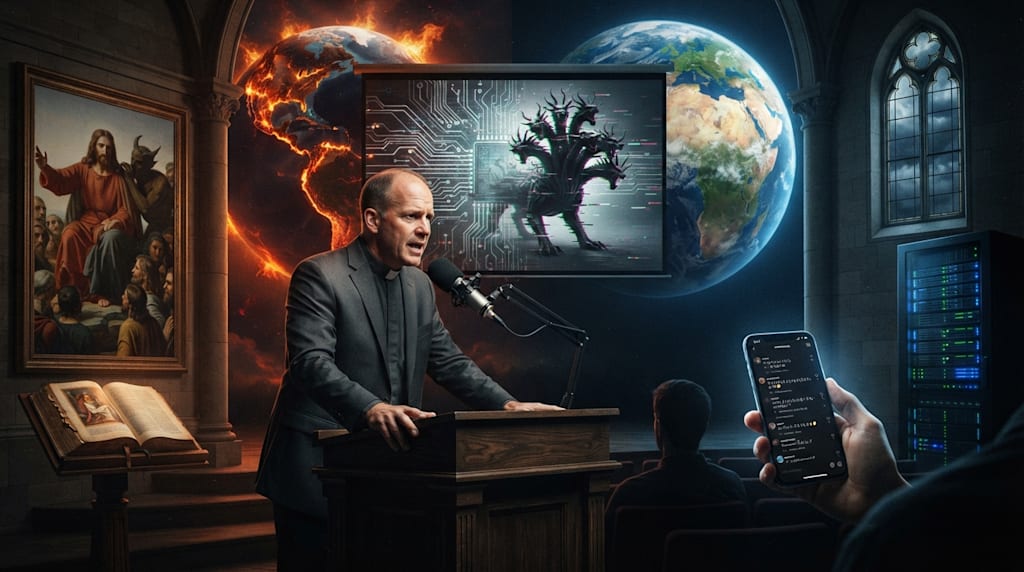
Atlanta, a Sunday. Philip Anthony Mitchell stood behind the pulpit, palms pressed to the wooden edge. Behind him, a screen showed a circuit board, its traces spreading like roots. He said: "Artificial intelligence will play an important role in the end times."
Someone in the audience raised a phone. Fifteen seconds later, the line was on TikTok, under a low synth drone, tagged #AI, #Antichrist, #EndTimes. The first comment quoted Revelation 13. The second was a prayer written by ChatGPT. It began, "Dear Heavenly Father, we ask for wisdom for the algorithm."
Mitchell is not a Silicon Valley engineer. He is based in Atlanta, leads a large congregation, and his podcast gets high download numbers. When he says "end times," he does not mean next quarter's earnings. He means the end of the world. More than a year later, from TikTok to podcasts to Christian publishing meetings, many prominent Christians are asking the same question: Could AI become the catalyst for the world's destruction?
Megachurch pastor Greg Laurie asked in a sermon: "Will artificial intelligence be part of the end-times script?" He paused. "It very well could be." Pastor Mike Signorelli leaned into his podcast microphone. It picked up his breath. "This is a key part of how the Antichrist comes on the scene," he said.
These pastors say AI can be used for good. Hospitals use it to read scans. Translators use it to spread the gospel. Churches use it to manage congregations. But they warn that Satan's representative, the Antichrist, could use it to trick people into worshipping him instead of God.
Seven heads and ten horns, and the second beast
In Revelation, John sees a beast rise out of the sea. It has seven heads and ten horns. Many Christians read this as metaphor: Rome persecuting the early church. Others read it as prophecy. The prophecy also describes a second beast, a false prophet, who deceives humanity into venerating the Antichrist. Some say AI is that second beast. Some say AI is the Antichrist itself.
Orvieto Cathedral, in Italy's Umbria region. Right transept, San Brizio Chapel. On the wall is a fresco by Luca Signorelli, The Preaching and Deeds of the Antichrist, painted between 1499 and 1504. The Antichrist has a beard, long hair, and a flowing robe. He looks like Jesus. Satan, horned, leans in and whispers. His hand moves as if working a puppet. The Antichrist stands where Jesus should be, preaching to people who suspect nothing.
Today, a detail of that fresco is cut into a YouTube video. The image zooms in. Satan's mouth is at the Antichrist's ear. A caption appears: "Look. This is AI."
The soil of anxiety
Saint John's School of Theology and Seminary. Professor Noreen Herzfeld's office. Books are piled on the desk. A computer screen is lit. She studies AI and technology ethics. "Talk about the end times always rises in periods of major change," she says.
She compares AI's effect on jobs to the Industrial Revolution. Both bring deep uncertainty and anxiety. "We live in a time of rapid change," she says. "Computer technology is advancing faster than at any point in the past. We are told it will take jobs, change everything, overturn everything. That speed is very hard for people to bear."
There is also the feeling of losing control. Like it or not, AI is part of most of our lives. And people in Silicon Valley keep warning that there is a 10 percent or 15 percent chance AI destroys us all. Herzfeld says that if people feel God is still in control, that all of this has meaning and is ordained, they can ask: "How do I face this moment? What should I do? How do I put myself on the side of good, not evil?"
A 2022 Pew Research Center survey found that nearly 40 percent of American adults believe we are living in the end times. Among Christians, the number rises to 47 percent.
My grandmother's Antichrist
Elon University, North Carolina. Professor Jeffrey C. Pugh. "My grandmother thought Franklin Delano Roosevelt was the Antichrist," he says.
Roosevelt took office during the Great Depression. It was a time of uncertainty and poverty. His solution, the New Deal, looked revolutionary then. Pugh says his grandmother's view "shows exactly how irrational it is to fit current events into a particular biblical narrative."
End-times talk has returned again and again in America. It became widespread in the 1960s. "It was a period of severe social upheaval," Pugh says. "We had two political leaders assassinated. Three, if you count Martin Luther King Jr. Our cities burned with Black anger at white oppression. Our children began to express themselves in ways never seen before." Anti-war protests. A youth counterculture. It kept going.
By the 1970s, The Late Great Planet Earth was a sensation. The book linked end-times prophecy to current events and geopolitics. "From then on," Pugh says, "every social upheaval was fitted into that end-times framework."
During the Cold War, the Antichrist was the Soviet Union and communism. After 9/11, for some Christians, it was Islam. "No matter the era," Pugh says, "the fears of that era get projected onto these narratives."
Daniel in the age of algorithms
Australian pastor Stephen Driscoll wrote Made in Our Image: God, Artificial Intelligence, and You. He cannot say who or what the Antichrist is. He calls AI "one of the most terrifying technologies we have created" and "a candidate." But he also says using the Bible to predict the future does not help much.
"The Bible gives us far more than guesses about who the Antichrist is," Driscoll says. It "prepares us for change. It gives us a theology of work and tools for looking realistically at the AI alignment problem."
He turns to the Old Testament. "It talks about agricultural innovation, things like threshing sledges. It says all of this comes from God." God, he says, is a God of technological wisdom. He is in control of "every technological age, from stone tools to bronze, iron, steel, nuclear power, and now artificial intelligence."
In the Old Testament, Daniel lived in exile under empires that used different technologies. Driscoll says Daniel "could not control the times. He could not stop the empires that were coming, even if they brought disaster." "But he could remain faithful, full of hope. No matter where he was, he could live well, love his neighbor, and obey God."
"He could not control the times. But he could live well."
The pope, Jensen Huang, and a former researcher
On May 26, 2026, Pope Leo XIV warned of "new forms of digital slavery." He called for AI to be "disarmed."
On September 21, 2026, Nvidia CEO Jensen Huang rejected fears that AI will wipe out humanity. He called them a "doomsday narrative."
On September 13, 2026, a former employee at a major AI company said peers in the industry fear human extinction. The person said the West must coordinate with China.
Jacob Coxon, a former researcher at Anthropic, claimed: "We could all die in the near future." Other technology executives have warned that if development is not slowed, there will be major risks.
The Sunday morning push
A Sunday morning. Pastor Mitchell stepped down from the pulpit. He picked up his phone. The screen lit. A notification sat there: an AI-generated scripture push. He tapped Share. The congregation left their seats. Some were still photographing the circuit-board pattern on the screen. At the parking lot exit, a car radio played an end-times podcast. "Next time," the host said, "we talk about AI and the mark of the beast." The signal cut out.
The screen was still lit. Half the Earth was lava and flame. The other half was calm and blue. Living things and ruin sat side by side in the same image. No one knows tomorrow. But someone was already writing a sermon for it.
About the Creator
Jin
Writer of reamstories
https://reamstories.com/jin
Enjoyed the story? Support the Creator.
Subscribe for free to receive all their stories in your feed. You could also become a paid subscriber, letting them know you appreciate their work.
Comments
There are no comments for this story
Be the first to respond and start the conversation.