
The AI Quota Died at 2 A.M. Here’s What Happened Next.
The uncomfortable truth about the AI coding era: someone still has to catch the fall.
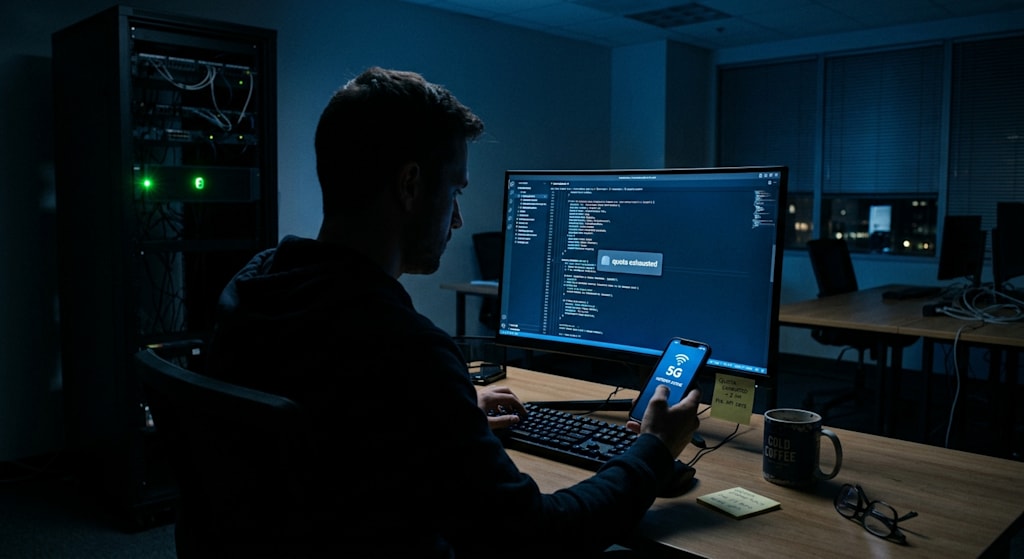
It sounds like a joke, but it describes how the responsibility chain in software engineering is already evolving. AI generates code, AI helps locate the problem, AI proposes a patch, and humans own the requirements, judgment, acceptance, and release. If the quota runs out, wait. If the provider goes down, switch. If the network dies, use a locally deployed model or a 5G hotspot. The era of hand-writing code is over, whether you admit it or not.
That is partly true. But it can easily slide into a cheerful optimism: as long as you have enough subscriptions and models, plus redundancy, writing code no longer needs human hands. The question that matters is whether your team can keep the system running when the main AI path temporarily fails. Manual editing is a detail; the fallback is the point.
My answer is yes: I will manually edit AI-generated code. But I will not make manual editing the default way of working. Hand-writing code is moving from being the primary mode of production to being the last line of defense. It is no longer the default. But it is still the safety rope.
1. When the quota runs out, do not start with hand-writing
If the token quota runs out, a mature engineering team should not immediately enter primitive mode. Call a meeting and divide the modules so everyone starts typing by hand—that is the instinct. It sounds heroic. It is usually a bad deal.
To hand-write a piece of business code, you need to read the surrounding context, align the interfaces, consider edge cases, add tests, and go through review. AI generates the same piece in about thirty seconds, and five minutes of review is often enough to ship it. Saving thirty seconds of waiting in exchange for two hours of manual labor is not a good deal.
So when the quota runs out, do not rush to type. Ask three questions.
Is it urgent? If not, wait, or switch to another provider. Most developers today have more than one subscription. One provider goes down, switch to another. That is basic redundancy.
Do you have only one provider? If one provider gives you five models, you still have one provider. Providers go down, not models. You need at least two providers before you have slack.
Is there a local fallback? If the company has an A100 server running a local model, you can keep working for a while even without the internet. If not, turn on a 5G hotspot and keep calling the cloud API from the laptop. None of this is elegant, but it keeps you from getting stuck at the worst moment.
If none of that works, then humans step in. And when humans step in, they apply the smallest possible patch to restore the system, then let AI do the full refactor when the quota comes back. Hand-writing the entire feature from scratch is the last resort.
2. Hand-writing is the safety rope
I know a front-end developer who has a habit. Every time AI generates a component, he manually edits a few lines. He does it to make sure he has read every line. It is not about distrusting AI. He says, “If the network goes down one day, at least I’ll know why this button doesn’t respond.”
In an AI-first team, this habit looks old-fashioned. But it saved him once. Last year the office network failed. The AI assistant could not connect. The product manager stood next to him waiting for an urgent fix. He opened the file, read ten lines, changed one state check, and fixed it in five minutes. The colleague at the next desk was still restarting the router.
That is where hand-writing sits today: the fallback capability on the critical path, used when the main path fails. You do not need to perform CPR every day. You should still know how.
When people say “the era of hand-writing code is over,” they mean hand-writing is no longer the mainstream mode of production. That is true. AI writes most repetitive code and glue code faster than you can, with fewer typos. If you insist on hand-writing all of it, you are fighting yourself.
That does not make it safe to forget. “No longer mainstream” is not the same as “optional.”
3. “AI writes, AI fixes” is right. Responsibility cannot be outsourced with it.
“Whoever wrote the code should fix it. If AI wrote it, AI should fix it.” At the tool level, this is correct. For AI-generated code, letting AI locate the problem and generate and explain a patch is efficient. In the future, the IDE will probably have this loop built in: error, retrieval, fix, run tests, fix again. Humans will be more like approvers and boundary-setters.
But the responsibility chain cannot be outsourced along with it. AI can change code, but humans must be responsible for whether the requirement is right, whether the architecture is sound, whether the tests cover enough, and whether the release is safe. AI will not be named in the incident review, and it will not take the 3 a.m. call. The person who signs off is still a person.
So “AI writes, AI fixes” needs a parenthetical: under human supervision and acceptance. Otherwise it becomes a new way of passing the blame. AI wrote the code and fixed the problem, and then a model hallucination took the blame for the incident. Every step has an explanation, and no one is responsible for the system.
A healthy process looks like this: AI generates, AI assists with fixes, humans review, tests verify, monitoring catches the fall. The quota runs out: switch models. The model goes down: switch providers. Everything goes down: humans step in. And when humans step in, they use their ability to read and edit code to make the smallest possible intervention, so the system can return to a state where AI can maintain it again. Hand-writing the entire system from scratch is not the goal.
4. Redundancy is engineering
The redundancy you mentioned (multiple subscriptions, local A100 deployment, a 5G hotspot) is all correct. But it has a cost.
For an individual developer, two subscriptions can be a burden. For a small team, a local A100 is not the default configuration. For a large company, multiple providers, local models, and offline plans also need a cost-benefit calculation.
Redundancy means no single point of failure on the critical path. It does not mean more of everything.
The question you need to ask is: in my development workflow, which step has only one provider? If it goes down, do I wait, switch, degrade, or fall back to a human? That answer matters more than “how many subscriptions do I have.”
And redundancy can only reduce anxiety. It cannot replace capability. Three providers can rate-limit you at the same time. A local model may not handle complex tasks. A 5G hotspot does no good when the laptop battery dies. The last door is still a human.
5. What is over is the era of “only knowing how to hand-write”
Hand-writing code still exists. What ended is the assumption that it is the only skill that matters.
The engineers who will be more valuable in the future can switch between the AI main path and the human fallback path. Typing speed and prompt skill matter less than that. When AI is available, they break down the task and let the model generate code while they hold the line on review and testing. When AI is unavailable, they can read the code, locate the problem, apply the smallest patch, and restore service. They do not stop working because the quota ran out, and they do not ship blindly because AI says “fixed.” They know which things can wait and which things require a human immediately.
Back to the 2 a.m. scene. Xiao Chen adds the null check. The payment pipeline recovers. He opens the AI assistant window, looks at “quota exhausted,” closes it, and goes back to monitoring. The next day, when the quota is restored, he asks AI to refactor the line and add logging and tests. Those four minutes were a transition. Without them, there would have been none.
So, when the tokens run out, will I manually edit AI-generated code? Yes. But only when I need to stop the bleeding, when the change is small, when waiting costs more than human labor, or when a human must catch the fall. I will not retreat into hand-writing an entire feature just because the quota ran out, and I will not romanticize hand-writing as a new-era virtue. Hand-writing is the safety rope.
The era of AI writing code is already here. But software engineering has never been just about “who writes the code.” The question that matters is: when the generation tool fails, who can still keep the system running? The answer to that question cannot be AI alone.
About the Creator
Jin
Writer of reamstories
https://reamstories.com/jin
Enjoyed the story? Support the Creator.
Subscribe for free to receive all their stories in your feed. You could also become a paid subscriber, letting them know you appreciate their work.
Comments
There are no comments for this story
Be the first to respond and start the conversation.