
The AI Pioneer Who Thinks We’re Looking at the Wrong Frontier
Fei-Fei Li helped build one of the foundations of modern AI. Now she says the next breakthrough lies in the physical world, not in longer chat logs.
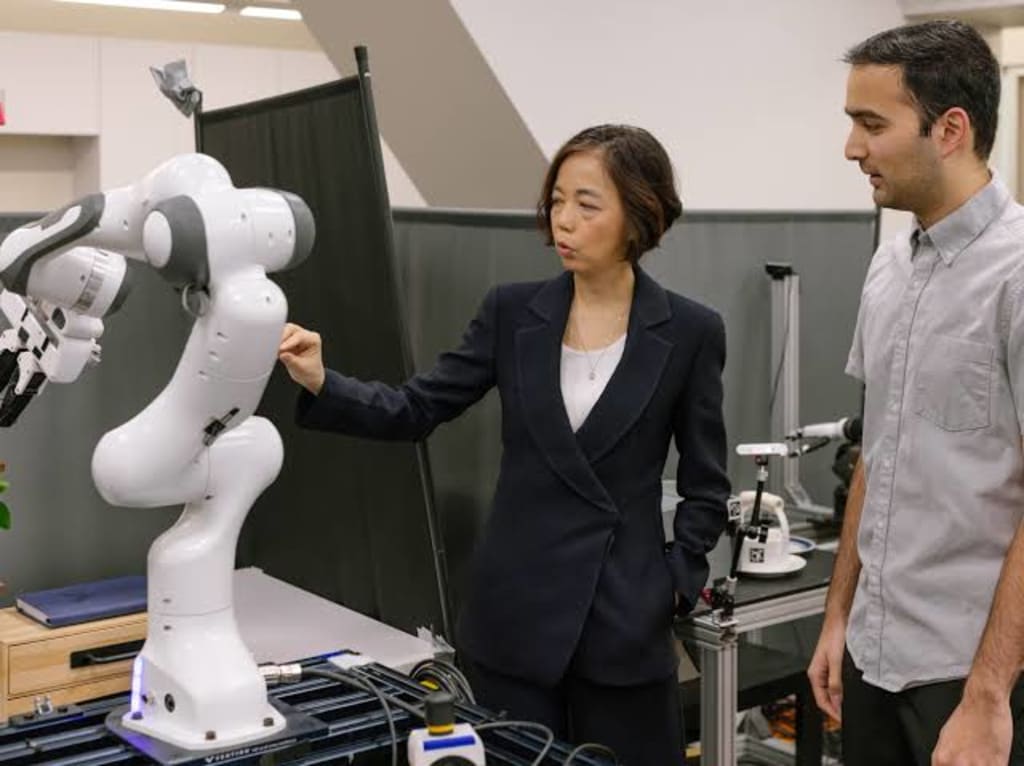
For two years, public talk about AI has been dominated by bigger models, more data, longer context. Text, code, Q&A, agents. The race has been to stretch the token stream. Fei-Fei Li offers a different read: large language models are one chapter, not the last one. The next frontier, she argues, is spatial intelligence.
That claim carries weight because Li built ImageNet when much of academia treated data work as dirty labor. She has a habit of choosing the road before the car. While others polished algorithms, she labeled images. While others rushed into language, she went into the 3D world.
The interview matters because it links technical judgment, scientific ethics, personal history, and social anxiety. The next chapter of AI is about model capability, and it is also about how we understand intelligence, constrain tools, and distribute the gains.
Life did not start with language. Five hundred million years ago, trilobites sensed light and sorted predator from prey. Seeing, judging distance, predicting motion, deciding to flee or hunt: these capacities are far older than speech. Language arrived late. The base of intelligence is not grammar. It is a living system acting in a physical world.
That point exposes a blind spot in the language model story. A language model handles human knowledge compressed into text. It can write a poem, debug code, summarize a paper. It cannot reliably tell whether a cup at the table’s edge will fall, how tires grip on a wet turn, or how much force a surgeon needs at the wrist.
Li calls this cluster spatial intelligence: seeing, touching, planning, operating, reasoning in 3D, and imagining what happens next in space. Language remains a high-level expression of intelligence. It is not the only base. If AI is to leave the screen and enter robots, driving, medical training, factories, buildings, and classrooms, it has to learn the physical world.
Why bet on spatial intelligence now? Go back to ImageNet. In the mid-2000s, academic taste favored elegant algorithms. Data was an accessory. Li and her team cleaned, sorted, and labeled millions of images. The dataset grew to 15 million images across tens of thousands of categories. In 2012 it helped set off the deep learning boom. The lesson is not that data matters. The lesson is method: when the field optimizes the car, build the road.
Spatial data is harder than text. It is not static, one-dimensional, or easy to label. It includes depth, occlusion, material, physics, motion, and feedback. To make AI understand the physical world, you need new data infrastructure, new representations, and new simulation environments. That is the difficult part of World Labs. It is a longer, heavier, less certain infrastructure bet. Li has chosen the hard path again. The moat sits in the slow, dirty, patient work.
Spatial intelligence has three layers. Perception lets machines read 3D structure, distance, material, and motion. Computer vision has built a base, but real scenes are messier than lab datasets. Representation and generation let a model build a computable, reasoning, simulatable world inside itself, not just output a video or a picture. A room that looks right is not the same as a room whose geometry, object relations, and physical constraints are understood. Action and interaction let robots, vehicles, and machines finish tasks in the physical world. This layer is hardest because mistakes cost money, time, or safety. Reality does not offer a regenerate button.
Li’s bet does not mean language models disappear. It suggests a split: language models handle semantics, knowledge, and interaction; spatial intelligence handles physical understanding and action. The two are complements. Commercially, spatial intelligence will move slower. Language models spread through APIs. Spatial systems face hardware, scenes, safety, and data loops. Li is not betting on next quarter. She is betting on the next decade of infrastructure.
The interview also has a clear statement about science. Science is a correction machine: experiments, observation, reproducibility, peer review, open argument. AI has a habit of confusing a high benchmark with a grasp of intelligence, or a large user base with a definition of the future. Li’s reminder is simple: stay honest, stay humble. Technical researchers should not claim a moral or truth high ground. Hard tech lives in measurable loops. Human society runs on darker, messier stuff: institutions, conflict, value tradeoffs. Code that runs is not the same as a society that works. The scientific spirit starts with a limit: a powerful tool means knowing where its edges are.
Deepfakes are the sharpest case in the interview. The same generation and simulation stack can train robots, generate rare driving scenes, or model a virus entering a cell. It can also produce video, audio, and text that pass as real. Li says the field must face this with humility and stop pretending the lab is clean. She wants lawyers, ethicists, sociologists, policymakers, and engineers in one room. That is a start, not a solution. Ethics talk cannot replace institutional design. Cross-disciplinary panels cannot replace liability. Deepfakes are not only a misuse problem. They expose platform incentives, spread mechanics, evidence costs, legal gaps, and weak media literacy. Scientists can warn. Institutions, enforcement, and public governance have to put the bridle on.
There is another point in the interview that tech talk often buries. Faster productivity does not automatically spread wealth and opportunity. Li says she is pained that teachers in K-12 and universities are being left out of the AI conversation. Tech elites talk about AGI timelines, parameter counts, and compute clusters. Teachers worry about grading, classroom discipline, and whether their job will be redefined. An information gap sits next to a resource gap. Li also points to public institutions and academia as producers of public goods: trained people, basic research, studies of job dislocation, tracking of social change. These goods do not pay back next quarter. They decide whether a society can absorb a shock. That is why she and Condoleezza Rice went to Washington to argue for public support. Innovation gains do not trickle down by themselves. Someone has to repair the distribution channel.
Li’s own story explains her appetite for hard problems. She immigrated to the US at 15 with little English. Her family landed with 20 dollars. She worked as a cashier, cleaner, and delivery worker. Her parents could not tutor her. They gave her support and curiosity. She applied to Princeton because of Einstein. Physics trained her to ask the hardest question in the room. She compares immigrants and scientists. Immigrants cross language and culture. Scientists cross the known and the unknown. Both face a void and build a path. A person with no track is not bound by one. Having nothing can remove fear.
Personal story is not institutional analysis. Li says she is grateful for the system that gave her a chance. Public schools, universities, research funding, and an open society carried part of the load. A story that only celebrates grit misses that structure.
Li says language models are not the end. Spatial intelligence is the next frontier. Her definition of frontier matters more. A frontier includes the model boundary, but it also includes the limit of what a society can absorb. Spatial intelligence can push AI into the physical world. If education, work, ethics, law, and public institutions lag, stronger tools can widen the tear. From ImageNet to World Labs, Li keeps choosing infrastructure problems. Her career suggests a rule: the frontier tends to sit in the hardest, slowest, most patient room. The next chapter of AI will not be written by scientists alone. Engineers, teachers, legislators, ethicists, and ordinary people will write it too.
Language models are not the end. Spatial intelligence is not the end. The end is a future where technical capacity and social institutions evolve together.
About the Creator
Jin
Writer of reamstories
https://reamstories.com/jin
Enjoyed the story? Support the Creator.
Subscribe for free to receive all their stories in your feed. You could also become a paid subscriber, letting them know you appreciate their work.
Comments
There are no comments for this story
Be the first to respond and start the conversation.