
The AI & Machine Learning Landscape in 2026: What's Real, What's Hype, and What Actually Matters
The AI & ML Landscape in 2026: What's Real and What Matters

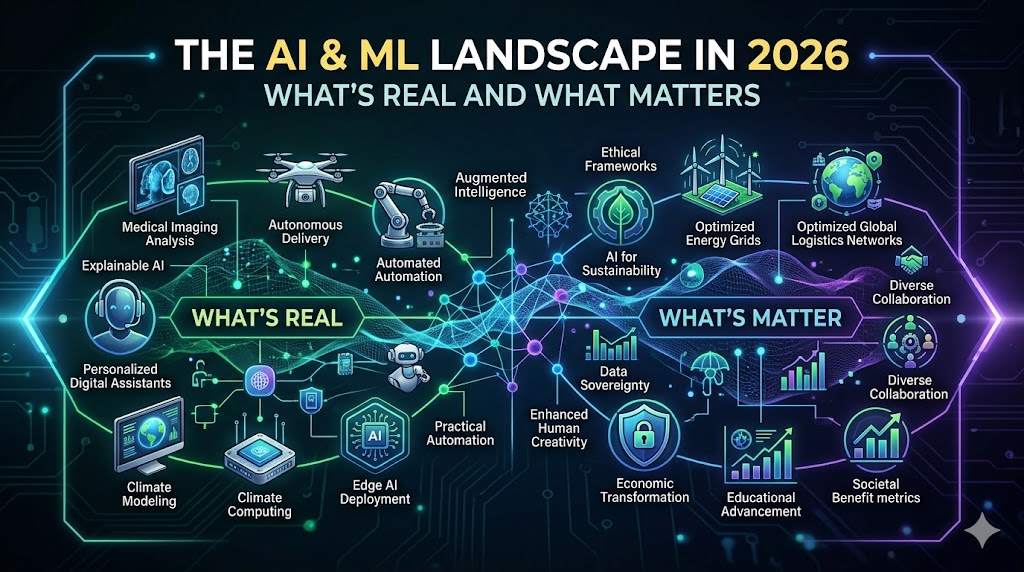
Every year since 2022 has been declared "the year of AI." The announcements keep coming, the benchmarks keep improving, and the investment keeps flowing. But for technologists trying to cut through the noise and understand what's actually worth paying attention to , what's production-ready, what's genuinely new, and what's repackaged hype , the signal-to-noise ratio has never been worse.
This is an attempt to fix that. A clear-eyed look at where AI and machine learning actually stand in mid-2026 , the breakthroughs that are real, the limitations that persist, and the areas where the technology is creating genuine, measurable value.
What has genuinely changed in the past 18 months
The honest answer: more than most cycles, less than the headlines suggest.
- Reasoning capability crossed a meaningful threshold. The jump from GPT-4-class models to the current generation of frontier models, in terms of multi-step reasoning, mathematical problem-solving, and handling ambiguous, complex instructions, is qualitative. These models don't just retrieve and recombine; they reason through problems in ways that produce correct outputs on tasks that stumped earlier systems entirely. For developers building on top of these models, the practical implication is that a much wider class of problems is now tractable.
- Multimodal is now baseline. The leading models process text, images, audio, and video natively. This isn't a premium feature , it's table stakes for frontier model releases. The use cases this unlocks, from visual debugging to document understanding to real-time video analysis, are genuinely new.
- Inference costs collapsed. The cost of running LLM inference has dropped by roughly 90% over the past two years. Tasks that were economically unviable at 2023 pricing , running LLM calls on every user interaction, processing large document corpora, powering real-time voice applications , are now well within the economics of production deployment for most businesses.
- Agentic systems moved from demos to production. AI agent systems that pursue multi-step goals using tools, memory, and autonomous decision-making have moved from research curiosities to production deployments. They're writing and shipping code, managing business workflows, conducting sales calls, and executing data pipelines with meaningful autonomy.
The areas where limitations still bite
Honest coverage of AI requires the full picture. Here's where the technology still falls short of the hype:
- Hallucination is not solved. Frontier models still generate confident, plausible-sounding incorrect information. The rate has improved; the problem hasn't been eliminated. Any production AI system handling consequential decisions needs validation layers, human oversight for high-stakes outputs, and a design philosophy that assumes the model will occasionally be wrong.
- Long-context reliability is uneven. Most frontier models now accept context windows of 100K tokens or more. What they do with all that context is a different question. Performance on tasks requiring precise reasoning over very long documents, finding specific contradictions, tracking multi-entity relationships across hundreds of pages, remains inconsistent. The context window is large; the reliable working memory within it is smaller.
- Evaluation is genuinely hard. Knowing whether an AI system is actually performing well in production, as opposed to performing well on benchmarks that don't reflect real usage, is still an unsolved problem for most teams. Benchmark scores and production quality have a complicated relationship. Teams that don't invest in task-specific evaluation infrastructure often discover the gap the hard way.
- Data quality dominates fine-tuning outcomes. Fine-tuning and retrieval-augmented generation (RAG) are powerful tools for customizing model behavior for specific domains. The quality of the underlying data determines the quality of the output, and most organisations' internal data is messier than they expect. Garbage in, garbage out hasn't changed.
Where ML is creating the most real-world value right now
Setting aside the frontier model conversation for a moment, where is ML actually applied to drive measurable business outcomes in 2026?
Predictive operations
Manufacturing, logistics, and infrastructure companies are deploying ML for predictive maintenance and demand forecasting at scale. The models aren't glamorous, gradient boosting and time-series forecasting on sensor and operational data, but the outcomes are: reduced unplanned downtime, lower inventory carrying costs, and more efficient resource allocation. This is mature, production-proven ML delivering quantifiable ROI.
Document intelligence
The combination of LLMs and structured extraction pipelines has made document processing dramatically more capable. Contracts, invoices, clinical notes, legal filings, insurance claims , documents that previously required manual review or rule-based extraction are now being processed with high accuracy by AI systems. For industries built on document-heavy workflows, the efficiency gains are significant.
Code generation and developer tooling
This is the ML application with the highest adoption rate among technical teams right now. AI coding assistants are in the workflow of the majority of professional developers, and the productivity impact is measurable: faster boilerplate generation, reduced context-switching for documentation lookup, accelerated debugging cycles. The ceiling is rising , AI systems are increasingly capable of end-to-end feature implementation, not just autocomplete.
Personalization and recommendation
Recommendation systems have been ML-driven for years, but the quality ceiling has risen significantly with modern approaches. E-commerce, media, and SaaS platforms are deploying more sophisticated personalization models that go beyond collaborative filtering , incorporating sequential behavior, contextual signals, and LLM-generated explanations , with meaningful improvements in engagement and conversion.
Fraud and anomaly detection
Financial services, cybersecurity, and insurance are deploying ML anomaly detection systems that identify patterns no rule-based system could catch. The adaptive nature of ML models , continuously learning from new data , is particularly valuable in adversarial environments where attack patterns evolve constantly.
The infrastructure questions that determine production success
The model is rarely the bottleneck in a production AI system. What usually is:
- Data pipelines. AI systems are only as good as the data they operate on. Building reliable, well-governed data pipelines , with proper handling of missing data, distribution shift, and data quality monitoring , is unglamorous but critical work.
- Latency and cost optimization. Production AI applications have real latency and cost budgets. Model selection, caching strategies, batching, and prompt optimization all matter. Teams that treat inference cost as an afterthought often discover it's a significant line item.
- Observability. Knowing what your AI system is doing in production , not just whether it's running, but whether it's doing the right thing , requires purpose-built monitoring. Standard application observability tools don't capture the signal you need for AI systems.
- Model versioning and deployment. Updating AI models in production without degrading performance, without surprising users, and without introducing regressions requires disciplined MLOps practices. Teams that treat model updates like software releases , with testing, staged rollouts, and rollback capability , avoid most production incidents.
What the next 12 months look like
A few trends worth watching closely:
- Smaller, specialized models gaining ground. The race to the largest model is plateauing. Purpose-built models , smaller, faster, cheaper, fine-tuned for specific domains , are increasingly competitive with frontier models for well-defined tasks. For many production use cases, a specialized 7B model outperforms a general 70B model at a fraction of the cost.
- AI in the IDE becoming transformative. Agentic coding tools , systems that don't just suggest code but write, test, debug, and deploy it , are maturing fast. The developer workflow of 2027 will look meaningfully different from 2025.
- Regulatory clarity arriving. The EU AI Act is in effect; other jurisdictions are following. AI teams are increasingly building compliance into their systems from day one rather than retrofitting it. This is ultimately healthy for the ecosystem , clear rules create a more level playing field.
- Physical AI emerging. Robotics, autonomous vehicles, and industrial automation are being transformed by the same model capabilities driving software AI. The timeline is longer, but the direction is clear: AI is moving from software into the physical world.
About the Creator
Nishant Bijani
As a visionary CTO with a proven track record in AI engineering, I excel in leveraging emerging tech advancements. Foster a culture of innovation, and prioritize ethical AI development.
Enjoyed the story? Support the Creator.
Subscribe for free to receive all their stories in your feed.
Comments
There are no comments for this story
Be the first to respond and start the conversation.