
The Agent Era Is Here: What 3D Generative Models Will Fight Over Next
GPT-6 Astra can open Blender and build a house. The next contest is whether specialized 3D models can be called, edited, and reused by Agents.
On September 3, GPT-6 Astra launched. In an official video under three minutes, it enters Blender and starts building a scene from one residential design request. It generates a minimalist house, then expands it into a family home around a courtyard. Bedrooms, office, kitchen, bathroom; bed frame, wardrobe rod, oven, cutlery drawer, lighting simulation. When the normal on the sink surface breaks, it fixes it. For a 30-second interior walkthrough, it places the camera at about 1.65 meters, human eye height, and arranges four movements with a 24–26mm lens. After entering Unreal Engine 5, it handles FBX, JSON, the meter-centimeter unit gap, coordinate conversion, material mapping, collision, and first-person controls.
This demo signals a shift. General models are moving from understanding 3D to operating 3D. Now that general models can do 3D, what happens to specialized 3D generative models?
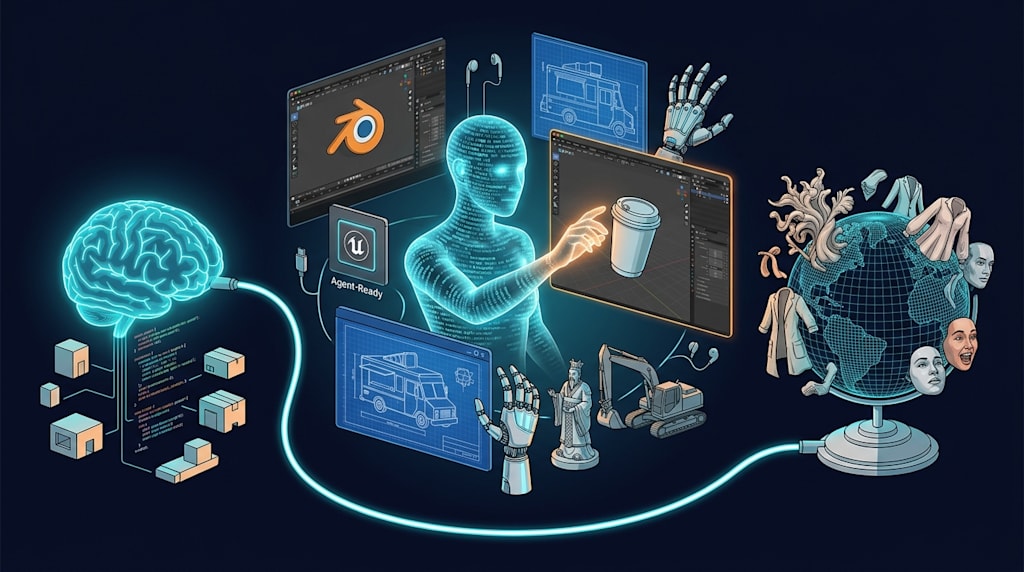
They get redefined. The users of 3D tools are expanding from humans to Agents. Beyond stable generation quality, specialized 3D capabilities must be understood, called, and modified by Agents. Whether a product is Agent-Ready is becoming the new threshold for 3D generation.
I. Astra's capability boundary
Astra demonstrates a complete long chain: understand a request, enter professional software, build a scene, handle materials, adjust lighting, arrange cameras, import into an engine, and fix units and coordinates.
The threshold for 3D creation is shifting. In the past, a person needed Blender, UE5, modeling, materials, lighting, cameras, blueprints, and coordinate systems. Now Agents can take on much of the execution. Humans decide creative goals and judge design trade-offs.
Astra's boundary is clear. After testing, Meshy.ai founder Hu Yuanming said Astra performs strongly on box-like, architectural, and hard-surface geometry: buildings, vehicles, furniture. It is less stable on organic forms and complex topology. Its output often stays at the level of rough primitive-block approximation. That works for silhouette blocking. It is still far from production-ready detail.
The deeper limit: Astra generates geometry through code. That suits regular structures and repeated patterns. For sculptures, creatures, clothing, and other irregular surfaces, the procedural path cannot match specialized 3D generative models in efficiency or quality.
A capability boundary based on geometric complexity appears:
General models understand goals, plan processes, call tools, and generate regular structures.
Specialized 3D generative models handle complex forms, fine geometry, material expression, and editable topology.
The two can collaborate. Astra handles understanding, planning, and assembly. Specialized 3D models generate the complex parts Astra struggles with. For an excavator, Astra first identifies the parts: cab, tracks, chassis, boom, arm, bucket. It sends the main parts to a specialized 3D generative model for independent assets. Then it judges scale and spatial relationships, assembles them, and uses Three.js to add hydraulic pipes and screws.
The division makes sense. Procedural modeling works for objects with clear mathematical relationships and repeated structures. Specialized 3D generative models work for human faces, creatures, clothing, and sculptures.
II. From generator to Agent-callable tool
For years, 3D generative models competed on generation quality. Did the model look good? Was geometry fine? Were materials realistic? Was speed fast enough? Seed3D 2.0's preference rate over mainstream models in texture and material generation exceeds 69%. Lux3D sits at the industry front in material texture metrics such as PSNR and CMMD.
When Agents become users, the criteria shift.
Agents will not open a webpage, upload images, wait, download files, and move them back. They need to generate an asset they can continue using, when they need it, in a form they understand.
That creates three requirements.
The interface must be callable. Hyper3D Rodin connects to agents such as Codex, Claude Code, and Kimi Code CLI through MCP. When an Agent needs a 3D model, it can call Hyper3D Rodin, wait for completion, retrieve the result, and stay inside its working environment. Qunhe Technology's Lux3D supports Harness mode integration into AI coding and 3D modeling tools. MCP is becoming the standard interface between 3D generation and Agent workflows.
The input must be understandable. Agents often face mixed references: front, side, dashboard, engine, and exhaust close-ups of a vehicle; front, back, weapons, and accessories of a character; industrial drawings, dimensions, structural schematics, and material references. The system must identify the subject, keep the useful information, determine which views belong to the same object, and infer missing parts.
The result must be editable and iterable. Generation is not the end. A 3D asset may need geometry edits, topology changes, material work, dimension changes, part separation, rigging, and animation. Then it enters a game engine, AR, 3D printing, or simulation. If the output is an unmodifiable black-box mesh, the Agent workflow breaks.
These three requirements define Agent-Ready. Generation quality must be good enough. The Agent must also know what input to give, which modeling path to take, and what can still be done after generation.
III. What Hyper3D Agentic Mode adds
Hyper3D recently launched Agentic Mode. It combines Hyper3D Rodin with LLM multimodal context analysis in one process. The system understands input, improves it, and chooses the right modeling path.
It first takes over the professional judgment that used to be called preparation but directly affects output.
A casual photo of the statue of Qian Liu, King of Wuyue: cloudy day, unclear face, bow and arrow mixed with the background. After the single-view image goes in, Agentic Mode identifies and fills in facial details. It does not confuse the bow with tree branches. When the view turns to the back, the clothing style and texture match the front.
Industrial design is harder. A reference set may contain the whole and parts. Different views may belong to one object, and may mix dimensions, structural notes, and material references. In the food truck case, the input is not a product photo. It is a set of technical schematics with dimensions, structural zones, partial notes, and multiple views. Traditional modeling struggles because it cannot understand that this is industrial information built for modeling.
Agentic Mode lowers the input threshold. It also extends generation from creative assets into industrial design and other fields that demand structure, specifications, and iteration.
After understanding input, it chooses a modeling path. Agentic Mode supports Low-poly N-GONS models with natural-language parametric control, animation presets, and material enhancement. These capabilities connect input understanding and modeling planning into a generate, inspect, and modify loop.
The robotic hand case shows why this matters. The final model needs working joints that can still move. Agentic Mode generates a Low-poly N-GONS model, then adds animation presets to check joint movement. After an earphone detail image is generated, material, texture, and color changes happen by drag-and-drop.
Agentic Mode does more than produce a high-quality model. It hands more professional judgment in the generation process to AI. Reading design material, choosing a modeling method, and adjusting after generation become one process.
IV. Video generation walked this path first
Moving from generatable content to Agent-Ready assets is not unique to 3D. Video generation went through the same evolution.
A few years ago, SeedDance, Runway, and Kling competed on seconds generated, image clarity, character detail, expression stability, and camera movement. Once single-pass generation improved, competition shifted to Agent workflows.
This year Google added an Agent to Flow. It handles multi-step creation under user control, generates options, batch edits, and organizes material. Flow Tools supports custom tools and workflows through natural language. Professional products started turning scattered operations into a continuous creation process.
As models improved, production methods that lived in people's heads became part of Agent capability: when to use which model, where regeneration is worth it, where local editing is enough, whether the first round should chase speed or quality, and how to preserve character and asset state across dozens of shots.
3D faces its own version of this shift.
In video generation, ordinary people can describe the effect and path in natural language. In 3D generation, the system must understand the relationships among plan views, 3D views, and dimension drawings. It must turn those relationships into interlocking production steps.
Generated content also must be modifiable, iterable, and suited to its final scene. A car in a product display, a racing game, and a robot simulation has different requirements for appearance, parts, and downstream processing.
Astra shows long-chain execution. Specialized 3D models still solve another set of problems: how to generate complex forms, how geometry and materials meet the target, and whether parts can be controlled and modified after generation. These capabilities become professional tools Agents call.
A single line like "GPT can already use Blender" does not close the gap between general and specialized 3D models. Even if general models keep improving, specialized 3D production holds Know-How: how to organize input, which object takes which method, when to keep an asset and modify it, when to rebuild, which parts to separate for a game, and what structure to leave for simulation.
Those choices affect cost. When a plan changes, can you generate a similar model again, or adjust the existing result? Whether AI can take over professional judgment decides modification cost and workflow continuity.
V. From Production-Ready to Agent-Ready
Hyper3D's product updates over recent years solved one problem first: make assets usable, controllable, and able to enter production pipelines.
The core model Hyper3D Rodin kept iterating. It launched natural language editing 3D Editing, recursive part separation BANG, and controllable generation 3D ControlNet. Those formed its answer to Production-Ready.
In the Agent era, the product line moved forward:
The interface layer connects external Agents through MCP.
The input layer uses Agentic Mode to understand material and plan modeling paths.
The interaction layer provides natural language editing and part separation.
Hyper3D is expanding a tool once operated item by item by professionals into a 3D workbench Agents can use continuously.
Two changes now happen at once.
3D content generation is accelerating into industrial design, game assets, simulation, and training. These fields are more complex and demand more expertise.
At the same time, users can become less professional. They do not need to know how many models sit behind the system. They do not need to know Blender or topology. They can still generate professional 3D assets.
Agents have not removed the complexity of professional content generation. They have taken over judgment across input organization, model selection, generation, modification, and post-processing. That judgment becomes part of the system.
Design ideas that were too expensive to model and verify can now enter 3D creation more easily.
An industrial design team can turn a product sketch or a dimensioned reference into a discussable 3D proposal. A game can give attention to minions and map edges, not only bosses and core scenes. An embodied intelligence team can use 3D modeling to make rare corner cases more realistic alongside simulation data. A home design team can finish sketch and scene modeling as soon as the concept is clear, making OPC possible.
For creators, the gain is less time lost to material preparation and repeated operations. Professional knowledge still matters. More time goes to the proposal itself.
VI. What the next fight is about
When Agents become users of 3D tools, competition moves along five lines.
Agent invocation efficiency. Generation quality remains the base. Interface standards, stable calls, and structured returns decide whether specialized 3D capabilities can enter automated workflows.
Input understanding. Real inputs are non-standard, incomplete, and mixed from many views. Whoever can identify the subject, fill gaps, and read industrial drawings takes on harder modeling tasks.
Editability and iteration. Agents need an asset that can be processed, parametrically adjusted, separated, rigged, and brought into an engine. Native quad topology, semantic part separation, material IDs, collision bodies, LOD, and unit conventions become concrete Agent-Ready requirements.
Collaboration with general models. General models handle understanding, planning, and regular structures. Specialized models handle complex geometry and fine materials. The specialized model that becomes the default tool for general models enters more Agent workflows.
Depth in industry workflows. 3D generation is moving from single assets to complete worlds. Games, industrial design, embodied intelligence, home design, AR, and 3D printing each demand different assets. Specialized 3D models must package industry Know-How into the system instead of offering one generic generate button.
Conclusion
Technology and interaction changes are turning 3D modeling into a capability any task can call.
In the past, 3D creation was wrapped in software operations, material preparation, modeling paths, and post-processing. Now Agents take over much of the judgment and execution. Humans still set creative goals and judge design trade-offs. Agents handle more of the concrete work.
The next fight in 3D generation is about becoming a reliable, callable, modifiable professional tool in an Agent workflow. A beautiful model is not enough.
An Agent needs a cup in a project. It calls an interface, waits, retrieves the result, and keeps writing code. That is all.
About the Creator
Jin
Writer of reamstories
https://reamstories.com/jin
Enjoyed the story? Support the Creator.
Subscribe for free to receive all their stories in your feed. You could also become a paid subscriber, letting them know you appreciate their work.
Comments
There are no comments for this story
Be the first to respond and start the conversation.