
The $9.90 Startup
One eviction notice, one Craigslist post, and the first PayPal ding that changed everything.
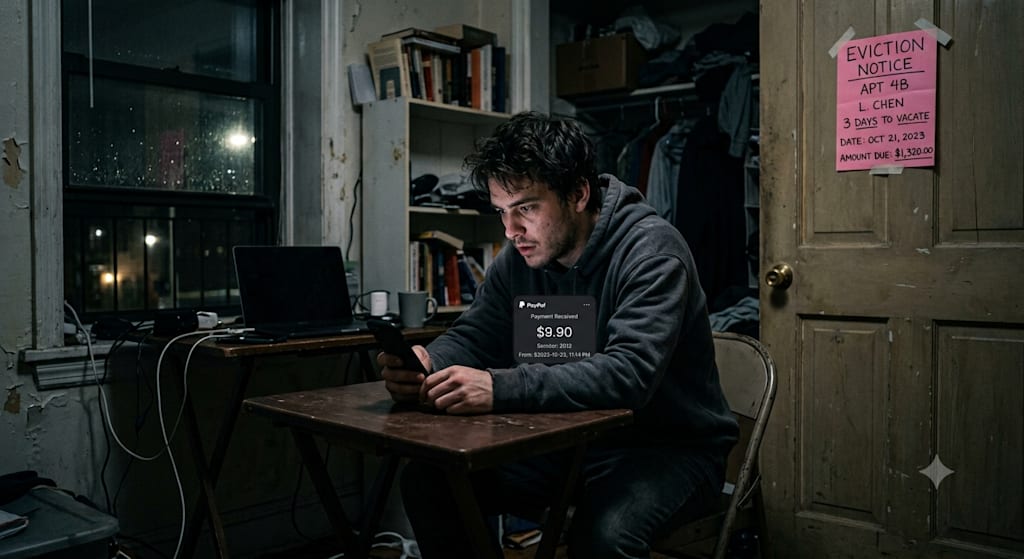
The eviction notice was the color of a Band-Aid. Jack had stared at it for three mornings in a row, drinking cold water from a Mason jar because he’d sold the coffee maker. His bank account sat at four hundred and thirty-seven dollars. The rent was twelve hundred. He didn’t have a business plan. He had a folding table from IKEA and a phone that buzzed occasionally with spam calls.
That afternoon, he typed a sentence into the services section of Craigslist. No logo, no pricing tiers, no branding. Just: I’ll find any digital file you need. Payment after I locate it, your call on the amount.
He set the phone face down and went to refill his jar. When he came back, the PayPal app had chirped. A woman named Monica in Boise had sent him nine dollars, along with the title of an academic article her daughter needed for a college application. She’d written, “I’ve been looking for this for two weeks. If you can find it, keep the nine.”
It took him seventeen minutes. He emailed her the PDF and said, “Here it is. Good luck to your daughter.”
Monica replied within sixty seconds. “You have no idea what this means. Thank you.” She added a heart emoji. Jack sat there, holding the phone in both hands, and for the first time in months he didn’t feel his stomach tighten. The money was so small he couldn’t buy a decent lunch with it. But Monica had given it to him. She had chosen to. That fact rearranged something inside him.
He took a screenshot of the PayPal notification and saved it to a folder he named Evidence: not evidence for anyone else, but for himself, a record that he could be useful in a way that mattered to another person.
Eight months earlier, Jack had spent his entire savings building a local-events app. He’d obsessed over the color of the navigation bar, the radius of the buttons, the exact wording of the onboarding screen. He’d hired a freelance designer to tweak the icon seventeen times. The app launched to forty-three downloads, none of which turned into a paid account. He deleted it from his phone in the middle of a Tuesday afternoon and immediately threw up into his kitchen sink. That failure had taught him nothing about business. It had only taught him that trying to guess what strangers might want, in isolation, was a form of self-harm.
So this time he guessed nothing. He simply asked what someone needed, and then he found it.
The requests came slowly at first. A retired librarian in Florida wanted a particular issue of a 1974 photography journal. Jack combed through defunct forums and scanned-book repositories until he found a digitized copy on a server in Lund, Sweden. The woman’s son called him the next day to say his mother had cried when she saw the cover. Jack didn’t charge extra, but the son insisted on sending him a twenty-five-dollar gift card to a coffee shop. Jack used it to buy a bag of decent beans, and every morning he ground them by hand, thinking about the Swedish server and the crying librarian.
It would be easy to turn this into a success story now, to tell you how Jack built a six-figure business from a folding table. That’s the kind of narrative the internet rewards. But Jack never built a company. He never had employees or a brand. What he built was a way of listening. He learned that people aren’t just looking for files; they’re looking for the proof that something they care about still exists somewhere. A paper their father wrote before he died. A song that played at their wedding and vanished from streaming. A manual for a film camera no one manufactures anymore. When Jack sent these things back to them, they paid him what they could, sometimes ten dollars, sometimes fifty, once a hundred and fifty, and he never once felt like he was charging for a service. It felt more like being let into a secret room in someone’s life, and the money was simply the key turning in the lock.
There was a woman named Emma, a research fellow at a university in California, who had been chasing a specific neuroscience paper for three years. Jack found it in an institutional repository that required a login he didn’t have, so he emailed a professor in Oslo he’d helped months earlier and asked for a favor. The professor sent the PDF within the hour. Jack forwarded it to Emma with a note: “Found. No rush on payment.”
Emma replied, “How much do I owe you?”
Jack typed, “Twenty dollars.”
Emma sent him two hundred. “The paper is worth more than twenty,” she wrote. “And you’re worth more than you charge. Start billing by the hour or I’ll find someone else to force money on.”
That night Jack opened the Evidence folder and created a new document inside it. He called it Permission. He didn’t write anything in it. The blank page was the point.
A year later, he still worked from the same folding table. The eviction notice was gone, replaced by a framed photo of the first nine-dollar PayPal notification, printed out and stuck into a cheap black frame he’d bought at a drugstore. People would come over and ask what it was, and Jack would say, “Proof that someone believed I could help.” They usually nodded and moved on, which was fine. The picture wasn’t for them.
He never did write a business plan. He never built another app. And if you asked him what he did for a living, he’d say, “I find things,” and then change the subject. The real answer was more private: he had learned, slowly and with great difficulty, how to let himself receive.
Late one evening, after a long day of digging through archives for a man in Dublin who was trying to locate his grandmother’s lost sheet music, Jack sat down and wrote an essay. Not a how-to guide, not a listicle, just an account of what the last year had felt like. He wrote about Monica in Boise, the Swedish server, the librarian who cried, Emma’s two-hundred-dollar lesson, the frame on his wall. He wrote about the first time he heard the PayPal chime and how his hand had trembled when he picked up the phone.
He ended the essay not with a lesson, but with a single detail he’d never told anyone: after Monica sent him that first nine dollars, he walked to the corner store and bought a carton of eggs, a loaf of bread, and a small block of cheddar cheese. He came home and made himself an omelet. It was the first meal he’d cooked in three days, and he ate it standing up at the folding table, looking at the screenshot of the transaction, feeling for the first time in a very long while that he was allowed to be here.
He published the essay on a quiet personal blog no one read. He didn’t share it on social media. He didn’t put a payment button at the end.
Ten minutes later, his phone chimed. Someone had read it and sent him six dollars through the tip jar he’d forgotten was even there. The note said, “I just wanted you to know this mattered.”
Jack added the screenshot to the Evidence folder and closed his laptop. Outside his window, a streetlamp flickered on, and the light fell across the folding table in a pale orange rectangle. He left it there, unfolded, exactly as it was.
About the Creator
Jin
Writer of reamstories
https://reamstories.com/jin
Enjoyed the story? Support the Creator.
Subscribe for free to receive all their stories in your feed. You could also become a paid subscriber, letting them know you appreciate their work.
Comments
There are no comments for this story
Be the first to respond and start the conversation.