
THE 770B AI BEAST JUST WENT OPEN SOURCE
Hands-On with Tencent Hy4 Preview – It builds games in one sentence and crushes spreadsheets, but I found 2 deal-breaking flaws you need to know.
On August 28, 2026, Tencent's Hunyuan team published Hy4 preview—a model card on the website, a few live demo links, no press conference.
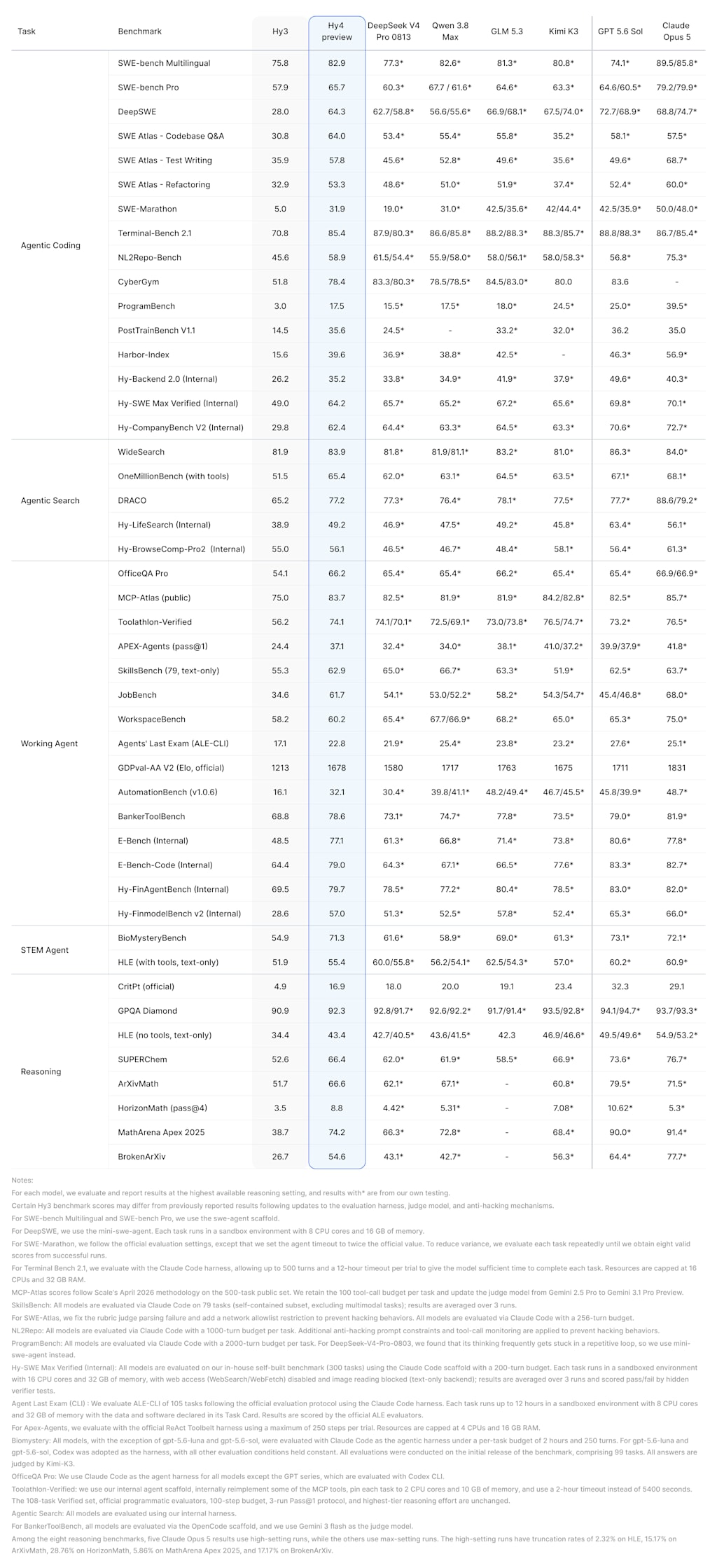
The numbers: 770B total parameters, 49B activated, 1M context window. Apache 2.0, ¥6 per million input tokens, ¥18 per million output. Benchmarks put it ahead of DeepSeek‑V4 Pro 0813 and within striking distance of GLM‑5.3 and Kimi K3.
That's the spec sheet. The practical question: how much work can it actually do?
I. Architecture: Big, Sparse, Text‑Only
Hy4 preview uses a Mixture of Experts design. Seventy‑eight layers; all but the first are MoE. Each layer has 256 routing experts plus one shared expert; each token activates eight. Total parameters: 770B. Active during inference: 49B. That's the MoE trade‑off—large enough to hold knowledge, lean enough to keep inference costs from climbing too fast.
The attention mechanism combines Gated DSA (similar to DeepSeek) with IndexCache (similar to Zhipu) to handle the 1M context. In practice, it takes proven ideas from the community, integrates them, and tunes them for production.
One limitation: this preview version does not process images. Upload a picture, and the system hands off to another model. Text only. The team has said both pre‑training and post‑training have room to improve, so the full release will likely fill that gap. For now, Hy4 preview is specialized—optimized for text and productivity, with other capabilities deferred.
II. Benchmarks: Ahead, but Not by Much
Tencent ran internal blind tests: 163 experts, 203 engineering tasks. Hy4 preview scored 2.99 out of 4.00. Kimi K3 scored 2.94; GLM‑5.3, 2.92.
Head‑to‑head win rates: 46.8% against GLM‑5.3, 51.2% against Kimi K3. The models trade blows; no one has a decisive edge. Hy4 preview lands in the first tier, but the tier is crowded.
The engineering benchmarks tell a sharper story:
DeepSWE (software engineering agent benchmark): Hy3 scored 28.0; Hy4 preview scored 64.3. That jump is not incremental—it's a different class.
Terminal Bench 2.1 (terminal programming): 85.4, tying Claude Opus 5.
Those numbers mean Hy4 preview has genuinely improved at code, scripts, and command‑line work—not marginally, but substantially.
Still, mathematical reasoning can stumble. In a "24‑point" arithmetic test, it occasionally reused digits—basic errors that show its symbolic reasoning isn't fully stable. It can solve hard problems but may trip on simple ones.
III. Hands‑On: Seven Tasks
I ran seven tests across three categories: creative prototypes, office automation, and engineering.
Task 1: Interactive page from one sentence.
I asked for a "Pikachu holographic card" page. One output; no regeneration. Visual quality and swipe response exceeded expectations.
Then a low‑poly parkour game: jump, slide, lane changes, obstacles, magnets, shields. Controls were smooth enough that I played several rounds without noticing the time.
Then a 3D pixel‑style garden—pagoda, pond, arched bridge, vegetation, sky. Petals drifted; clouds moved; birds circled. Lighting switched from dawn to dusk to night.
What this means: someone with zero coding experience can now turn a mental image into an interactive prototype with one sentence. Not a shippable product. But it's the lowest‑friction step I've seen from "idea" to "something you can show."
Task 2: Office suite—all three formats at once.
One prompt: "Create materials about the film Odyssey." It returned:
A PowerPoint with character relationship diagrams, charts, and auto‑navigation.
An Excel workbook with three sheets—journey stages, character map, box office and reviews—with formulas, conditional formatting, and charts.
A Word document over 3,000 words, with cover page, multi‑level headings, headers, footers, and footnotes.
WorkBuddy supports human‑AI co‑editing and real‑time collaboration. This isn't a one‑off output; you can iterate with it.
Task 3: Full‑stack bug fix with CI.
I fed it a full‑stack codebase with CI gates. It fixed the bug and ran the entire CI pipeline—all passed.
Many models fix the code but skip the CI check. Hy4 preview didn't. That detail suggests it was trained to care about engineering completeness.
Two tasks that were decent but not essential:
Fluid‑effect website: mouse hover triggers ink‑like diffusion, rotation, and fade, revealing color photos underneath. Visually striking, but it's a one‑time novelty rather than a daily tool.
Windows OS replica: boot→lock screen→desktop, twenty runnable apps, and a blue‑screen easter egg when you type "crash" in the terminal. Polished, but it's a demo piece, not a productivity booster.
Two sticking points:
Slow reasoning. Chain‑of‑thought is long, making generation noticeably slower than competitors. Token consumption is also high—if you're paying per API call, factor that in.
No vision. Upload an image, and it switches to a different model. Hy4 preview itself cannot handle images. If you need mixed‑media content creation, this version won't help.
Also, the "two‑week free trial" drew a flood of users, causing long queues and task interruptions on WorkBuddy and Yuanbao. Free is generous, but the experience suffered.
IV. Business Model: Open Source and Ecosystem
Hy4 preview is open‑sourced under Apache 2.0 for commercial use.
The strategy: not selling the model itself, but selling the surrounding tools. You can deploy Hy4 preview on your own servers, fine‑tune it, and build private solutions. Tencent's revenue comes when you use the model and adopt Tencent Cloud, WeCom, CodeBuddy, or WorkBuddy alongside it.
API pricing: ¥6 per million input tokens; ¥18 per million output. Not the lowest—DeepSeek is more aggressive on cost—but not premium either. Hy4 preview's advantage is integration: if you're already on Tencent's workplace stack, adding this model is a natural step.
V. Who Should Use It (and Who Shouldn't)
Consider it if:
You're a developer who needs code generation, bug fixing, or CI/CD support.
You produce documents, slides, or spreadsheets regularly.
You want to prototype games or interactions without writing code.
Skip it for now if:
You need vision or multimodal capabilities—wait for the full release.
Your application has tight latency requirements.
Your work involves deep symbolic reasoning or pure math.
VI. Bottom Line
Hy4 preview is optimized for productivity—engineering, code, and office automation. It outperforms its predecessor by a wide margin, and in some scenarios it can match top‑tier closed models. But it also has gaps: no vision, slow reasoning, and unfinished features.
The "preview" label is honest: here's what we have; use what works; we're still iterating.
The second half of 2026 has shifted the competition from "best benchmark" to "actually gets work done." Hy4 preview delivers results that justify its parameter count. The real test is whether Tencent can close the gaps, boost the speed, and convert free‑trial users into paying customers over the next three to six months.
About the Creator
Jin
Writer of reamstories
https://reamstories.com/jin
Enjoyed the story? Support the Creator.
Subscribe for free to receive all their stories in your feed. You could also become a paid subscriber, letting them know you appreciate their work.
Comments
There are no comments for this story
Be the first to respond and start the conversation.