
The $70 Billion Bet: Why ByteDance Is Turning Itself Into a Data‑Center Empire
Behind the record‑breaking $29.6 billion loan and the all‑in AI spending that could reshape the global tech order — or break the company.
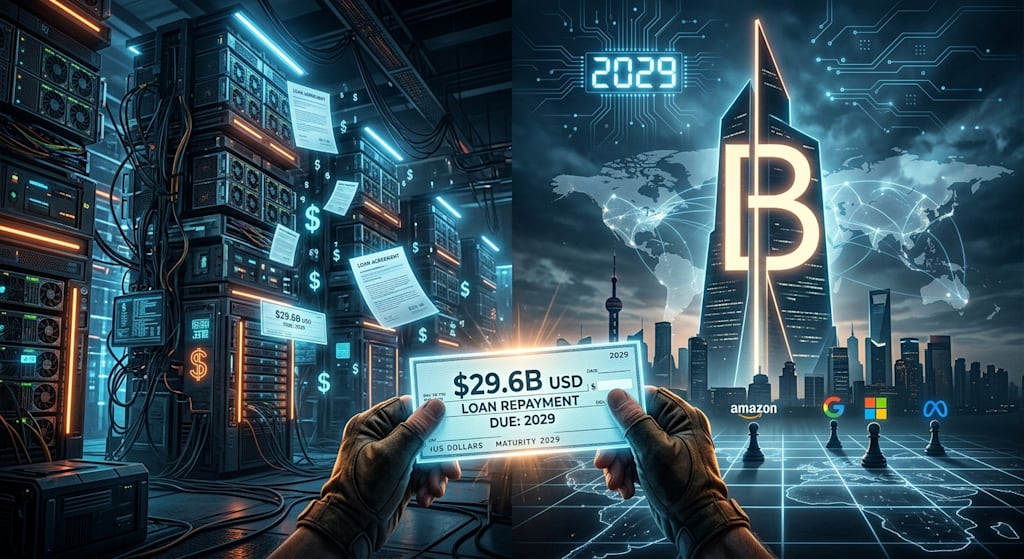
On September 3, 2026, Yicai reported that ByteDance had secured a $29.6 billion offshore syndicated loan. The initial target was $20 billion. Subscriptions surged past $30 billion, pushing the final size to $29.6 billion. The interest rate is SOFR plus 68 basis points, 17 basis points lower than the 85 bps on its $10.8 billion loan in 2024. Syndicate members and final allocations are still being confirmed. The agreement has not been formally signed.
This is ByteDance's largest offshore financing ever. In Asia's dollar loan market for 2026, it ranks second only to SoftBank's $40 billion bridge loan signed in March.
Banks are not charities. At SOFR plus 68 bps, against the lingering tailwinds of the global rate‑hiking cycle, this rate approaches the lowest tier available to any unlisted tech company. Nearly 50% oversubscription means one thing: capital markets judge this company's cash flow strong enough, and the AI track's odds attractive enough, that even with over $20 billion pushed its way, default risk remains negligible.
$29.6 billion is roughly RMB 210 billion. That exceeds the full‑year revenue of most Hong Kong‑listed companies.
But what shook the market followed shortly after: the capital expenditure plan disclosed in the same period. ByteDance is discussing raising its 2026 capex to as high as $70 billion, more than double the 2025 level, primarily for data centers, AI server clusters, and network infrastructure. If conditions allow, the number could reach $100 billion in 2027.
What does $70 billion mean? ByteDance's net profit for 2025 is estimated by the market at about $50 billion. That means it would plough virtually every dollar earned that year into concrete, racks, GPUs, and fibre.
Placing $70 billion in a global frame makes the pressure more tangible. Multiple Wall Street investment banks and firms like TrendForce project 2026 capex for the world's four largest cloud and AI giants as: Amazon ~$220 billion, Alphabet ~$185 billion, Microsoft ~$190 billion, Meta ~$130 billion. Together, the four approach $750 billion, up about 60% from the previous year, the largest annual increase this century. ByteDance's $70 billion alone is close to one‑tenth of the combined total of those four giants. This has moved beyond a race. It is a bet on survival.
A more subtle signal comes from inside the company. Recently, ByteDance raised its employee option price again, from $229.50 to $241.35 per share, a 5.1% increase. This is the second hike in 2026, with the first in April from $200.41 to $229.50. Since 2019, the option price has been raised at least seven times. An internal pricing increase typically carries only one interpretation: management believes long‑term value will cover current costs. Even if short‑term profits are squeezed by heavy capital spending, the future valuation floor will still move up. This is not an announcement or a pledge. It is a numerical signal written directly into each employee's account.
If the story stopped here, it would be routine news about financing and expansion. But ByteDance's particular twist is that it is transforming from an "app factory" into a "compute factory". Its traditional strengths lie in software: Douyin, TikTok, Jinri Toutiao, all driven by algorithmic recommendation, with marginal costs near zero, and growth fuelled by data and user experience. However, training and inference for large AI models impose exponential demands on physical infrastructure. Compute, storage, bandwidth, every item requires real money laid on the ground.
In August 2026, Alibaba placed 710 million new shares, raising net proceeds of about HK$79.7 billion, all earmarked for AI infrastructure. Tencent issued about $4.66 billion in dual‑currency bonds in June, including RMB 15 billion in dim‑sum bonds and $2.45 billion in dollar notes, with maturities stretching to 30 years. China's three internet giants chose three entirely different financing tools: Alibaba used equity, Tencent used bonds, and ByteDance used a syndicated loan. ByteDance's logic for choosing a loan is clear: no equity dilution, but higher financial leverage. The risk is equally clear: if AI revenue growth cannot outpace the accumulation of depreciation and interest, that balance sheet will get heavy.
This is precisely the deeper contradiction embedded in ByteDance's character. What is the character of ByteDance? Light assets, fast turnover, high margins. Algorithmic recommendations do not require self‑built power plants; content distribution does not require laying fibre optics. It used the lightest assets to gain the largest user base. That was the winning formula for the past decade. But now, AI competition has turned everything on its head. Training a large model requires compute clusters with tens of thousands of GPUs, each NVIDIA H100 costing tens of thousands of dollars. Data centres, from site selection, environmental assessment, and civil construction to power and network hook‑up, take years. ByteDance is forcing itself to do something against its genetic make‑up: become heavy.
In April 2026, at an internal ByteDance meeting, founder Zhang Yiming's remarks were cited by Bloomberg: "AI is the strategy. We should be willing to sacrifice some short‑term returns for long‑term goals." Translated into financial language, that means: 2026 profit is estimated at about $50 billion, but capex could hit $70 billion. That leaves a $20 billion gap to be covered by cash on hand and this $29.6 billion loan.
This is where ByteDance breaks. Not because it faces an external enemy, but because it must fight its most critical battle using the methods it is least good at. The U.S. Bureau of Industry and Security (BIS) has never relaxed its export controls on high‑end GPUs, and the supply stability of NVIDIA's H20 chips for the Chinese market remains a constant threat. In the same month that news of ByteDance's loan broke, The Wall Street Journal reported that BIS is considering further tightening AI chip export parameters. ByteDance is only one step away from the global compute poker table, but the chip restrictions pour cold water on that almost‑there moment, turning the euphoria into a chilling reality. It can build the largest data‑centre clusters within China, but if it cannot secure enough high‑end GPUs, the racks will be empty. Idle servers generate no revenue, yet they incur quarterly depreciation, electricity, and maintenance costs.
If all of this ultimately fails, what would that picture look like? A planned ultra‑large data centre, designed for 100 megawatts of power consumption, with an 18‑month construction cycle and upfront investment of several billion yuan. After commissioning, if the utilisation rate of compute capacity falls below the 65% breakeven line, every percentage point shortfall will eat into a significant chunk of the profit and loss statement through depreciation, amortisation, and interest expenses. Compute overcapacity is not a theoretical exercise. Since the second half of 2025, idle racks have already appeared in some of China's tier‑2 and tier‑3 city AI‑compute centres. ByteDance holds some of the most advanced cluster plans in the country and globally, but that also means that if demand falls short, the cost of idle capacity will be equally top‑tier. It is a cycle that every heavy‑asset industry goes through. ByteDance's difference is that it enters this cycle still wearing the label of an "internet lightweight". But that label is being peeled off, one piece at a time.
In September 2026, the loan has not yet been formally signed, but the syndicate member list is largely set. JPMorgan, Citi, HSBC, Standard Chartered, and other top international institutions are all on board. The official use of funds is stated as "general corporate purposes", but the market knows well enough: the first stop for this $29.6 billion, once disbursed, will be GPU purchase contracts and data‑centre construction accounts.
Several key milestones for ByteDance are already on the calendar: Volcano Engine's AI compute leasing business is transitioning from internal testing to commercial launch; Doubao's monthly active users continue to climb, though monetisation still relies on traffic‑driven and subscription models; Jianying and other product lines are embedding more AI features to lift user willingness to pay. The specific revenue numbers for these businesses remain locked inside financial reports, but together they form the answer to one core question: Can the borrowed money be turned into revenue?
The banks cast the first vote with low rates. The internal option hike cast the second vote. The third vote, the most critical one, lies in the hands of the market and users. It will not appear in any financing announcement or any internal speech. It will only show up in the financial statements of the coming quarters, in the form of three numbers: year‑on‑year growth of AI business revenue, the slope of falling unit compute costs, and the quarterly movement of data‑centre utilisation.
September 2026. ByteDance's $29.6 billion loan is awaiting final signing. 701, 702, 703… the first pile for that planned data centre has not yet been driven into the ground. The loan matures in 2029. The clock is ticking.
About the Creator
Jin
Writer of reamstories
https://reamstories.com/jin
Enjoyed the story? Support the Creator.
Subscribe for free to receive all their stories in your feed. You could also become a paid subscriber, letting them know you appreciate their work.
Comments
There are no comments for this story
Be the first to respond and start the conversation.