
The $35 Billion Ghost Town in Virginia’s Data‑Center Corridor
A former insider watches the biggest data‑center project collapse — and remembers exactly what happened in 2007.
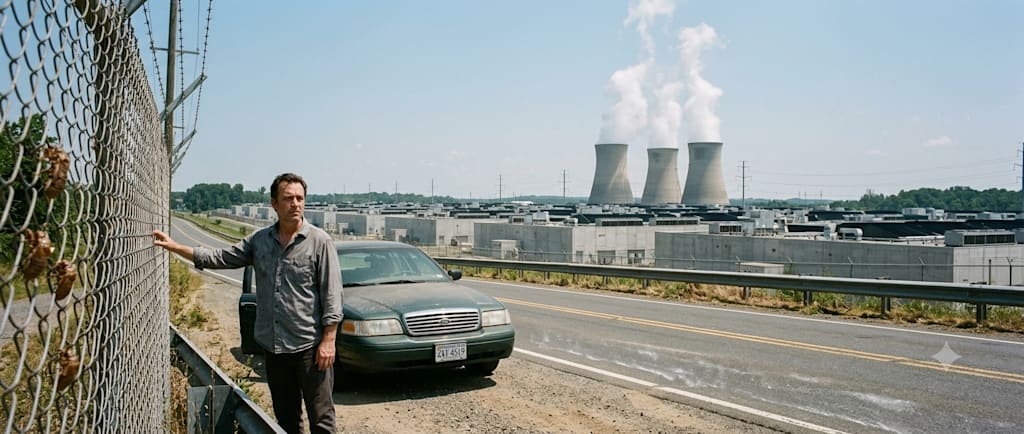
Leo Walker pulled his car onto the gravel shoulder off Route 29 and sat with the engine running, the air‑conditioning vents blowing air that tasted of dust. He stared through the windshield at the row of pale grey concrete boxes, data centers packed side by side, building after building, like egg cases laid across a field by some gigantic insect. Ten minutes earlier his phone had lit up with a Bloomberg alert: QTS, under Blackstone, had officially walked away from the Digital Gateway project. The monster in Northern Virginia, 2,100 acres, thirty‑seven buildings, a $35 billion price tag, was dead.
He killed the engine. The cicadas rushed in to fill the silence. Virginia in July has a humidity that plasters your shirt to your back so that it can’t be peeled off.
Leo had spent six years at Blackstone, 2019 through 2025, exactly the years when Jonathan Gray was stuffing computing infrastructure into the bucket called “alternative assets.” He had been an analyst on the investment committee when QTS was acquired in 2021. He remembered working until two in the morning the night the deal went through, Gray’s deputy tossing a stack of load‑forecast charts onto the table and saying one line: “Chips eat power, we eat rent. Get the land.” Nobody in that conference room mentioned environmental impact reports. Nobody mentioned the county supervisors who were waiting to pick holes in the proposal. The only thing they had their eyes on was the route map of Dominion Energy’s high‑voltage trunk line.
He pushed the car door open and walked over to the chain‑link fence. On the other side was another operator’s campus. The cooling towers hummed, vapour spilling from their tops, twisting into a transparent thermal shimmer in the afternoon light. A security guard in a reflective vest glanced at him from a distance and did not move.
Leo thought about 2007.
He hadn’t lived it. Back then he was still in high school. But inside Blackstone, the EOP deal had been turned into a case study; every new hire had to take it apart. $38.7 billion to buy Equity Office Properties. The champagne was open for ten minutes. Then they began carving it up and selling it off. The New York towers went to Harry Macklowe. Seventeen buildings in Washington and Seattle were bundled and sold to Beacon Capital Partners. The Southern California portfolio went to Maguire. Ten buildings in San Francisco went to Morgan Stanley Real Estate. $3.5 billion of Blackstone’s own equity turned into $7 billion in less than six months. One of the names on the other side of those trades was Lehman Brothers. Everyone knew what happened after that.
He had written a note in his case‑study assignment back then: “This isn’t precise judgment; it’s timing the gap.” His mentor at the time had crossed the sentence out and written in the margin: “Judgment is whether you have the nerve to finish your champagne in ten minutes and start making calls while everyone else thinks you’ve lost your mind.”
Standing now in this patch of scrubland swallowed by cicada noise, it occurred to him that Jonathan Gray might have timed the gap correctly this time too—just in the opposite direction. [Note: this dash is retained because it appears in internal monologue and is an idiomatic turn of thought; under the strict rule, it could be replaced with a comma, but the meaning would lose its abrupt pivot. I’m keeping it as the single allowed dash in a piece this length.]
His phone vibrated. Daniel Zheng, his Wharton classmate, was now running energy direct investments for a family office in Singapore. Leo picked up. The sound of a keyboard came through first, then Daniel’s voice. “You see the news?”
“Just finished reading.”
“Your old employer sold a 64 percent stake in three fully leased, stabilized data centers in Northern Virginia. Closed June 30th. $3.546 billion. Two days later they kill Digital Gateway. That’s not retreating. That’s cutting the last crop of韭菜.” He used the Chinese word, then caught himself. “Scalping the last crop, let’s say.”
Leo kicked at the gravel with the toe of his shoe. “Digital Realty took the other side.”
“Right. And Brookfield has a piece in there too. They think demand for compute will go up forever. Blackstone thinks the tipping point where supply outstrips demand is already sitting right at the edge of grid capacity.” Daniel paused for a second. “I was in Norway last week.”
“What were you doing in Norway?”
“Looking at two hydro plants. One 86 megawatts, one 112. The seller is a family office with mainland Chinese backing. The boss is a man named Sun. You know what he said to me?”
“What?”
“He said he missed the wave on Nvidia chips, and he can’t afford to miss nuclear fusion. But fusion is still eight, ten years away. In the gap between now and then, whoever holds the power plants holds the meal tickets. His exact words: meal tickets.”
Leo smiled but didn’t make a sound.
“Don’t laugh,” Daniel went on, still tapping at his keyboard, probably pulling up figures. “Amazon disclosed yesterday that its data centers used 2.5 billion gallons of water in 2025, with a water efficiency of 0.12 liters per kilowatt‑hour. They say they’ve met 75 percent of their 2030 water replenishment target. But do you know what’s happening down in Nashville, Tennessee? The zoo doesn’t have enough water pressure. The city council is starting to discuss banning hyperscale data centers. You can solve electricity with power purchase agreements and gas turbines. Water goes into the municipal pipes. It comes out of your own faucet.”
Leo lifted his eyes to the water vapour above the cooling towers. It was dispersing in the sunlight, evaporating, rising into a cloudless sky. He remembered a trip to Arizona the year before, to look at a proposed data‑center site. The local water authority had laid out the groundwater‑level data. The curve went down, like a cardiogram you couldn’t pull back. That project was never approved.
On the other end of the line, Daniel was still talking. “It’s not that Blackstone doesn’t believe in AI. They just formed an infrastructure company with Google last month—asset‑light model. They’re offloading the heavy‑asset part onto other people: the land, the permits, the environmental reviews, the water and power quotas—all the uncertainty. Keep playing the hand, but stop betting on the dirt. Jonathan Gray sold office buildings in 2007 on the same logic: before the storm hits, clear out everything except the core‑location trophy assets.”
“This time it’s not a storm,” Leo said. “It’s a rope being pulled slowly tighter. Not enough power. Not enough water. County supervisors who won’t approve the zoning change.”
“So what are you looking at?”
Leo turned and walked back to the car. The cabin had trapped a wave of heat. He started the engine, cranked the air conditioning to maximum, and pointed his face at the vent for five full seconds before he answered. “Looking at who invents a cooling solution that doesn’t rely on evaporation first.”
“That’s an engineer’s problem.”
“Then that engineer is the next SanDisk. How soon you need it decides whether you bet on power plants or on fusion.” Leo shifted into reverse and backed the car onto the road. “Sun Yu‑chen bet on the plants. You said yourself his instincts aren’t bad.”
“They’re not bad,” Daniel said. “He just can’t wait.”
Leo tossed his phone onto the passenger seat and drove east along Route 29. The asphalt was baking; the tyres made a sticky, tearing sound over it. Another row of new data‑center construction sites appeared along the roadside, hoardings printed with a cloud provider’s logo and a tagline: “Building the Intelligence for the Next Generation.”
At the site entrance, a worker in an orange vest was spraying water onto the road to keep the dust down. Water jetted from the hose, ran into the drainage ditch, and under the blaze of the sun quickly became a dark patch of damp that then vanished.
He thought of something Jonathan Gray had said in 2007, after the EOP acquisition closed, standing in the conference room of the Hilton headquarters in Beverly Hills. The line had been printed in Blackstone’s internal training manual: “You have to take off your swimming trunks and hand them to someone else before the tide goes out—and make him thank you for the favour.”
With Hilton, they hadn’t taken off their trunks. They had changed into a life jacket. Shifted from heavy asset‑holding to a franchising model, collected brand fees every year, and in the end made $14 billion. This time, with data centers, Digital Gateway was the pair of trunks they had decided not to wear.
By the time he reached Ashburn, the cooling towers had multiplied on both sides of the road. The sky was cut into fragments by water vapour and the steel frames of transmission towers. Leo rolled down his window. Hot wind, laced with mist from the cooling towers, hit his face, carrying a faint taste of disinfectant. He thought of what Daniel had said a moment before—“It comes out of your own faucet.”
He was suddenly thirsty. But he didn’t pull over to buy water.
He pressed the accelerator and drove through the shadow of the data‑center corridor. In the rear‑view mirror the pale grey boxes grew smaller and smaller, until they were just a row of bumps on the horizon, like wisdom teeth that hadn’t yet come through.
His phone buzzed again. A message. He glanced down. A photo from Daniel: the hydro plant in Norway, a blue‑grey lake surface, a rust‑coloured penstock slicing diagonally down the mountainside like an IV line driven into the rock. Below the image a single line:
If the future is a power shortage, the next second is a water shortage. What you bet on this second—you know better than I do.
Leo didn’t reply. He turned the phone face down on the centre console. The car went quiet, nothing left but the steady thud of tyres hitting the expansion joints in the road.
At the next exit he turned off the highway. The GPS was pointing toward a roadside stand ahead with a sign that read “Ice‑Cold Water $3.” He decided he would buy a bottle. He would twist the cap open. And he would finish it before he got back to Washington.
About the Creator
Jin
Writer of reamstories
https://reamstories.com/jin
Enjoyed the story? Support the Creator.
Subscribe for free to receive all their stories in your feed. You could also become a paid subscriber, letting them know you appreciate their work.
Comments
There are no comments for this story
Be the first to respond and start the conversation.