
The $30 Trillion Mirage
Anthropic wants you to believe AI can swallow twelve tech industries whole. The math—and the fog over San Francisco—tells a very different story.
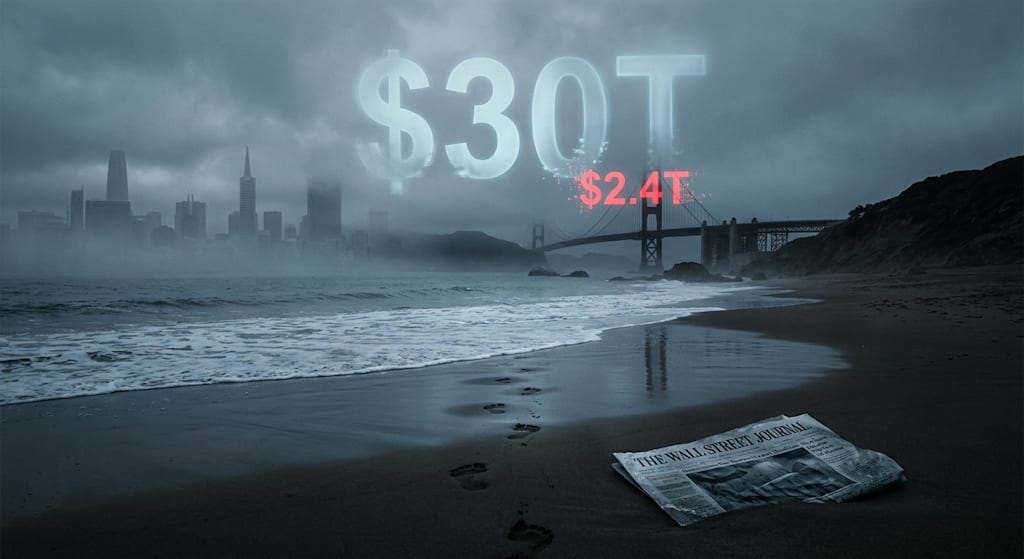
The $30 Trillion Prospectus and the September Fog of San Francisco
On August 25, 2026, the Wall Street Journal leaked a number that, if it had come three months later, would have landed straight in Anthropic’s S‑1 appendix. People close to the matter said the Claude developer is telling potential investors its total addressable market (TAM) exceeds $30 trillion.
No exclamation point needed. One comparison does the work: all 191 tech companies in the S&P 1500 combined for $2.4 trillion in revenue last year. Thirty trillion means Anthropic believes it could, in theory, eat the sum of twelve entire tech industries. The catch is “in theory” carries no weight—and TAM was built to make “in theory” sound like “in math.”
This isn’t the first time someone stuffed the universe into a spreadsheet.
SpaceX’s pre‑IPO TAM in 2025—treated as gospel by bankers—remains a dark‑comedy classic in valuation history. Of its $28.5 trillion pie, $26.5 trillion came from AI: $22.7 trillion in “AI enterprise applications,” $760 billion in “AI consumer subscriptions,” and $600 billion in “AI digital advertising.” The remaining $2 trillion was space: $1.61 trillion for Starlink broadband and mobile, plus $370 billion for “space‑enabled solutions.”
Aswath Damodaran, the NYU professor who makes a living tearing apart valuation contraptions, said only that it “has touched the boundary of reasonableness and is beginning to break through it.” In plain language: you’ve counted everything that happens after a Mars landing, and not a single screw has been driven into Martian soil.
Anthropic didn’t even bother with Mars. Its logic: if an AI model can theoretically do a job, the GDP attached to that job goes into TAM. No time horizon. Give it 100 years, factor in 5% annual dollar depreciation, and $30 trillion starts to look conservative. Using inflation and eternity to inflate valuation is a more sophisticated legal hallucination than outright fraud.
So why the rush?
The calendar answers that. The Financial Times had already hinted on August 13 that Anthropic expects an October IPO at a $2 trillion valuation, potentially breaking SpaceX’s $86 billion fundraising record. Over at OpenAI, the CFO told an all‑hands that the target is 2027—“but sooner if growth accelerates.” Those two words—“sooner”—expose the anxiety running through the industry.
That anxiety comes from three concrete pressures, not vague feelings.
Compute bills fall due every quarter. Nvidia H100 rental prices softened in Q2 2026, but top players still spend over 80% of revenue on capital expenditure. Burn rate waits for no one, and the public market’s door is wider than the private one.
The July crash in AI stocks was no accident. It was a stress test. Wall Street needed a sharp swing to measure retail’s capacity to absorb supply—and the test passed (the bounce came). So larger blocks must be unloaded before the next test. That’s trading‑desk calendar logic, not conspiracy.
The quietest pressure: much of the AI infrastructure debt was built on high‑interest short‑term paper that must be repackaged and transferred before the end of 2026. An IPO is not the finish line. It turns rigid balance‑sheet liabilities into elastic losses on retail accounts. They ran this play in 2008, calling it CDOs. Today it’s AI compute REITs.
Cross the Pacific, and the temperature shifts entirely.
While Anthropic counted zeros in its TAM, a Shenzhen‑based AI vision company, in its IPO filing, anchored revenue growth on “reducing false‑positive rates on steel mill inspection lines to 0.3%.” A Beijing large‑model firm, rumored to be starting its own listing process, gave its longest public talk in early 2026 the title: “Output Efficiency per FLOP.” No one shouts $30 trillion there, because their customers bill in fractions of a cent per thousand tokens.
That’s not modesty. It’s a different survival rule. The U.S. capital market’s TAM game needs an infinite sink for money already burned. China’s AI sector, having missed the “unlimited leverage” frenzy over the past two years, got pushed back to the oldest business logic—you save your client money first, then take a cut from what you saved. That logic won’t produce a $30 trillion slide deck, but it does produce renewal contracts.
Back to that number.
If $30 trillion supports Anthropic’s $2 trillion offering price this autumn, the underwriters will call it “AI’s iPhone moment.” But the iPhone sold physical glass and aluminum in 2007. Anthropic today sells the total value of every workflow that could ever be automated. Between them lie twenty years of discounted cash flows—and an inevitable liquidity contraction.
September roadshows. October pricing. November lock‑up expirations. The calendar is explicit. When the underwriters finish counting the last zero in that prospectus, outside the window sits San Francisco’s September fog—the same kind that appeared in March 2000, when the Nasdaq touched 5,000 and everyone said “this time is different.”
After the fog lifts, the footprints on the beach remain, but the tide has receded far. Thirty trillion won’t vanish. It will become a footnote in the next bubble narrative—proof that at the height of monetary hallucination, people once took the trouble to put a price tag on the universe, with utter seriousness.
About the Creator
Jin
Writer of reamstories
https://reamstories.com/jin
Enjoyed the story? Support the Creator.
Subscribe for free to receive all their stories in your feed. You could also become a paid subscriber, letting them know you appreciate their work.
Comments
There are no comments for this story
Be the first to respond and start the conversation.