
THE $2,500 COMPROMISE
Apple cut Face ID and the telephoto lens to build the ultimate foldable. Was it worth it?
There are fewer than two weeks to go until 1:00 a.m. on September 10.
The lawns at Apple Park have already been mowed three times. Security barriers are going up around the Steve Jobs Theater. Two extra cleaning shifts have been added to the campus schedule. A note beside the coffee machines in the cafeteria reads, "Extended hours until 2 a.m. starting Wednesday." The staff who go through this every September are now in that peculiar state: everything is ready, yet something still doesn't feel quite ready.
In some unremarkable office building somewhere in Cupertino, a team has spent the last four years tearing down hundreds of rival foldables. Samsung's hinge‑wear test reports, Huawei's screen‑crease lab data, Google's every patch note for Android large‑screen interactions—these documents have filled several shared hard drives. What they are trying to do is something this company hasn't done in a long time: build a phone from scratch in a race that others have been running for seven years.
As of the end of August 2026, only two things are certain about this device. First, it exists. Second, it will not be a phone that "everyone will love."
Passport
If you saw the internal prototype codenamed "V68" in the winter of 2025, the most unusual thing you would have noticed is that when closed, it doesn't look like a phone. It looks more like a passport.
120.6 mm long, 83.8 mm wide. Unfolded, the main screen measures 7.7 inches diagonally, with a resolution of 2713×1920 and 428 PPI. The outer screen is 5.5 inches, 2088×1422, 460 PPI. Both panels come from Samsung's LTPO OLED production lines, and Apple has signed an exclusivity agreement: Samsung's own Galaxy Z Fold 8 cannot use the same display.
These numbers mean nothing on their own. But if you overlay them, you see an obsession that has been repeatedly calibrated: the aspect ratio is roughly 3:2, close to 4:3.
What does that mean? Unfolded, what you hold is proportionally more like an iPad mini than a stretched‑out phone. Apple didn't choose the "cinematic" ratio common among Android foldables, because on that ratio, when you view documents, webpages, or email lists, you always have empty margins on both sides. 3:2 is the legacy of the iPad—Apple's smallest common denominator for "content should be presented whole."
When closed, it is wider and shorter than the Galaxy Z Fold 8. That means it won't poke your ribs when placed in the inside pocket of a suit, and when you pull it out of your trousers, it won't get caught on the fabric. Those unspoken, everyday anxieties about "carrying this thing with me all day"—Apple spent four years grinding them down on CAD drawings.
The word "portability" will appear only once during the keynote, but for that one appearance, the entire design logic of the phone has been rewritten from the ground up.
What Got Cut
On Cupertino's decision tree, some branches are sawn off at the root.
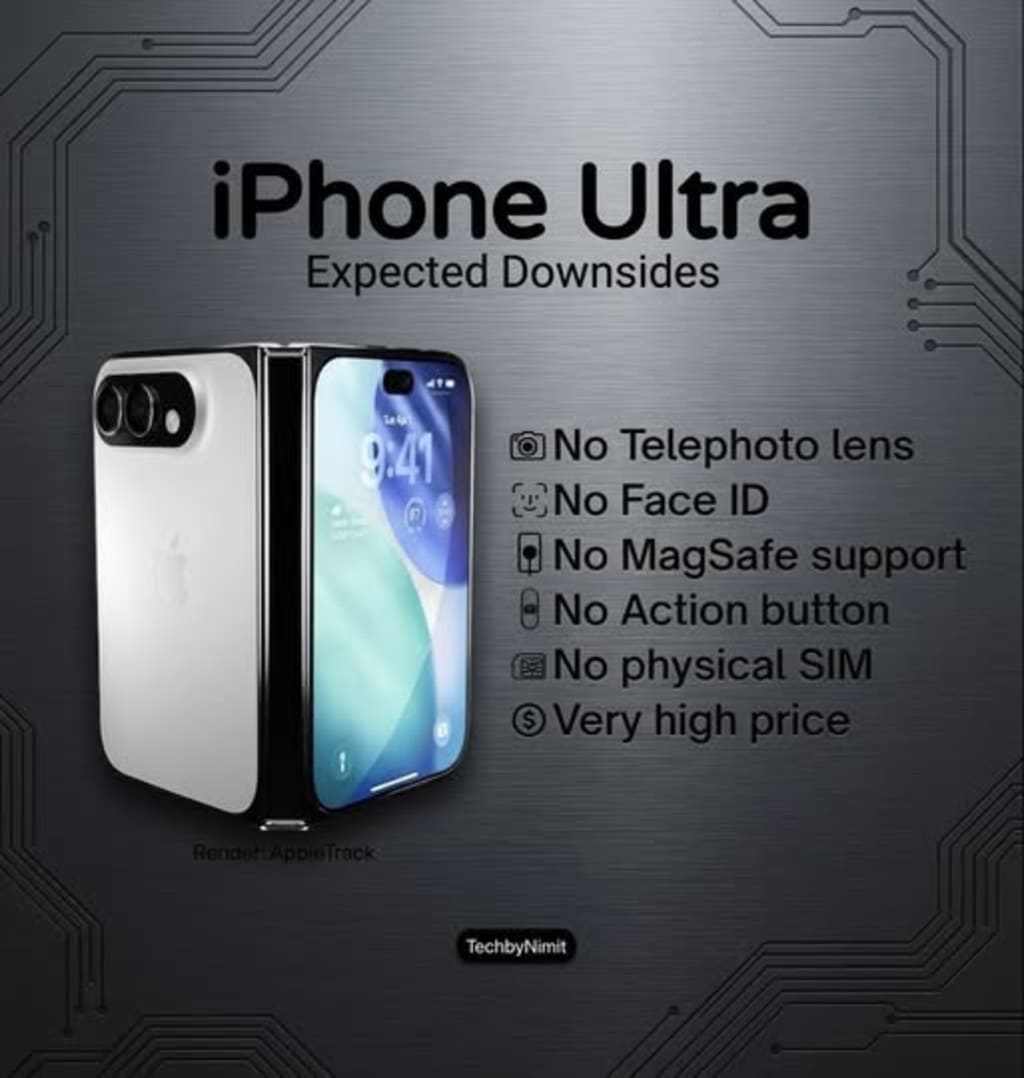
The first to go is Face ID.
Since the iPhone X introduced facial recognition in 2017, Apple has never stepped backward on its premium product line. For eight years, you've grown accustomed to the sequence: pick up the phone, the screen lights up, swipe up—no pause between those actions. The Face ID sensor array—infrared camera, dot projector, flood illuminator—occupies a fixed physical space at the top of the screen. That area was called the "notch," later compressed into a "pill," then hidden under the display. But it was always there.
On the foldable, there's no room for it. When folded, the device is only 4.5 mm at its thinnest point; when unfolded, the depth behind the screen is insufficient to house that entire optical module. To meet the specification of "overall thickness no more than 9.5 mm when closed," engineers compressed internal space to the point where every 0.1 mm had to be simulated for thermal airflow. The Face ID module simply wouldn't fit.
It is replaced by Touch ID integrated into the side power button.
That means your unlocking gesture changes: from "glance at it" back to "touch it." For Apple, this is a cost—not progress, not regression—paid for the foldable form factor. They chose to pay it and to offer no explanation.
The second thing cut is the periscope telephoto lens.
Only two cameras on the back. Main 48MP, ultrawide 48MP. No third lens. Not the one that gives you 5x optical zoom on the iPhone 18 Pro.
Supply chain manifests have confirmed this configuration. The most expensive components in the entire phone—the screen that can fold over 200,000 times, the liquid‑metal hinge, the A20 Pro chip built on TSMC's 2nm process—already occupy the top lines of the bill of materials. The camera module falls further down the list. With limited space, Apple chose to keep the camera bump as small as possible, because when folded, the two screen halves press together; any protrusion would widen the gap, inviting dust, uneven hinge stress, and irreversible damage to the display over repeated folds.
You lose a telephoto lens. What you gain: a phone that, when folded, leaves no gap between the two screens, thin enough to shame any other foldable on the market. Apple is betting that you will accept that trade.
Battery
5,400 to 5,800 mAh. The largest battery Apple has ever put in a phone.
When that number surfaces, engineers on the Android side might chuckle—foldables with 6,000 mAh or more are already out there. But Apple's battery capacity has never been directly comparable, because the power‑efficiency curve of the A‑series chips lives on a different chart from Android flagships. TSMC's 2nm process increases transistor density, meaning the same computational task consumes roughly 15‑20% less power than the previous generation. Add to that the LTPO display's adaptive refresh rate, which can scale from 1Hz to 120Hz without steps, and this nearly‑8‑inch giant consumes almost no power when showing static content.
Range anxiety on this phone is handled not by "stuffing in a bigger battery," but by "making every milliampere‑hour go further."
Apple's second‑generation in‑house C2 modem also debuts here. That means a complete removal of the physical SIM card slot. Whether the Chinese mainland version will support eSIM and when carriers will enable the service are questions that will only be answered after the keynote—but the hardware direction is locked: no more pinhole for a SIM tool, no more swapping cards, and signal strength controlled by Apple‑designed RF front‑ends.
This will certainly stir debate after launch. Someone will tweet, "I still need a physical SIM when traveling to remote areas." Someone on a forum will ask, "What if the eSIM fails?" Apple's typical response to such voices is only one: make the next generation's signal test reports look better, and keep moving forward.
The Crease
Every foldable phone faces one problem: the crease down the middle of the screen.
The Android camp's evolution over the past seven years can be roughly summarised as: from "so obvious you can feel it with your fingernail," to "you can feel it but barely see it," to "almost imperceptible under normal viewing angles." At this step, Apple chose a more expensive route—liquid‑metal hinge.
This is a non‑crystalline alloy, 2.5 times stronger than titanium, but without titanium's brittleness. Using it in the hinge structure means that with every fold and unfold, the deformation on the internal gears and springs is kept to an absolute minimum. The screen's bending radius is larger and gentler; the stress concentration at the crease is distributed across the entire curved area, rather than along a single fixed line.
Cross‑verified sources from multiple supply‑chain leaks suggest the crease depth on this device will be kept below 0.15 mm. What does that mean? When you run your finger across the centre of the screen, your tactile sense will almost never tell you "there's a groove here." Visually, under normal office lighting, indoor ambient light, or overcast outdoor conditions, the crease won't actively jump out to remind you that "this is a foldable."
If you deliberately tilt it at 45 degrees under harsh direct light to look for it, of course it's still there. Physics doesn't suspend its laws just because Apple makes a phone. But for ninety percent of daily use scenarios, it disappears.
That is probably Apple's biggest contribution to foldables—not eliminating the crease, but pushing it to a point where you only notice it when you're specifically looking for it. Compared to Android vendors' pursuit of "completely invisible," this goal sounds more modest, but they have achieved it.
The List of Compromises
Lay out all this information, and the compromises on this phone look more striking than its innovations:
No Face ID—the first absence on a premium iPhone in eight years.
No telephoto lens—camera specifications fall below the same generation's Pro series.
Starting price around $1,999–$2,500—the Chinese mainland version is pegged at around ¥15,000, making the cheapest foldable iPhone also the most expensive iPhone ever.
Apple's internal team knows exactly what these three things mean. Microsoft's first‑generation Surface Duo didn't even have a rear camera, and it was marked down to 40% off four months after launch. People willing to spend over $1,500 on a phone are far more sensitive to camera performance than mid‑range users. This is a rule repeatedly validated in the consumer electronics market.
But Apple went ahead anyway. Not because they are unaware of that rule, but because they have stronger faith in another one: if you push the foldable form itself to the extreme, people will redefine what they want.
This is a high‑stakes gamble, but Apple has never been the first to the table. They simply waited for others to play seven rounds, saw which cards win and which lose, and then sat down with a new hand.
Software
Information on the software side is almost entirely blank at this point. iOS 27's specific interaction design for the foldable has not leaked; outsiders can only imagine it based on Apple's eight years of iPad multitasking experience.
What is certain, however, is that when you unfold this device, what you get is not a "bigger iPhone" but an "iPad that fits in your pocket." This is not wordplay—it is a fundamental difference in software ecosystem.
The problem with Android foldables has never been hardware; it's app adaptation. As of the end of 2025, the proportion of apps on the Google Play Store labelled "optimised for large screens" was roughly just over 60%. The remaining 40%—including some mainstream apps with hundreds of millions of daily active users—either stretch violently, leave blank margins, or simply refuse to go landscape when unfolded. Developers have little incentive to adapt specifically for a device that accounts for less than 3% of sales.
Apple's situation is entirely different. All apps in the App Store that have been adapted for iPad—according to Apple's own data, that's roughly 70% of the top eight million apps—can run natively on this 7.7‑inch, 4:3 screen without any extra work from developers.
That means on keynote day, when Tim Cook (or the new CEO, John Ternus) pulls the phone from his pocket, opens it, and demonstrates split‑screen multitasking, the audience will see a mature ecosystem—not a "coming soon" promise.
Split‑view drag‑and‑drop, app handoff, seamless switching between inner and outer screens—these features have been refined on the iPad for more than five years. Now they are compressed into a foldable device. The interaction logic requires no relearning; muscle memory carries over directly. This is probably Apple's most subtle but lethal advantage over every Android competitor.
Color
The final suspense may be surprisingly simple: color.
Classic black and white are confirmed for the initial lineup. But supply‑chain movements over the last two months suggest a growing possibility of a third colour—something close to dark red, internally referred to as "dark cherry red."
The interesting backdrop: in the third quarter of 2026, the new flagship models from two major Android vendors also happen to feature red‑centric shades. If Apple unveils a dark‑red foldable iPhone on September 10, it will be the most delicate "coincidence"—or the most restrained declaration of intent—in the smartphone industry this year.
A dark‑red body paired with a stainless‑steel frame, under keynote lighting, will present a hue somewhere between burgundy and deep brown. It is not loud; it's not that "look at me, I bought a new phone" bright colour. It is more like the inner lining revealed beneath a dark suit—you see it, but you wouldn't bring it up at a first meeting.
This fits the device's overall character: expensive, restrained, dismissive of explaining its own expensiveness.
The Wait
Less than two weeks to go until the keynote.
By tradition, Apple will send supplementary briefing notes to the media about a week before the event, confirming the live stream link and the embargo time for press releases. But until then, everyone reading this—including you and me—can only piece together the device's appearance from those leaked data points, those supply‑chain shipping manifests, and those analysts' predictions "based on reliable sources."
This may be Apple's riskiest product since the iPhone 4 in 2010. That year, the antenna‑gate scandal forced Steve Jobs to say at a press conference, "You can just hold the phone differently." Fourteen years later, if this foldable iPhone stumbles on any one of the crease, the battery, or software adaptation, the new CEO Ternus will face a crisis even bigger than antenna‑gate.
But if it succeeds—if that crease really is "invisible to the naked eye," if that screen genuinely elevates email and document reading by more than an order of magnitude, if that iPad‑derived interaction logic truly transforms "fold" from gimmick to everyday reality—then the entire foldable market will have its "iPhone moment."
After the iPhone 4 launched in 2010, Nokia and BlackBerry took about two years to realise they had been left behind. In the 2026 foldable market, Samsung and Huawei will not be out, but they will face a completely different landscape: a competitor with an ecosystem of 200 million actively used devices, carrying a phone that makes no functional compromise (well, except for telephoto and Face ID), only a form‑factor optimisation, and begins eating away at the most profitable tier of foldable users.
Those users don't mind spending an extra five hundred dollars. What they care about is: closed, it fits into the inside pocket of a suit; opened, it handles email and documents smoothly; and in between, no crease reminds them that "this is new technology."
1:00 a.m. Beijing time, September 10. When that screen lights up, all suspense will end.
Until then, all discussion remains discussion. All anticipation—and all anxiety—hangs in the air.
The wait has its own meaning: some details are simply too big for Apple to allow a leak, and some are too uncertain for even the best analysts to call with conviction.
Less than two weeks.
That screen will light up.
About the Creator
Jin
Writer of reamstories
https://reamstories.com/jin
Enjoyed the story? Support the Creator.
Subscribe for free to receive all their stories in your feed. You could also become a paid subscriber, letting them know you appreciate their work.
Comments
There are no comments for this story
Be the first to respond and start the conversation.