
The 1985 Message Board Where Strangers Learned to Care
Before feeds and likes, a dial-up community called The WELL showed that words on a screen could become relationships.
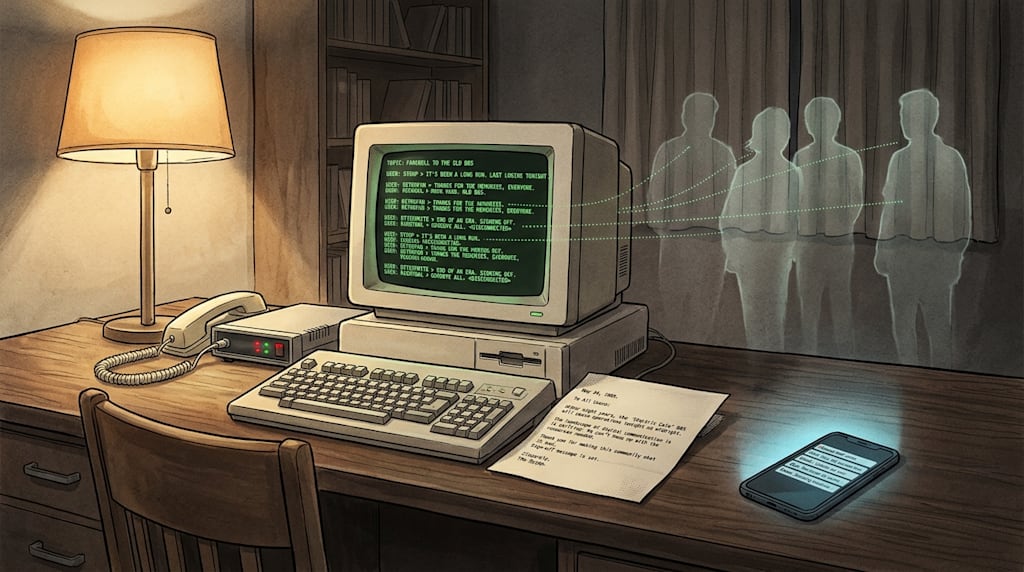
In 1985, going online meant accepting hassle. You plugged the phone cord into a modem, listened for the dial tone, and waited for words to crawl across the screen. The line stayed busy. Family members could not call out. For a small group, the hassle was the door. They joined a dial-up bulletin board called The WELL, short for Whole Earth 'Lectronic Link. Stewart Brand and Larry Brilliant started it in 1985. Members entered conference areas and talked about technology, politics, books, and their own lives.
People lived far apart. They still entered the same conversation. They argued, traded ideas, made friends, and got used to people they had never seen. Howard Rheingold was one of them. He joined in August 1985, when only a few dozen people were online with him. Later he said the discussions ate into work and personal time. He stepped into other people’s interests. Other people’s questions pushed against his assumptions.
In 2005, Rheingold wrote about Kevin Kelly, then editor of Whole Earth Review. Kelly used The WELL to find topics and writers. The internet was not yet a large information system. For Rheingold, it was a small group of people who wanted to talk. The value came from the people in the conversation.
Once, Rheingold sat in a face-to-face discussion about The WELL. Someone said people who talked through computers were isolated and could not form decent relationships. Rheingold disagreed. He said The WELL worked like a community. Kelly told him to write that down. In 1987, Rheingold published an article about virtual communities. Five years passed before a publisher accepted a book on the subject. At the time, many people did not take the idea seriously: ordinary people could build relationships through computers.
Rheingold did not simply guess what the internet would become. He ran into something the communication assumptions of his time could not explain. The people on the other side of the screen were not only information sources. They took part in a shared environment. That environment had rules.
One rule was “You Own Your Own Words.” Members had to answer for what they posted. Complete anonymity was not allowed. A post belonged to the person who wrote it. You could disagree with someone’s background, job, or looks, but disagreement did not erase responsibility. A statement could be questioned, remembered, and pulled into a later conversation. The written record stayed.
That meant people had to read one another without many signals. No facial expression patched a sentence. No tone of voice separated sarcasm from hostility. No room explained the relationship. Meaning had to come from the words. The setup was flawed. People misread one another. Arguments heated up. The community set standards for behavior. Technology did not make The WELL a utopia. It was a social experiment, and it depended on members keeping the place working.
Over time, the conversations carried more than talk. Members shared births, relationships, and hard periods. Some supported one another through illness. Some friends stepped out of the screen and met. In 1995, a longtime member named Tom Mandel was dying of cancer. He did not vanish from the community. He wrote a farewell letter to people he had spent years arguing with, thinking with, and building relationships with. The letter said leaving the community made him sad. He said goodbye to people, not to usernames or threads.
Mandel wrote that letter while dying. The relationships had grown mostly through text. The feelings behind them were not fake. Distance did not stop people from becoming part of each other’s lives.
The WELL did not need complex equipment. By modern standards, the setup was simple. A community does not need people to live nearby. It needs participation, memory, recognition, and some responsibility toward others.
Today, communication takes little effort. You can join thousands of groups, post an opinion at once, and talk to strangers across the world. Easy communication does not create relationships. An audience can watch without joining. A community requires people to remember one another, answer one another, and accept that words have consequences.
Early WELL members used a slower internet with fewer people. Participation cost time. The setting was small. Relationships could last. Rheingold later recalled the farewell letter again. Its sentences were short. When he finished speaking, he paused, then moved to another subject. The old modem sat on the desk, unused. The phone cord lay looped beside it.
About the Creator
Jin
Writer of reamstories
https://reamstories.com/jin
Enjoyed the story? Support the Creator.
Subscribe for free to receive all their stories in your feed. You could also become a paid subscriber, letting them know you appreciate their work.
Comments
There are no comments for this story
Be the first to respond and start the conversation.