
The 109GB Illusion
Huawei’s new AI doesn’t add storage—it just stops wasting it. Here’s how.
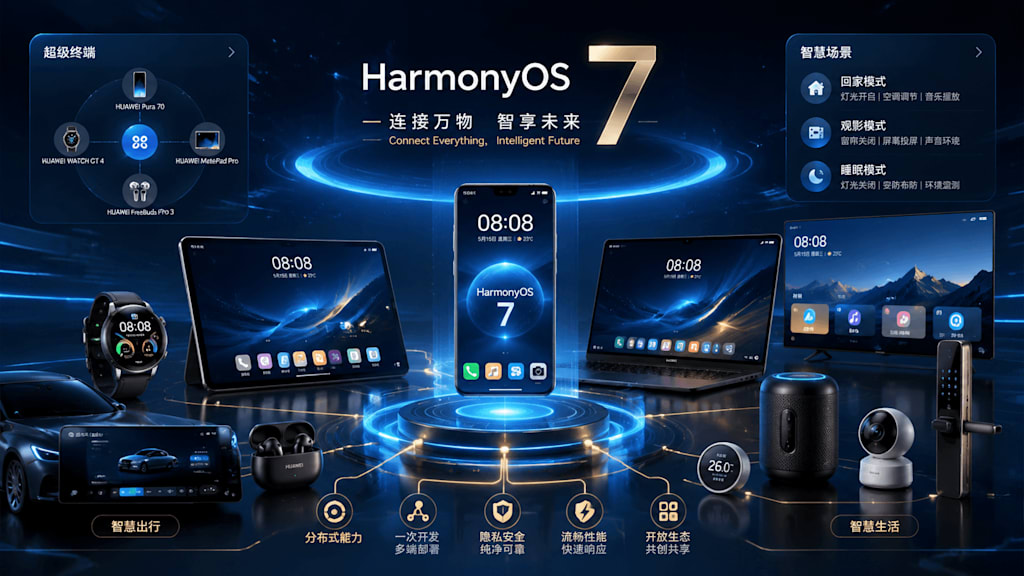
HarmonyOS 7’s Ultra‑Space Storage: Gimmick or Breakthrough?
A 1 TB phone can free up to 109 GB of storage after upgrading to HarmonyOS 7. That is the headline. The real question is how.
The answer hinges on two operations: deduplication and compression.
You take a photo, share it to a family group, save it to a memo, and later send it to a friend via Huawei Share. In a traditional file system, that same image occupies three separate physical copies on the flash chip. Ultra‑Space merges these into a single master file; the other locations become lightweight pointers. Every app still shows the full image, but the storage chip holds only one copy.
Then there is compression. Some files are rarely used—chat logs from six months ago, old update packages, or assets from a game you finished long ago. The system labels these as cold data and applies lossless compression. When you need them again, it decompresses in milliseconds, and your foreground interaction never notices the lag.
These are not exotic ideas. What makes them work at scale is the performance model embedded in the Ark Storage Engine, trained on two billion data samples. It decides which files to deduplicate, what to compress, and when to run these tasks without interrupting a game or a video stream. The system provisions proactively rather than reacting after the fact.
The official numbers are straightforward:
256 GB devices gain up to 22 GB.
512 GB devices gain up to 51 GB.
1 TB devices gain up to 109 GB.
Lab conditions produce the upper bounds. A typical user can expect 70 to 80 percent of these figures. Even at that discount, an 80 GB recovery on a 1 TB device is enough to store a 4K copy of Oppenheimer without deleting a single personal photo.
The benefit is sharper for older 256 GB models. Mate 60 series users receive the update in October. These two‑ or three‑year‑old devices often run on less than 5 GB of free space. For them, 22 GB is not a luxury; it is an extra year of usable life.
Deduplication and compression are not Huawei inventions. Apple’s APFS uses clone‑based deduplication for copies within the same volume, but its scope stops at that copy operation and does not sweep the entire system. Android vendors rely on UFS 4.0 speed to mask fragmentation. The fragmentation never disappears—the hardware just outruns it.
HarmonyOS 7 differs by welding the capability into the file system and keeping it always active. No clean‑up button, no weekly manual scan. You upgrade, the system runs a background pass overnight, and you wake up with tens of gigabytes reclaimed. That effortless recovery defines a well‑tuned OS better than any animation.
There is a trade‑off. For the first two or three days after the upgrade, you may see higher battery drain and warmer temperatures. The system is re‑indexing and restructuring storage. Huawei’s engineers judged that mild discomfort worth the long‑term breathing room.
This feature is not merely a convenience. From Huawei’s perspective, it acts as a governor for the ecosystem’s inevitable expansion. Native HarmonyOS apps will grow larger—on‑device AI models, high‑precision 3D assets, and multi‑device sync caches all consume space. Without a low‑level mechanism like Ultra‑Space, users would feel pressured to upgrade hardware within two years. Huawei wants the opposite: the longer you use the device, the smoother it becomes.
One layer deeper, the Ark Storage Engine exposes APIs to third‑party developers. Future apps can use this framework to manage their caches and resource bundles. They no longer worry that an app taking 5 GB will get uninstalled. When the system provides the safety net, apps can slim down and the ecosystem can grow organically.
In practical terms, this is a highly polished system‑level implementation rather than a breakthrough in foundational research. Deduplication, compression, and tiering are textbook subjects. Welding them into an OS that runs on 85 million devices, without requiring the user to think about it, is an engineering feat.
In this specific area, HarmonyOS 7 moves more aggressively than iOS, which tends to be slower and more conservative with storage optimization. It also operates more systematically than Android, where vendors still rely on standalone “phone manager” apps instead of integrating the logic into the file system itself.
The simplest verdict: you upgrade, it works, and you forget it exists. A system feature that fades into the background has already succeeded. The best storage optimization is the one that makes you never feel you are running out of room.
About the Creator
Jin
Writer of reamstories
https://reamstories.com/jin
Enjoyed the story? Support the Creator.
Subscribe for free to receive all their stories in your feed. You could also become a paid subscriber, letting them know you appreciate their work.
Comments
There are no comments for this story
Be the first to respond and start the conversation.