
The 10,000-Box Test: Why Humanoids Lose the Warehouse Math
Conveyors, AMRs, and forklifts win on speed, payload, and upkeep. Humanoids make sense only when the environment refuses to change.
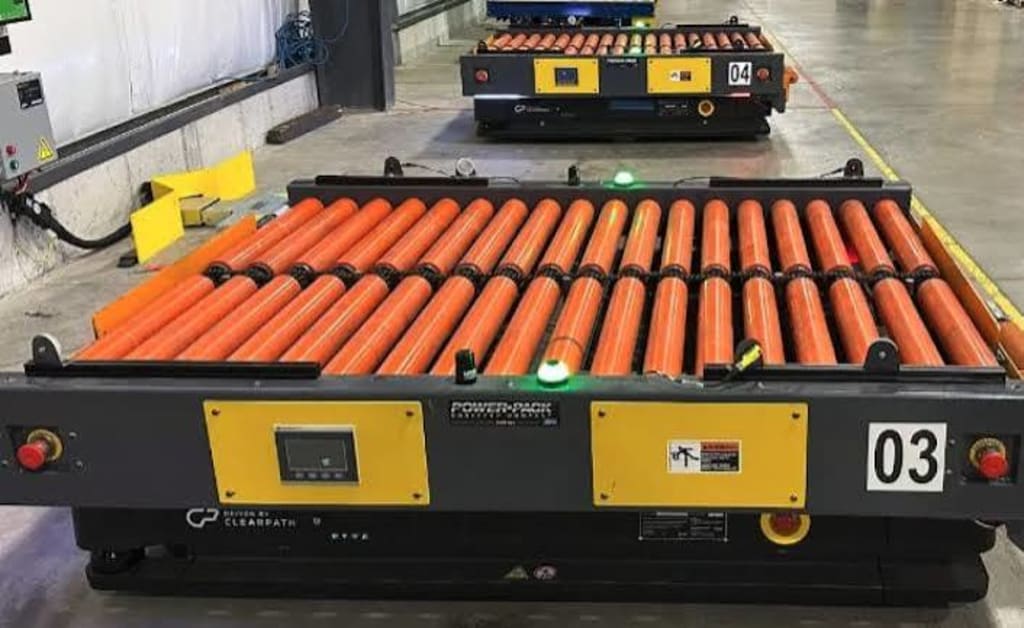
Ten thousand boxes, from Warehouse A to Warehouse B. Straight-line distance: 80 meters. Two roll-up doors in between. Epoxy floor. The task is simple: move them over, stack them, do not drop them.
Ask a logistics engineer and you will get a short list: conveyor belts, roller conveyors, autonomous forklifts, wheeled AMRs, AGVs, or a mobile base with a robotic arm. A humanoid robot will not be first. A humanoid can move a box. The math still fails at the start.
Conveyors run all day, AMRs swap batteries, forklifts lift a ton and a half
Start with the equipment built for the job.
A conveyor runs 24 hours a day. It does not balance. It does not shift its center of gravity. It does not stabilize every step. Power goes into motors and rollers, not into staying upright. Maintenance is simple: replace rollers, tighten belts, clean idlers. A conveyor can run for ten years in a factory and nobody finds that strange.
A wheeled AMR runs on flat ground. It navigates by lidar or QR codes, carries a rack or roller module, swaps batteries once a day, or returns to charge on its own. It does not need legs because the floor is flat. Payload can reach hundreds of kilograms or a ton. Range and cycle time are planned by shift. The maintenance system already exists: wheels, motors, batteries, sensors. If a module breaks, swap it.
An autonomous forklift is more direct. Fork a pallet. Lift 1.5 tons. Turn. Put it in the truck. A driver can sit on it, or it can run unmanned. Load capacity, lift height, and aisle width are designed around the cargo, not around the human body.
A humanoid robot carries a 15-kilogram box, takes two steps, and calculates its center of gravity. Bipedal walking limits payload. Balance control eats battery life. More joints and sensors mean more failure points. Logistics engineering fears unplanned downtime because downtime means waiting lines, late orders, and manual backfill. A humanoid does not go to the doctor and take medicine by itself. Every bit of wear is a cost the boss pays.
For this task, specialized equipment is not a little better. It sits in a different class.
A wheeled base with two arms is more practical than bipedalism
Someone will ask: if you want generality, why not use a wheeled base with two robotic arms?
That question has a good answer in many factories.
On flat ground, concrete, or epoxy floor, wheels do not need balance control. Energy use is low. Range is easy to extend. Payload is easier to raise. Two arms can grasp, load, unload, use tools, and perform fine work. Height and reach can be designed for the job. There are fewer maintenance points, and safety certification is easier.
In warehouses, workshops, laboratories, and restaurant kitchens, a wheeled base with two arms will likely land earlier, more reliably, and at lower cost than a bipedal humanoid. It does not try to look human. It tries to finish the task.
A wheeled mobile manipulator is not omnipotent. Stairs, thresholds, narrow gaps, and unstructured terrain are harder for it. Bipedalism has a theoretical edge there. The problem is the cost of making a biped stable enough to carry cargo, climb stairs, pass through narrow gaps, and avoid twitching in place. The advantage scenarios exist. They are narrow.
Stairs, thresholds, narrow gaps: the scenarios exist, but the math does not add up
The useful place for bipedal humanoids is not carrying boxes on flat ground. It is work where the environment was built for people, and a machine must provide general substitution.
Older factories have stairs. Building services need elevator buttons, doors, and narrow passages. High-mix, low-volume work changes lines often. Some jobs are dangerous, dirty, hot, or cold. Night shifts are hard to staff. Some tasks require human tools and human interfaces.
The common feature: changing the environment costs too much, the tasks are too varied, and specialized equipment does not pay back. A humanoid offers no environment modification and general movement. It does not offer carrying efficiency.
Even there, a humanoid must cross thresholds of stability, safety, maintenance, and cost. A factory may have three staircases, two narrow doors, and one floor that needs an elevator button. Keeping a bipedal robot for those three places does not add up. Embodied intelligence would need to handle many exceptions, generalize across tasks, avoid environment changes, and keep bipedal maintenance cheap. Before that, the robot can look advanced and still fail to produce reliably.
Humanoids are pushed for reasons other than speed
Humanoid robots are pushed for several reasons.
The environment is designed for humans. Door handles, stairs, elevator buttons, shelves, and tools follow human dimensions and two hands. In theory, a humanoid needs no environment changes.
Task generality. The same body can carry, pick, twist, press, push, and use tools. That suits high-mix, low-volume production, temporary tasks, and exception backfill.
Data and software reuse. Human demonstration data, teleoperation, and VLA or embodied intelligence models move more easily to a humanoid form.
Flexible backfill. When hiring is hard, on night shifts, in dangerous positions, or on temporary lines, a humanoid can be piloted as general labor if specialized equipment costs too much to modify.
Brand display and financing narratives also play a part, and so do policy support, technical validation, and data collection.
These reasons hold under conditions. The tasks must be varied enough. Environment changes must be expensive enough. Labor substitution must be urgent enough. Embodied intelligence must be stable enough. If those conditions fail, a humanoid moving boxes in a factory becomes a proof of concept, not a production tool.
Restaurant delivery robots rarely take humanoid form for the same reason. Delivering food to a table is mobility plus a fixed tray. A wheeled robot is optimal. A humanoid is unnecessary. Form should serve the task.
Every item in this bill is paid by the boss
To judge whether a humanoid robot is worthwhile, look at total cost, not only at whether it can do the job.
Depreciation of the robot body. Joints, servos, reducers, and sensors each have a service life. Bipedalism has more joints and more wear points.
Maintenance. A humanoid does not go to the doctor and take medicine by itself. Joint failure or a balance-control problem means downtime plus repair cost. Battery degradation adds to the bill.
Energy. Bipedal walking uses more energy and more control effort. In a 24-hour logistics operation, energy is not a small line item.
Exception handling. What happens when it carries crooked, gets stuck, or drops something? Specialized equipment has a ready clearing procedure. A stuck humanoid may need an engineer on site.
Integration and safety. Safety fencing, human-robot collaboration certification, and insurance all cost money.
Downtime. Logistics engineering fears line stoppage. Every extra failure point on a humanoid adds downtime risk.
Put those costs on one side. On the other side are the cost of replacing labor, savings from avoided environment changes, and flexibility benefits. In fixed carrying work, environment savings are near zero, flexibility benefits go unused, and humanoid costs stay high. The inequality is hard to satisfy.
In high-mix, low-volume, unstructured work that needs hand tools and temporary deployment, no environment modification and general movement may become valuable. That is another ledger.
The forklift driver pushes the last pallet into the truck
Return to the ten thousand boxes.
Lay the conveyor. Run the AMRs. Let the forklift move one pallet at a time. Let the palletizer stack them. A humanoid robot can stand nearby for demonstrations, collect data, and validate general manipulation. Mass production will not wait for it.
The argument favors specialized equipment for fixed carrying. Humanoids can stay in the tool kit for work that needs generality.
The goal is general mobile manipulation. Bipedalism is one way to move. Wheels are another. In flat factories, a wheeled base with two arms will likely land earlier and at lower cost than a bipedal humanoid. For humanoids to make the math work in carrying, embodied intelligence must handle many exceptions, generalize across tasks, avoid environment changes, and bipedal maintenance must drop sharply.
Before that, logistics engineering still cares most about wear, cycle time, reliability, and TCO. Humanoids can be explored. They should not be the default.
The forklift driver pushes the last pallet into the truck, closes the door, and goes for a smoke. The conveyor is still running.
About the Creator
Jin
Writer of reamstories
https://reamstories.com/jin
Enjoyed the story? Support the Creator.
Subscribe for free to receive all their stories in your feed. You could also become a paid subscriber, letting them know you appreciate their work.
Comments
There are no comments for this story
Be the first to respond and start the conversation.