
The $100 Line of Code
What 170 million tokens buy at 3 AM (and why you never see it).
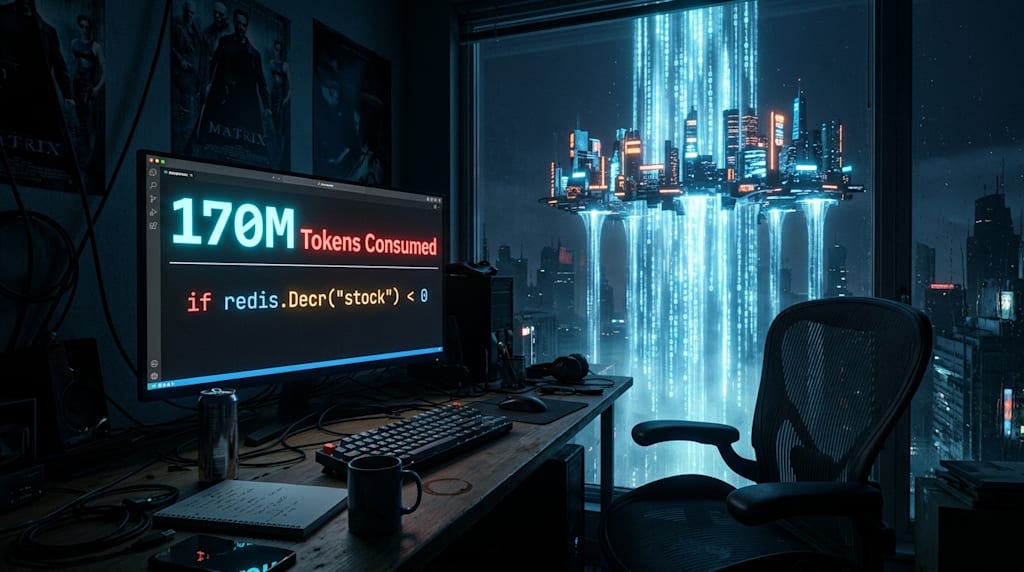
I. The Receipt at 3 AM
The lights on the twenty‑third floor of a Hangzhou office building were still on at three in the morning.
Programmer Zhou Shen stared at the scrolling logs on his terminal. The coffee stain in his mug had dried into a brown ring. He had just sent out a prompt – seventeen Chinese characters: "Fix the inventory oversell issue under high concurrency. Prioritise data consistency."
Over the next one hundred and twenty seconds, his account was debited the cost of three cups of pour‑over coffee.
The terminal finally spat out one line of code:
go
if redis.Decr("stock") < 0 { redis.Incr("stock"); return errors.New("out of stock") }Seventeen characters in. Forty‑five characters out. Zhou Shen sipped from his cup – cold. He committed the line, closed the IDE, walked downstairs, and hailed a taxi home. On the way, he glanced at the bill: tonight's API calls had consumed 170 million tokens.
Outside the window, dim streetlights drifted past. He remembered a question he'd seen online years ago: "Programmers burn tens of millions or even hundreds of millions of tokens every day. What do they actually produce?"
Back then he had no answer. Now, he still couldn't sum it up in one sentence.
But he knew those 170 million tokens were not that forty‑five‑character line. When you see a surgeon sew seven stitches, you don't see the anaesthetist who kept watch for four hours, the nurses who changed three bags of blood, or the monitor's squiggly line that nearly flattened at 2:17 AM. That line of code was the final stitch. The thing that was actually consumed lay between the token counter and the visible output – an entire invisible sea.
II. Forgetting, and the Price of Fighting It
Most people misunderstand token consumption.
They think of tokens like mobile data: you download an episode, you pay for the data, the episode is stored locally, and you don't pay again next time. A large language model's memory doesn't work that way. Its memory has to be fed anew every single time. It's like a patient with severe amnesia. Every time you speak to them, you have to retell your entire shared history from the beginning, so they can catch the one sentence you're handing them now.
After Zhou Shen sent that seventeen‑character prompt, this happened behind the scenes:
On the first call, the system stuffed in "You are a senior back‑end engineer," the list of available tools, the database schema, and Zhou Shen's question. The model spat out a thought chain and a plan. The plan failed. An error.
On the second call, the system stuffed in "You are a senior back‑end engineer" again, the tool list again, the schema again, Zhou Shen's question again, the first thought chain and plan again, and the new error message – all of it. The model spat out a second thought chain and a revised plan. On the third call, everything from the first two calls came back, all over again.
Zhou Shen watched the scrolling logs and knew this tug‑of‑war was only beginning. Truly complex problems never resolve in three calls. A distributed transaction issue can drag on for dozens of rounds. A trace across multiple microservices might take more than a hundred.
By the hundredth call, the system prompt from the very first call had been repeated ninety‑nine times. Zhou Shen's original question had been repeated ninety‑nine times. Every thought, every error stack trace, every file name read, every intermediate output – all stacked together like a book that grows thicker with every page. To read the new page, you have to recopy every previous one.
This is nothing like a chat. When you talk to ChatGPT, the context only holds your back‑and‑forth conversation. On the programmer's side, the context crams in system role definitions, full tool function signatures, dozens of code snippets, complete error logs, intermediate step outputs, and test execution results. All of that piles up, making each API call fatter than the last.
Token consumption is not additive. It is multiplicative. Each call carries the entire payload of the previous one, like Sisyphus pushing a boulder that grows larger with every roll.
This explains why the phrase "a ten‑million‑token context" is so often misunderstood. Some people hear "the whole task consumed ten million tokens" – as if that were the total from start to finish. It is not. Ten million refers to the payload of a single API call. A complex debugging task may involve dozens or even hundreds of calls. The average payload grows with each step. The final total is the product of those two numbers.
Zhou Shen is thirty‑two now. He has been a back‑end developer for nine years. He remembers when he first started. Debugging a distributed lock meant flipping through books, reading blogs, and asking the senior architects. There was no token bill back then. There was time. A deadlock issue could take two full days. Saturday afternoons, air‑conditioning off, the fan hum of the server room, squinting at logs line by line – like a hunter tracking prey.
Not anymore. He now compresses two days' work into a hundred‑odd API calls at 3 AM. Those 170 million tokens are a compressed archive of time. The debugging path that used to take two days now runs in one hundred and twenty seconds. The price is the money those tokens burn.
But Zhou Shen does not dwell on the arithmetic. He thinks about something else. Every time he sees the bill, he notices that among those repeated system prompts, one line reads "You are a senior back‑end engineer." At the hundredth call, that line still sits at the top of the context. At the moment closest to a solution, the model still needs to be reminded that it is a senior back‑end engineer.
That strikes Zhou Shen as absurd. But under the current architecture, there is no better way. Forgetting is the model's nature. Fighting forgetting is the programmer's fate. Tokens are the ammunition in that fight. Every shot Zhou Shen fires carries the echo of all the previous ninety‑nine shots.
III. The Output: What You Don't See
If Zhou Shen had to explain to a layperson what those 170 million tokens produced, he would put it this way.
Two people stand in a desert. One sees an oasis in the distance. He runs excitedly, but the sand beneath him is quicksand. Every step sinks him deeper. It takes him an entire day to reach it. The other drives an off‑road vehicle with high fuel consumption. The tank holds the equivalent of 170 million tokens' worth of gasoline. He gets there in twenty minutes and plants a tree. The outsider sees only that last tree, not that the vehicle burned three thousand times more fuel than a normal car.
But why such high fuel consumption? Why can't the car be more efficient?
The engine has no navigation memory. Every time this car accelerates, it has to recalculate the entire route from the starting point to its current position. Every press on the accelerator recomputes the whole road. So the consumption is high.
Then why use this car? Because the quicksand shifts. A path that was safe a second ago may collapse the next. The person who ran for two days may find the oasis already dry. But this fuel‑guzzling monster can reach it in twenty minutes, plant the tree, and then, based on the shifting sand's latest state, decide what to do next.
So what is the output? Not the tree. The output is the ability to arrive before the sand shifts.
That is exactly how B‑end software works. You open an enterprise back‑end system, and it looks no different from three years ago. Same interface, same button positions. Even the response time has not improved much. But three years ago, this system crashed at 1 AM on Double Eleven. Order data was off by a few tenths of a percent. Finance did not spot the discrepancy until three days later. Now it does not crash.
It does not crash because Zhou Shen's tokens walked through those shifting‑sand scenarios ahead of time. Deadlock paths under high concurrency. Database connection pool exhaustion. Cache breakdown moments. Rollback boundaries in distributed transactions. All of these were run dozens of times before Double Eleven, using tokens. Every crack was found, marked, and filled. You see a system that "hasn't changed." What you do not see is the load‑bearing walls underneath, thickened by token‑poured concrete.
So Zhou Shen does not care much whether the interface gets fancier. He knows the tokens he burns at midnight buy something invisible: payments that always match, inventory that never goes negative, coupons that are never claimed twice. These things look like they "should just work." But to Zhou Shen, "should just work" was never a given. It was purchased with tokens.
IV. Why So Little Visible Change?
AI has been around for years. Why has the B‑end not been revolutionised?
Zhou Shen thinks of the operations dashboard at his company. It hangs in the middle of the office, showing the health status of dozens of microservices. Green means healthy. Red means trouble. Since AI arrived, the red lights have become fewer. But if you are a passing visitor, you would not notice. You would just see a sea of green and think, "Nothing special."
The special thing is the green. Green means nothing happened. And nothing happening is exactly what was bought at great expense.
People expect revolutionary change: redesigned interfaces, re‑engineered processes, total replacement of human labour. But when companies buy AI, the number‑one item on their priority list is never "change." It is "no change." No downtime. No data loss. No overselling. No reconciliation mismatches. All those "no"s, added together, are the entire face of the B‑end.
That is not to say AI has not created new value on the B‑end. It has. But it does so by eliminating the bad things that would otherwise have happened. Double Eleven did not crash. Bills did not mismatch. Inventory never went negative. Those "did not"s are blanks on the report and common sense to the user. But Zhou Shen knows that behind every "did not" lies a long token bill.
Sometimes he wonders: if tokens had colour, the server room would be drenched in neon. The heat from the vents would be RGB glow. But tokens have no colour, and the bill is visible only to him.
V. Another Understanding at 3 AM
The taxi cruised on the elevated highway. Zhou Shen leaned back and closed his eyes.
He remembered the first time he touched a large‑language‑model API. The context window had grown from 4K to 128K, and he thought, "That should be enough." Later he found it was never enough. Not because the window was not big enough. Because the model's effective attention within that window is limited. You pour in a million tokens. What it truly remembers might be only the last few tens of thousands. The earlier content is still in the window, but diluted to near‑zero influence.
So he spent a lot of time learning to compress context. Summarise the debugging history of the first ninety‑nine steps into three sentences. Truncate complete error stacks to the critical parts. Remove function signatures not needed for this call from the tool list. Like a traveller hauling water across a desert, every drop had to be rationed.
But even with rationing, consumption stayed high. Because it is an unsolvable contradiction: you want the model to remember what happened earlier, so you carry everything. But carrying everything makes the model forget anything. Zhou Shen works in the middle, constantly compromising and choosing. Which steps must be kept in full, which can be compressed into one sentence, which can be dropped entirely. That decision‑making process itself consumes energy.
Yet every time he winces at a task's token cost, he recalls one thing. In the pre‑AI years, the same problem would have taken two days. In those two days, he drank eight cups of coffee, missed dinner, and came home after his wife had gone to bed. Now he spends the price of three cups of coffee, gets an answer in twenty minutes, and still catches a ride home at 3 AM.
Looked at that way, those 170 million tokens do not seem so expensive.
The taxi pulled up in front of his building. Zhou Shen glanced at the bill, confirmed the charge, and pushed the door open. The sensor light in the stairwell flicked on. He walked up step by step, the heels of his shoes clacking on the concrete, the sound echoing in the empty shaft.
He fished out his key, slid it into the lock, and turned. Click. The door opened. The night light in the living room was still on, casting a warm yellow glow across the entrance mat.
Zhou Shen changed into slippers and placed his keys in the small tray on the shoe cabinet. Metal against ceramic. A crisp sound. He walked toward the bedroom and, on the way, reached out and straightened a cushion on the sofa that had gone askew.
That motion took one second. No tokens. No bill. But in the dark, Zhou Shen suddenly thought: if one day a large model could remember every detail of the previous ninety‑nine steps without having to retransmit the entire context – if forgetting were no longer a curse – then these cushions, this night light, the sound of keys falling into a tray – all these everyday moments that consume no compute at all – might become the most precious things of all.
He walked into the bedroom and gently pulled the door shut.
Outside the window, a few scattered lights still burned across the city. Behind those lit windows, there were probably other people staying up late, staring at scrolling logs on their screens, paying the price of three cups of coffee for a single sentence. The tokens they burned were like invisible fuel, holding up this digital world as it turned slowly. Tomorrow morning, when users open their software, everything will be so normal that not a trace remains.
Zhou Shen lay down and closed his eyes. He remembered that line of code he had committed today. It had finally worked. Inventory would never be oversold again. The bills were correct.
That was enough.
About the Creator
Jin
Writer of reamstories
https://reamstories.com/jin
Enjoyed the story? Support the Creator.
Subscribe for free to receive all their stories in your feed. You could also become a paid subscriber, letting them know you appreciate their work.
Comments
There are no comments for this story
Be the first to respond and start the conversation.