
The $10 billion chip that doesn’t exist yet
A team of ex-Tesla engineers is raising money for hardware it hasn’t built. AWS has a conditional deal. a16z is in talks. The whole bet comes down to one tape-out.
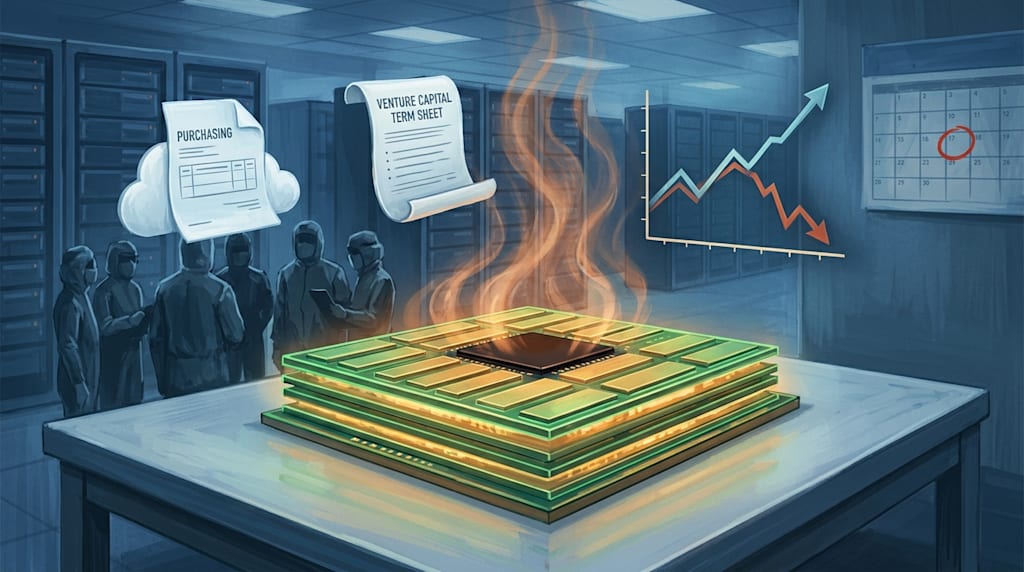
The $10 billion chip that has not been built
In September 2026, DensityAI entered late-stage talks to raise hundreds of millions of dollars at a post-money valuation near $10 billion. Andreessen Horowitz is negotiating to lead the round. The company has no chip to sell. It has a term sheet, a conditional purchase agreement with AWS, and about twenty former Tesla engineers.
Sina Tech, 36Kr, and Cailian Press reported the talks. The valuation would put DensityAI next to semiconductor companies with products and revenue. Its chip is still in early research and development.
The Dojo alumni
DensityAI was founded in 2025, one month after Tesla shut down Dojo. Elon Musk ended the supercomputer program in August 2025. He said it made no sense for Tesla to split resources across two different AI chip designs. The decision sent Tesla toward outside suppliers. It sent Dojo’s core team into a new company.
Ganesh Venkataramanan, who led Dojo, founded DensityAI. Bill Chang, a longtime Tesla engineer and Dojo’s chief systems engineer, became CTO. Ben Floering, Tesla’s former AI infrastructure lead, became a co-founder. In July 2026, Sishuang Sun left Tesla, where he was senior director of AI hardware design, to join DensityAI and lead packaging and systems hardware. At Tesla, Sun worked on turning custom silicon into hardware that could be built at scale. That work is the same kind DensityAI needs now.
Chip startups depend on their engineering teams. A data-center accelerator requires architecture, physical design, packaging, system validation, and software. Each layer needs engineers who have shipped before. DensityAI’s founding group covers those layers. The team is the asset. The chip is still a plan.
3D DRAM and the memory wall
DensityAI’s main technical bet is 3D DRAM stacking. Instead of placing DRAM beside the compute die, DensityAI plans to stack DRAM layers above or below the compute core. Vertical interconnects shorten the distance data travels. Shorter distances mean lower latency and lower energy per bit.
The company frames the problem against current GPUs. HBM solutions deliver about 8 TB/s of bandwidth and 192 GB of capacity. Compute utilization sits near 7%. DensityAI says its target is bandwidth in the 300 TB/s range and compute utilization above 90%. If those numbers hold, inference throughput and energy efficiency would jump by an order of magnitude.
The engineering problems are hard. DRAM cells are heat-sensitive. Their junction temperature is usually limited to around 85°C. High-performance compute hotspots can exceed 150°C. Stacking hot logic directly under or over fragile DRAM makes heat removal difficult. Hybrid bonding adds another problem. The thermal steps used during bonding can degrade DRAM charge retention, which shows up as refresh degradation. d-Matrix discussed refresh, ECC, and spare-bank design at around 105°C in its Hot Chips 2026 paper. Thermal management is not a side issue. It is the issue.
Other companies are working on the same problem. d-Matrix has shipped or is shipping its Raptor inference chip, which uses 3D DRAM stacking. Raptor delivers 105 TB/s per card, claims 10x better energy efficiency than HBM, and plugs into Nvidia’s NVLink Fusion network. d-Matrix expects volume shipments in the fourth quarter of 2027. AMD has researched hybrid-bonded 3D DRAM and reported 17x efficiency gains. Cooling problems have kept it from commercialization. Nvidia and SK Hynix are exploring 3D HBM starting with HBM5, with a window around 2028 to 2029.
DensityAI is not first. It is trying to combine Dojo’s system-level design experience with a packaging approach that has defeated larger companies. Dojo used high-bandwidth interconnects and custom architecture for training workloads. Whether that experience transfers to a commercial inference chip is the open question.
AWS’s conditional order
DensityAI’s pitch to investors includes an agreement with AWS. Management says that if DensityAI’s chip meets specified performance targets, AWS will buy it. The agreement is not an unconditional order. It is a performance gate.
For AWS, the arrangement costs little up front and locks in a potential supplier of specialized inference chips. The technical risk stays with DensityAI. If the chip misses the targets, AWS has no purchase obligation.
AWS runs a dual strategy. It designs its own chips and buys from outside startups. The company has deployed more than 1.4 million Trainium chips. Trainium 3 doubles performance and cuts energy use by half compared with the previous generation. AWS has secured more than $225 billion in purchase commitments from Anthropic, OpenAI, and other customers. It also signed with Astera Labs in February 2026 for interconnect hardware and with Cerebras in March 2026 for disaggregated inference. A conditional deal with DensityAI fits that pattern. AWS keeps its own roadmap and keeps external options alive.
The AWS name gives DensityAI credibility with later investors. It also sets a clock. The agreement converts to revenue only when the chip hits the performance targets. Until then, it is a promise with a technical deadline.
The split in AI chip valuations
DensityAI’s $10 billion target is not an isolated number. It sits inside a market where valuations are separating into two groups: companies with progress that can be checked and companies with a story.
Cerebras raised $5.55 billion in its IPO. Its market cap briefly crossed $100 billion. The anchor is a contract with OpenAI worth more than $20 billion and a wafer-scale system that has no direct equivalent. Etched raised $700 million in August 2026, led by Jane Street. Its valuation doubled to $21 billion in a month. Jane Street tested the hardware before leading the round. The valuation rests on measured performance, not slides.
DensityAI is in a different position. It is seeking hundreds of millions of dollars, with a16z in talks to lead. Its valuation is about $10 billion. Its chip is still in early research and development.
Groq shows the other path. Its valuation fell from $6.9 billion to $3.5 billion after Nvidia acquired its assets and licensed its LPU technology for $20 billion. Groq stopped being an independent challenger. It became a module inside Nvidia’s stack. d-Matrix raised $275 million and is valued at about $2 billion. It is shipping or has taped out its chip. SambaNova, one of the earliest AI chip companies, saw its valuation compress from $5.1 billion in 2021 to a range of $800 million to $2.2 billion. Investors cut the number as enterprise sales slowed.
Valuations now attach to contracts, tested hardware, and shipments. Team pedigree opens the door. It does not keep the valuation up.
a16z’s hardware fund
Andreessen Horowitz’s interest in DensityAI runs through its hardware strategy. In August 2026, the firm closed its first AI hardware fund, Machine Age, at $1.1 billion. The fund covers chips, memory, networking, and storage. Raghu Raghuram, a managing partner on the fund, described the scope as “all the things inside the four walls of a data center.”
The fund reflects a broader reset in venture capital’s view of AI infrastructure. Martin Casado, a general partner at a16z, said that every new technology era puts pressure on infrastructure, but the current change is more violent than anything he has seen. From chips and memory to power, every link in the hardware supply chain is capacity-constrained.
a16z manages more than $100 billion in assets. An $11 billion fund is a small slice. But the brand and the network matter to a one-year-old chip company. DensityAI needs hiring, packaging partners, and cloud customers. a16z can open those doors. The fund also gives a16z a seat at the table in the inference silicon market without betting on a single architecture.
What the valuation assumes
A $10 billion valuation for DensityAI prices in several assumptions at once. It assumes the Dojo team can move 3D DRAM stacking from papers and lab demos to a manufacturable chip. It assumes AI inference demand for bandwidth and efficiency grows fast enough that AWS will lock in a supplier before tapeout. It assumes a16z and later investors will wait five years or more for design, tapeout, volume production, and deployment.
Those assumptions have support. Cerebras took about a decade to reach IPO. Etched moved faster. The window for AI chip startups is shorter than it was, but the bar is higher. DensityAI faces two risks. The technical risk is thermal management in 3D DRAM. No company has solved it at volume. The commercial risk is timing. If the chip misses its performance window, AWS can walk. If a competitor ships a comparable part first, the market may not wait.
The $10 billion valuation is a bet on execution. The team has shipped complex silicon before. The architecture has a clear target. The customer has a conditional order. The tape-out date is the only number that matters now.
About the Creator
Jin
Writer of reamstories
https://reamstories.com/jin
Enjoyed the story? Support the Creator.
Subscribe for free to receive all their stories in your feed. You could also become a paid subscriber, letting them know you appreciate their work.
Comments
There are no comments for this story
Be the first to respond and start the conversation.