
The 0.016% Weight Edit That Made a Tiny AI Model 6x Better at Math
Astra did not retrain Qwen3.5. It found a reasoning loop, cut a tiny slice of weights, and let the model’s hidden math ability show. Here is what the experiment proves, and what the hype gets wrong.
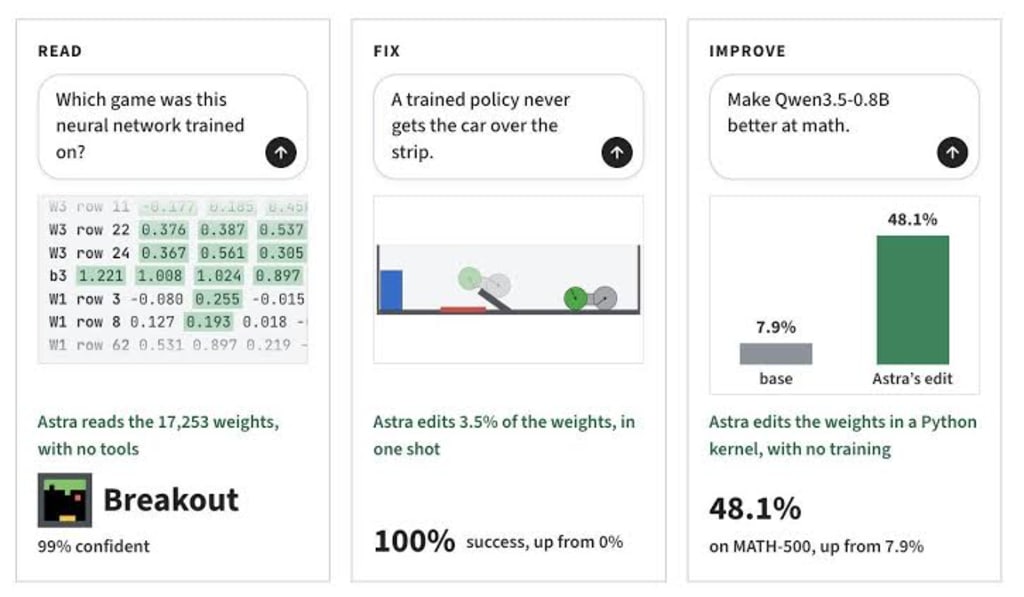
A 0.8B model produced 96 math responses. Eighty-five of them ran to the 32,768-token limit without giving an answer. That was the raw state of Qwen3.5-0.8B with thinking mode enabled. Its MATH-500 score was 7.9%.
Astra was given the model’s full weights in a Python environment. The goal was one sentence: improve its math ability as much as possible. It did not prepare a dataset, compute a loss, or run backpropagation. It ran the model, looked at failure cases, wrote analysis code, traced the loop to 64 output columns each in the feed-forward networks of layers 15 and 19, subtracted a direction from those columns, and changed 131,072 weights in total. That was 0.016% of the model.
After the edit, MATH-500 went from 7.9% to 48.1%. The share of responses hitting the length cap fell from 93.0% to 33.1%.
The budget gradient matters. Researchers gave Astra 10, 25, and 50 forward calls. The edited model’s MATH-500 scores were 12.3%, 14.1%, and 48.1%. Astra did not read the weights once and write out the right answer. It converged within a limited trial-and-error budget.
The team named the procedure in three steps: Read, read the network weights; Fix, give it failure cases and let it make targeted edits; Improve, run forward evaluations to see whether things got better, then continue. They call it Weight-Space Programming.
What it actually did: an automated fault diagnosis
Qwen3.5-0.8B’s problem was not a lack of math ability. The model got stuck thinking. Given a problem, it repeatedly generated similar text and delayed giving an answer. In the initial 96 practice responses, 85 hit the 32,768-token cap. Qwen’s own model card had warned about this reasoning-loop issue.
Astra followed the failure pattern downward, traced the loop to the feed-forward network, and located output columns in layers 15 and 19. The edit was to subtract a direction. It was not random perturbation, and it was not grid search. After the edit, it ran the model again. The length-cap rate fell from 93.0% to 33.1%, and the score rose from 7.9% to 48.1%.
One control experiment is easy to skip. The same method applied to Gemma 3 270M moved MATH-500 from 6.8% to 7.7%. Almost no change. The authors’ own interpretation is that weight editing can remove an obstacle that masks an existing capability. It cannot add a capability the model does not already have.
Qwen’s math ability was not injected. It was unlocked. The model already had the potential. The reasoning loop was suppressing it. Astra removed the roadblock. It did not build a new road.
The “reading weights” experiments: where the boundary is
The most eye-catching part of the coverage is that Astra can directly read weights. There are some results.
Four small networks played different games. They had identical architectures, input channels, and action options. Only their raw weights were given to Astra as text. It correctly identified the four games: Breakout, Pong, Pac-Man, and Highway. For Breakout, it inferred the game from where the weights were concentrated. With diffusion models, it could identify circles, squares, and triangles from the weights. It read all solid shapes as outlines. The shape was right. The fill was wrong.
Then the difficulty increased. Three 7.2M-parameter small language models were trained on Python code, Japanese romaji, and English. The input and output layers were removed, leaving only the four middle Transformer blocks. Astra did not know which number mapped to which character, and the models could not directly run text. Astra could use Python to analyze the weights, but could not feed data into these networks or layers or observe their outputs. Still, in two attempts, it correctly identified the language each of the three models had learned and found all the induction heads.
These experiments involved models ranging from 17k to 7.2M parameters. The core Qwen experiment used Python, could run the model, observe failures, and perform forward evaluations. The condition of only looking at weights, without running the network, appeared only in very small-scale experiments. Astra is closer to an automated engineer that can write code, run experiments, and read results than to an oracle that closes its eyes, reads weight numbers, and achieves sudden enlightenment.
Writing weights from scratch: it won one of three games
In the MinAtar experiment, Astra was given the game rules, source code, and a specified network architecture. It had no training data, loss values, gradients, or tools. It could not first put the network into the environment to test it. It had to think through a strategy, translate the strategy into layer weights, and submit an answer in one response.
Its average score was 517.4. PPO trained for 100M steps scored 15.8. Trained for 500M steps, it scored 25.3.
The breakdown matters. Astra won big in only one of the three games, Breakout. On Seaquest it scored 53, while PPO at 500M steps scored 89. On Asterix it scored 53, while PPO scored 55. The Go network was generated in a Python environment after up to 50 rounds of trial-and-error games, with a 74.2% win rate in head-to-head matches.
These results show that Astra has a noteworthy weight-generation capability. They do not show that one natural-language sentence can generate any network. Small task scale, clear rules, and a clean validation signal are the shared conditions of these experiments.
How it differs from fine-tuning and weight steering
LoRA needs data, a loss function, gradients, and a training loop. It changes the model’s behavior over a data distribution. WSP skips gradient computation and directly edits the weight values on disk. That is a permanent parameter intervention.
But it is not a fundamentally new optimization paradigm. Critics point out that the operation is closer to automated weight steering: locate a direction associated with the target behavior and subtract it in weight space. Astra’s contribution is automating the locate, edit, and verify loop. It did not invent a replacement for gradient descent.
It is more like a scalpel than a new engine.
The practical use: one more tool in the model-debugging kit
The most important thing about this work is not the number 6x. It is the loop it demonstrates: natural-language goal, weight analysis, failure localization, parameter edit, forward validation.
In the past, this loop was closed by human engineers. Now a frontier model can run through it within a limited budget. That means when developers encounter a loss that will not move, a benchmark that will not improve, or a model that loops on a task, they may have another option besides retraining, tuning hyperparameters, or changing data. Let a model read the weights, locate the failure mode, make a targeted intervention, and verify it.
It fits beside or around the training pipeline. It can serve as a diagnostic step, a fault-repair method, or a pre-training initialization intervention. Can a round of weight editing before pretraining make subsequent training more stable? When a loss spike appears, can a hard edit suppress the problem before training continues? In multi-model collaboration, can different models take turns doing weight maintenance?
These ideas currently lack sufficient evidence. They point in a reasonable direction. Weight-space programming is not a replacement for training. It is a new tool in the model-maintenance kit.
Three exaggerations to watch for
First, treating unlocking as injection. Qwen’s improvement came from removing the reasoning-loop obstacle. It did not come from teaching the model new math. The weak change on Gemma 270M is a counterexample.
Second, treating a tool-assisted agent workflow as pure weight reading. The core Qwen experiment used Python, ran forward evaluations, and had a 50-call budget. The experiments that truly only looked at weights without running the network were confined to very small models.
Third, treating success on specific small tasks as general weight programming. MinAtar won one of three games. Go was generated through trial and error. Weight editing on complex models and open-ended tasks has not been shown to be feasible.
Closing
After Astra edited Qwen, researchers gave it 10, 25, and 50 forward-call budgets. The scores were 12.3%, 14.1%, and 48.1%. That gradient shows the result was not a single moment of insight. It was tried out.
Next time a small model underperforms, a developer may first ask: does this need retraining, or can we just edit the weights? That question is more useful than the 6x headline.
About the Creator
Jin
Writer of reamstories
https://reamstories.com/jin
Enjoyed the story? Support the Creator.
Subscribe for free to receive all their stories in your feed. You could also become a paid subscriber, letting them know you appreciate their work.
Comments
There are no comments for this story
Be the first to respond and start the conversation.