
Thailand Digital Transformation Market Size and Forecast 2025–2033
AI, Cloud Computing, and Smart Infrastructure Fuel Thailand’s Digital Economy

Thailand Digital Transformation Market Set for Strong Growth Through 2033
Thailand is rapidly positioning itself as one of Southeast Asia’s most dynamic digital economies. Supported by ambitious government initiatives, widespread internet adoption, expanding cloud infrastructure, and increasing enterprise investment in emerging technologies, the country is witnessing a significant transformation across industries.
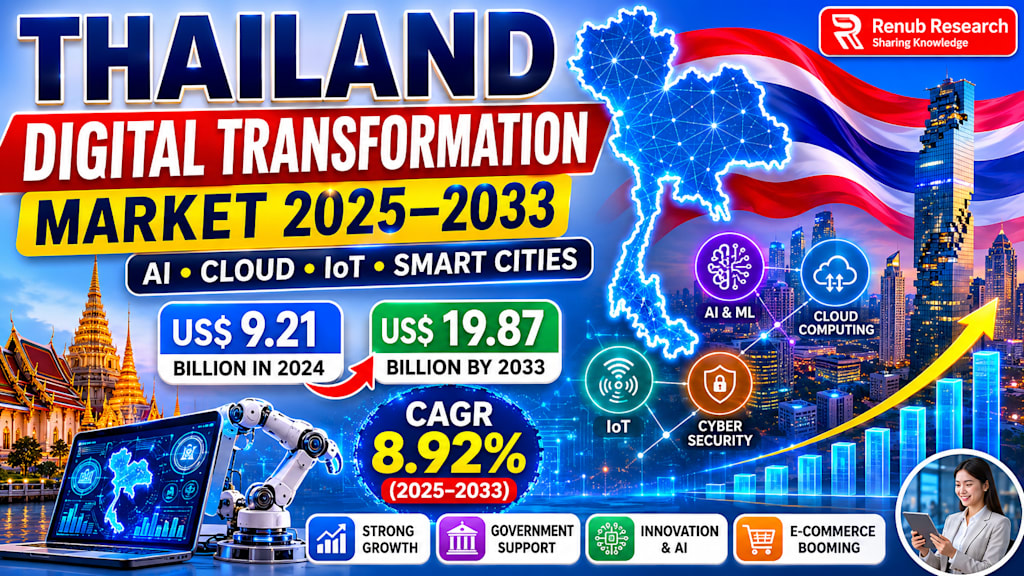
According to Renub Research, the Thailand Digital Transformation Market is projected to grow from US$ 9.21 billion in 2024 to US$ 19.87 billion by 2033, expanding at a CAGR of 8.92% between 2025 and 2033.
The digital transformation wave is reshaping how organizations operate, communicate with customers, manage supply chains, and deliver services. From artificial intelligence and cloud computing to cybersecurity and industrial robotics, businesses across Thailand are embracing technology-driven strategies to remain competitive in an increasingly digital world.
As public and private sectors continue to collaborate on infrastructure development and innovation programs, Thailand is emerging as a leading regional hub for digital transformation.
Thailand's Digital Economy Vision Accelerates Transformation
The foundation of Thailand's digital transformation journey lies in the country's long-term economic development strategy known as Thailand 4.0. The initiative aims to transition Thailand from a manufacturing-driven economy to an innovation-led economy powered by advanced technologies.
Government investments in 5G connectivity, digital public services, smart city projects, and technology education are creating favorable conditions for businesses to adopt digital solutions. Regulatory support and public-sector modernization programs are further encouraging enterprises to digitize operations.
Thailand's leadership recognizes that digital innovation is not merely an IT initiative but a critical driver of economic growth, productivity improvement, and global competitiveness.
As a result, organizations across manufacturing, healthcare, finance, retail, logistics, and government sectors are accelerating digital adoption at unprecedented rates.
Rising Internet and Smartphone Usage Driving Market Expansion
One of the strongest contributors to Thailand's digital transformation is its highly connected population.
Smartphone ownership and internet penetration have increased significantly over the past decade. Consumers now expect seamless online experiences for shopping, banking, entertainment, healthcare, and government services.
This behavioral shift is compelling organizations to modernize their digital infrastructure and customer engagement models.
E-commerce platforms continue to gain traction, while digital payment systems have become mainstream. Businesses are investing heavily in mobile applications, customer relationship management tools, analytics platforms, and digital marketing technologies to meet changing consumer expectations.
The widespread availability of mobile internet is also helping businesses reach customers in previously underserved markets, creating new revenue opportunities across the country.
Cloud Computing Becoming the Backbone of Enterprise Modernization
Cloud computing is playing a transformative role in Thailand's digital economy.
Organizations increasingly prefer cloud-based solutions due to their flexibility, scalability, and cost efficiency. Instead of maintaining expensive on-premise infrastructure, businesses can now access enterprise-grade computing resources through cloud platforms.
Cloud adoption enables organizations to:
Improve operational agility
Reduce IT costs
Enhance data accessibility
Support remote work environments
Accelerate innovation cycles
The growing presence of regional data centers and cloud service providers is further strengthening Thailand's digital infrastructure ecosystem.
Small and medium-sized enterprises (SMEs), in particular, are benefiting from cloud solutions that allow them to compete more effectively without large capital investments.
Artificial Intelligence Reshaping Business Operations
Artificial Intelligence (AI) is becoming a key pillar of Thailand's digital transformation strategy.
Businesses are deploying AI-powered technologies across multiple functions, including customer service, predictive maintenance, fraud detection, inventory management, and marketing automation.
AI-driven analytics helps organizations extract valuable insights from large datasets, enabling faster and more accurate decision-making.
In the financial sector, AI supports risk assessment and customer engagement. In healthcare, it assists diagnostics and patient management. Manufacturing companies are utilizing AI to optimize production efficiency and reduce downtime.
The establishment of AI-focused policies and innovation programs demonstrates Thailand's commitment to becoming a regional leader in artificial intelligence development and deployment.
Internet of Things (IoT) Driving Smart Infrastructure Development
The Internet of Things is emerging as a powerful enabler of Thailand's digital future.
Connected devices and sensors are being integrated into manufacturing facilities, transportation networks, utilities, healthcare systems, and smart city projects.
IoT technologies provide real-time monitoring capabilities that improve operational efficiency and resource management.
In manufacturing, smart sensors help companies monitor equipment performance and reduce maintenance costs. In urban environments, IoT supports intelligent traffic management, energy optimization, and public safety improvements.
The government's investment in smart city initiatives is expected to significantly boost IoT deployment across Thailand over the coming years.
Digital Transformation Transforming Major Industry Verticals
Manufacturing
Manufacturing remains one of Thailand's most important economic sectors and a major beneficiary of digital transformation.
Factories are adopting industrial robotics, AI-powered automation, digital twins, and predictive maintenance technologies to improve productivity and competitiveness.
Smart manufacturing initiatives align closely with Thailand 4.0 objectives and are helping local manufacturers integrate into global supply chains more efficiently.
BFSI Sector
Banks, financial institutions, and insurance providers are aggressively investing in digital technologies.
Digital banking platforms, AI-based customer service solutions, blockchain applications, and cybersecurity tools are transforming financial services delivery.
Consumers increasingly prefer mobile banking, digital wallets, and online financial services, creating significant opportunities for innovation.
Healthcare
Healthcare providers are embracing telemedicine, electronic medical records, cloud-based patient management systems, and AI-assisted diagnostics.
Digital transformation is improving healthcare accessibility, operational efficiency, and patient outcomes while reducing administrative burdens.
Retail and E-Commerce
Thailand's booming e-commerce sector is accelerating digital adoption across retail businesses.
Retailers are investing in customer analytics, omnichannel commerce platforms, inventory automation systems, and personalized shopping experiences to meet evolving consumer expectations.
Government and Public Sector
Government agencies are modernizing public services through digital platforms that improve transparency, efficiency, and citizen engagement.
E-government initiatives are simplifying administrative processes and enhancing service accessibility for residents and businesses alike.
Challenges Limiting Market Growth
Digital Skills Shortage
Despite strong growth prospects, Thailand faces a shortage of skilled digital professionals.
Demand for experts in artificial intelligence, cybersecurity, cloud architecture, data science, and software development continues to exceed supply.
This talent gap can slow technology adoption and increase recruitment costs for organizations seeking specialized expertise.
To address this challenge, government agencies, universities, and private-sector organizations are investing in workforce development programs focused on digital skills enhancement.
Infrastructure Gaps in Rural Areas
While major urban centers enjoy advanced digital infrastructure, some rural regions still face connectivity challenges.
Unequal access to high-speed internet and digital services creates disparities in economic participation and technology adoption.
Expanding broadband networks and improving digital accessibility remain essential priorities for ensuring inclusive growth across the country.
Continued investment in telecommunications infrastructure will play a crucial role in bridging these regional gaps.
Regional Analysis of Thailand Digital Transformation Market
Bangkok Leads the Digital Revolution
Bangkok remains the epicenter of Thailand's digital economy.
The capital city hosts major technology firms, multinational corporations, innovation hubs, startup ecosystems, and government agencies driving digital transformation initiatives.
Strong connectivity infrastructure, a highly skilled workforce, and access to investment capital make Bangkok the primary destination for digital innovation projects.
The city continues to attract substantial investments in fintech, cloud computing, AI, and smart city development.
Chiang Mai Emerging as a Technology Hub
Chiang Mai is increasingly recognized as an important center for digital entrepreneurship and innovation.
The city benefits from a strong academic ecosystem, lower operating costs, and a growing startup community.
Digital businesses, remote work professionals, and technology startups are contributing to Chiang Mai's expanding role in Thailand's digital landscape.
Phuket Advancing Smart Tourism
Phuket is leveraging digital transformation to strengthen tourism and urban management.
Smart city initiatives are improving transportation systems, public services, safety, and visitor experiences.
Tourism operators are increasingly using digital platforms, AI-powered customer engagement tools, and data analytics to deliver personalized services to travelers.
Phi Phi Islands Pursuing Sustainable Digital Development
The Phi Phi Islands represent an emerging market for digital innovation focused on sustainable tourism.
Digital booking platforms, contactless payment systems, and environmental monitoring technologies are gradually becoming part of the islands' tourism ecosystem.
Although infrastructure limitations remain, digital solutions are helping balance tourism growth with environmental conservation goals.
Recent Industry Developments
The Thailand digital transformation landscape continues to evolve through major investments and policy initiatives:
June 2025: Thailand announced a THB 1.34 trillion smart city project in Huai Yai under the Eastern Economic Corridor (EEC) initiative.
June 2025: Large-scale IoT infrastructure deployment plans were unveiled to support approximately 350,000 residents in the new smart city.
May 2025: The National AI Committee was formally established to coordinate artificial intelligence policies across government ministries and private organizations.
April 2025: New government programs were introduced to accelerate AI adoption among SMEs.
March 2025: The Thai cabinet approved approximately US$ 2.7 billion in data center investments.
March 2025: A 300 MW data center development project by Haoyang Cloud & Data received approval.
February 2025: Expansion of cloud infrastructure initiatives was announced to strengthen digital services nationwide.
January 2025: Additional support measures were introduced for smart manufacturing and Industry 4.0 implementation.
Late 2024: Increased investments in cybersecurity infrastructure were launched to strengthen national digital resilience.
Late 2024: Several digital government modernization programs were expanded to improve citizen access to online public services.
Competitive Landscape
The Thailand digital transformation market features a mix of global technology leaders and regional solution providers.
Major companies continue investing in cloud infrastructure, AI capabilities, cybersecurity solutions, consulting services, and digital transformation platforms.
Leading Companies Operating in the Market
Accenture plc
IBM Corp.
Microsoft Corp.
Amazon Web Services Inc.
Google LLC (Alphabet)
Siemens AG
SAP SE
Cisco Systems Inc.
Oracle Corp.
These organizations are helping Thai enterprises accelerate modernization initiatives through advanced digital technologies, consulting expertise, and scalable enterprise solutions.
10 Recent Developments by Major Companies
1. Accenture plc
Expanded AI-powered digital transformation services across Southeast Asia, helping enterprises modernize operations and customer engagement platforms.
2. IBM Corp.
Enhanced hybrid cloud and AI offerings focused on enterprise automation and data-driven decision-making.
3. Microsoft Corp.
Continued strengthening cloud infrastructure and AI ecosystem capabilities across the ASEAN region.
4. Amazon Web Services (AWS)
Expanded cloud service adoption programs supporting startups, SMEs, and large enterprises pursuing digital transformation.
5. Google LLC
Accelerated investments in cloud, cybersecurity, and generative AI technologies for enterprise customers.
6. Siemens AG
Advanced smart manufacturing and industrial automation solutions supporting Industry 4.0 initiatives.
7. SAP SE
Introduced enhanced ERP and business intelligence solutions to help organizations improve operational efficiency.
8. Cisco Systems Inc.
Expanded cybersecurity and networking solutions designed to support secure digital transformation initiatives.
9. Oracle Corp.
Strengthened cloud database and enterprise application capabilities for organizations migrating to digital-first operations.
10. Regional Technology Partnerships
Technology providers increasingly collaborated with Thai government agencies and private enterprises to accelerate smart city, AI, and cloud adoption projects.
Future Outlook
Thailand's digital transformation market is entering a period of sustained expansion driven by strong policy support, growing enterprise technology spending, and rising consumer demand for digital services.
The convergence of artificial intelligence, cloud computing, IoT, cybersecurity, and advanced analytics will continue reshaping industries across the country. Smart city initiatives, digital banking growth, e-commerce expansion, and manufacturing modernization are expected to remain key investment areas throughout the forecast period.
As infrastructure improves and digital skills development programs gain momentum, Thailand is well-positioned to strengthen its status as one of Southeast Asia's most promising digital economies.
Final Thoughts
Thailand's journey toward a digitally enabled economy is creating significant opportunities for businesses, technology providers, investors, and consumers alike. Supported by the Thailand 4.0 vision, expanding cloud infrastructure, rising AI adoption, and robust government backing, the market is on a strong growth trajectory.
With the Thailand Digital Transformation Market expected to increase from US$ 9.21 billion in 2024 to US$ 19.87 billion by 2033 at a CAGR of 8.92%, digital innovation will remain a cornerstone of Thailand's economic development strategy. Organizations that embrace digital-first approaches today will be best positioned to thrive in the country's increasingly connected and technology-driven future.
About the Creator
Enjoyed the story? Support the Creator.
Subscribe for free to receive all their stories in your feed.
Comments
There are no comments for this story
Be the first to respond and start the conversation.