
Tesla’s 100,000‑Unit Robot Bet Has Officially Begun — and the Industry Will Never Look the Same
A photo, a purchase order, and one internal review just yanked humanoid robots out of “what if” and into “how many.
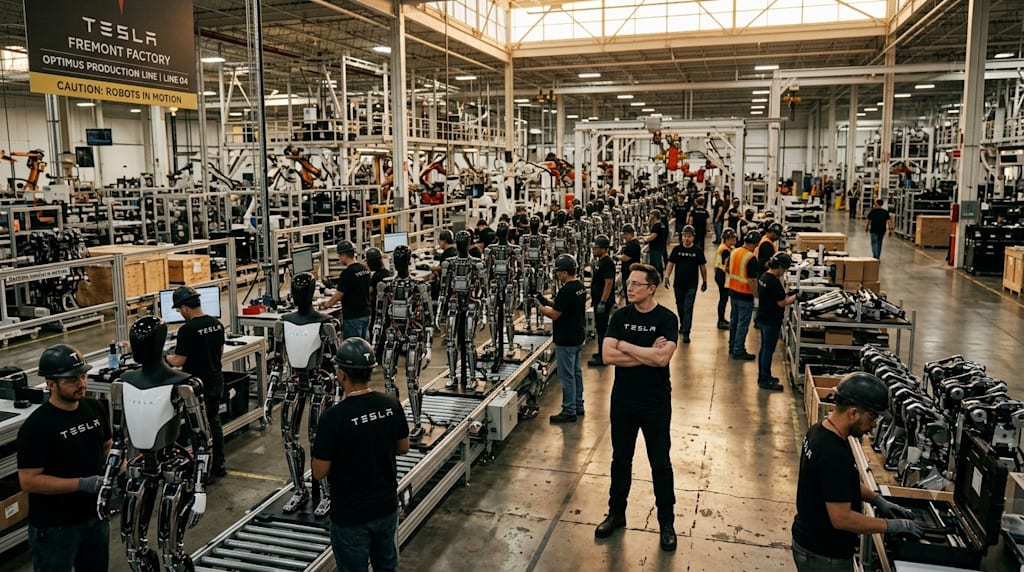
In late June 2026, Elon Musk posted a photo on X. It showed him standing with dozens of workers in front of an unfinished Optimus production line at Tesla’s Fremont factory in California. His expression was relaxed, as if he were inspecting a line that had been running for a decade.
The photo circulated in capital markets for two days. What actually moved institutional expectations wasn’t the photo itself, but the timing behind it. According to two sources close to Tesla’s supply chain, Musk had completed an internal Optimus review the week before. The third‑generation product had passed. The line could move.
More tangible than the photo were the purchase orders. Tesla suppliers recently received a clear parts procurement guideline: by September 2026, weekly production capacity must reach 1,000 units; by year‑end, that should climb to between 2,000 and 2,500. Two sources close to suppliers said Tesla typically places orders about two months in advance, and specific orders for August were already visible, hundreds of units, not trial production, but units meant to be stacked in warehouses.
Based on this pace, suppliers would have enough capacity by the end of 2026 to produce parts for roughly 100,000 Optimus units annually. That number isn’t large by automotive standards, but in the humanoid robot industry, where most companies still ship by the month, the figure lands with a different force.
From the 2022 AI Day demo to the preliminary finalization of the third generation, Optimus missed every public deadline Musk had set. But over the past four years, he shifted Tesla’s strategic center from car manufacturing to “a physical‑world AI company,” repeatedly telling investors that 80% of the company’s future revenue would come from robotics. This time, the purchase orders fulfilled his words.
The inflection point for the humanoid robot industry came earlier than most expected.
I. Four Years of Delays and Three Redesigns
For the Optimus team, the past four years have been like a closed‑book exam taken over and over. Each public announcement from Musk felt like a new deadline, and each deadline was missed.
At AI Day 2022, Optimus took the stage for the first time. It could walk and wave, but its movements were stiff, cables were exposed, and it looked like a prototype that hadn’t yet graduated from the lab. Musk said mass production would come within three years. The audience didn’t take it seriously.
For the next four years, the outside world saw almost none of Optimus’s full technical picture. Tesla occasionally released videos: a hand picking up an egg, another hand watering a plant. But the industry knew the videos were edited. What actually kept the team and suppliers waiting through a long stretch of uncertainty were the internal reviews.
Supply chain sources revealed that over the past six months, Optimus had gone through three iterations: Alpha, Beta, and C versions. Each involved substantial changes. The lead screws for the hand took nearly four years to finalize, and the wiring inside the motors was completely redesigned. One supplier commented: “Some domestic companies go to production after two revisions. Tesla has been revising for almost four years and is still going.”
Why so slow? Because Musk wasn’t aiming for “just moving.”
People close to Tesla said Musk repeatedly emphasized: no videos alone. Videos could be special effects, edited footage, or just one successful take out of five. He wanted live demonstrations, robots standing face‑to‑face with investors, shaking hands, picking up cups, writing names, with no cuts and no retakes. That benchmark held Optimus back for nearly two years.
To meet that standard, Optimus’s hardware was repeatedly torn down and rebuilt. The waist gained more degrees of freedom, the neck was redesigned, tactile sensors and gloves were added to the hands, and the head module was also revised. The current Optimus has 38 degrees of freedom in its body and 22 degrees in each dexterous hand, and it’s much lighter than most full‑sized humanoid robots.
The lightness comes from high integration. Engineers packed more components into smaller spaces. Suppliers estimated that the key actuators of Gen 3 are about 10% smaller in volume than the previous generation. But that still hasn’t reached Musk’s target.
The engineering challenges go beyond design. As the robot walks, grasps, and carries, the reducers, lead screws, and motors in its joints undergo continuous wear. The industry standard lifespan for reducers is 8,000 hours, which under an 8‑hour workday means less than three years before replacement. Planetary roller screws have even shorter lives. Humans don’t wear down that way; the body repairs itself. Machines don’t.
Tesla engineers believe that as long as the design direction is correct, precision and reliability are just a matter of time. But one supply chain source said, “They sometimes underestimate the time and resources this takes.”
And so progress dragged to the present.
II. The 100,000‑Unit Military Order
At the internal review meeting in late June, Musk did two things: he signed off on Optimus Gen 3, and he drew a line for the procurement team. If production targets weren’t met by year‑end, the entire team would be replaced.
That wasn’t a threat; it was a signal. Suppliers read it quickly: Musk was serious this time.
Over the past year, Tesla had been buying only about 50 robot parts per month. The supply chain wasn’t stocking up; it was adapting to ongoing design changes. Sometimes a part would just finish tooling, and the next month a notice would arrive: scrapped, new version.
So when the specific orders for August arrived, listing hundreds of units with confirmed timing and quantities, the suppliers’ first reaction wasn’t excitement but triple‑checking.
One supply chain source said, “You can’t say ‘Tesla is preparing to build that many.’ You can only say ‘Tesla is preparing to buy that many parts.’” The difference is that purchased parts might sit in warehouses. What truly matters is the technology maturity and real‑world use cases.
But Musk’s logic doesn’t work that way. His consistent approach is to build capacity first, then force technology and applications to catch up. That’s how Model 3 went, that’s how Cybertruck went, and Optimus will be no different.
Thus the 100,000‑unit annualized capacity target became a new test for suppliers. The old‑timers who had followed Tesla for four years were willing to bet: they had already invested too much to believe Optimus would stall. But newer suppliers were running the numbers: if Optimus doesn’t sell, these parts become inventory; if it does sell, falling behind in the production ramp means elimination.
“Musk said, either deliver or get out,” one supplier said. “There’s no ‘give me three more months’ in his system.”
III. The Chinese Contenders Got a Head Start
In the four years Tesla spent redesigning, Chinese robot companies had already started running.
For 2026, China’s major humanoid robot manufacturers revised their shipment forecasts upward to 40,000–50,000 units. Unitree delivered over 6,500 units in 2025, and Zhiyuan (AGIBOT) announced in March 2026 that cumulative production had reached 10,000 units. BYD plans to deploy up to 20,000 robots internally by year‑end, using them in its own factories. Figure AI and Boston Dynamics each target around 500–1,000 units in 2026.
Together, those numbers exceed Tesla’s 100,000 annualized capacity. In terms of actual shipments, Chinese companies are ahead.
Their strategy is clear: don’t chase the perfect product; get moving first. Unitree’s robots can carry boxes in warehouses. Zhiyuan’s robots do simple assembly in labs. BYD puts robots directly on its production lines. These scenarios don’t require 22‑DOF dexterous hands or 38‑DOF torsos. A gripper that can clamp, walk, and recognize markers is already useful on a factory floor.
Tesla is taking a different path: build something close to a human, then make it do everything a human can do. That road is steeper, but once cleared, the moat is also higher.
However, the premise of “once cleared” depends on product maturity. Chinese companies’ logic is: accumulate data in confined environments, iterate a version and ship it, repeat three or four times a year. Tesla spent four years on one version, then pushed it to 100,000 units all at once.
Which path is right? No one knows yet. But the market has responded: since early 2026, valuations of several Chinese robot companies have risen. Investors ask, “How many units can you deliver this year?” not “How many degrees of freedom do your hands have?”
Tesla’s procurement guideline, though only a guideline, reminds everyone of something else: when a company prepares to buy 100,000 sets of parts a year, the cost curve bends. Humanoid robots currently cost around $43,000 per unit. If production breaks a million, the unit price could fall below $20,000. At $20,000, factory owners will do the math: how many months for payback?
IV. A Story Without a Closed Loop
The production gears are turning, but Optimus’s story still lacks closure.
Currently, Optimus works inside Tesla’s factories dispensing glue, assembling, moving materials, all tasks in confined spaces that don’t demand much generalization. Chinese companies’ robots do the same jobs. It’s not unique to Optimus. Musk mentioned on social media that “AI + Optimus will allow everyone to access better medical care than the current best,” hinting that a medical‑surgery version might be in development. But that’s the future, not the present.
The real issue is this: Tesla currently has no plan for external sales. Every Optimus built is a capital expenditure, not revenue. If it only works inside factories, it’s a more efficient piece of equipment, not the “restructure of the global economy” Musk has talked about.
Without broad application scenarios, 100,000 units of capacity could become overcapacity. With them, capacity might be insufficient. The window between those two states could be only a few months.
Suppliers know this. Their current stance is cautious optimism: the purchase orders are real, the production line is real, Musk’s photo is real. But the other side of optimism is that they’ve been with Tesla through four years of R&D; they know how unpredictable this company’s rhythm can be.
“If there’s nowhere to use them when the time comes,” one supply chain source said, “at least our parts can sit in warehouses. Tesla will pay.”
V. The Inflection Point Has Arrived, the Answers Have Not
In 2012, Tesla began delivering the Model S. At the time, few believed electric vehicles could take half the combustion‑engine market in a decade.
In 2026, Optimus stands in a similar position. The difference is that Tesla isn’t running alone this time. Chinese companies are ahead, traditional giants are watching, and capital markets are tracking the data.
The 100,000‑unit annualized capacity draws a new starting line. On this line, three variables—technology, cost, and delivery capability—act simultaneously. Tesla with its technological lead, China’s fast‑iterating manufacturers, and the legacy industrial giants that could enter at any moment, will decide the industry’s endgame over the next two or three years.
The endgame could be what Musk calls “the largest industry in human history.” Or it could be a longer, more winding climb. The hardware complexity of robots, the boundaries of AI capabilities, the pace of scenario deployment—none of these have answers yet.
But three things happened in the summer of 2026: a photo, a purchase order, and an internal review. Together, they mean the humanoid robot industry has moved from “can we build it?” to “how many do we build?”
Once the production gears turn, they don’t stop easily. Every player in this industry, ready or not, has been pulled in.
About the Creator
Jin
Writer of reamstories
https://reamstories.com/jin
Enjoyed the story? Support the Creator.
Subscribe for free to receive all their stories in your feed. You could also become a paid subscriber, letting them know you appreciate their work.
Comments
There are no comments for this story
Be the first to respond and start the conversation.