
Tencent Is Paying $7 Billion to Rent AI Chips It Cannot Buy
The Oracle lease gives Tencent five years of offshore compute, a $2.1 billion upfront bill, and a policy risk it does not control.
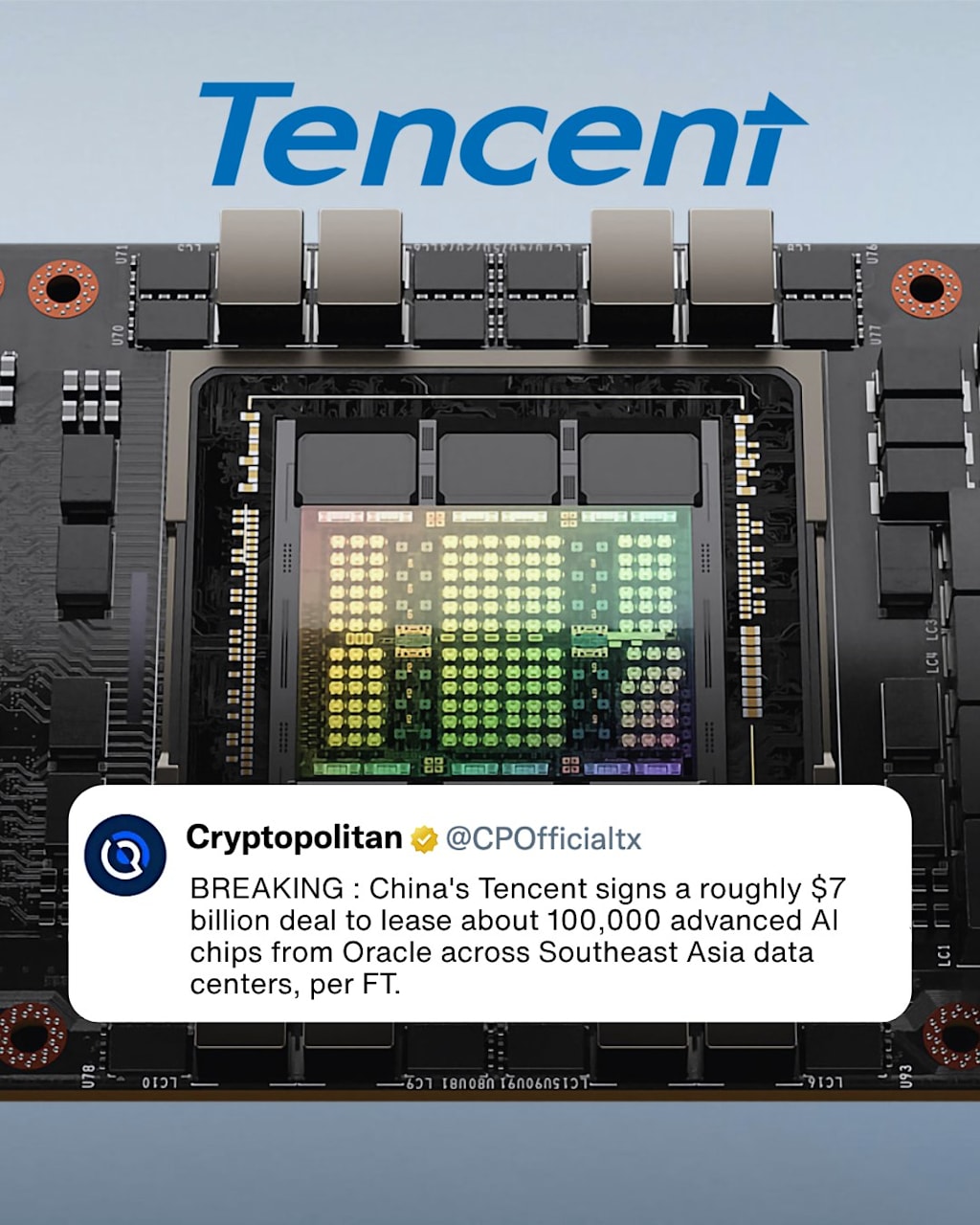
On October 1, 2026, the Financial Times reported that Tencent signed its largest overseas compute lease with Oracle. The deal covers multiple Oracle data centers in Southeast Asia. Tencent gets access to about 100,000 advanced AI chips. The transaction is valued at about $7 billion. The term is five years. Tencent paid about 30% upfront. Neither Tencent nor Oracle responded to requests for comment. Based on $7 billion, the upfront payment is about $2.1 billion. Tencent is renting the chips, not buying them.
I. Lease Details: 100,000 Chips, Five Years, 30% Upfront
The reported numbers are specific. About 100,000 advanced AI chips. Multiple Oracle data centers in Southeast Asia. Five years. About $7 billion. 30% upfront. People familiar with the matter said Tencent plans to use the compute for AI models and agent tools.
Tencent is not the largest customer of Southeast Asian data centers. ByteDance and Alibaba are. By signing a five-year lease, Tencent used an upfront payment to buy a seat at a table where competitors already sit.
The 30% upfront ratio matters. Data center operators have more pricing power over Chinese clients. Demand has pushed up prices, lengthened lease terms, and raised upfront ratios. Tencent accepted a five-year term and a $2.1 billion upfront payment. It wants a defined period of advanced chip access, not a short trial.
II. From “Sufficient Inventory” to “Can’t Buy”
Tencent management’s public comments about compute changed over two-plus years.
In August 2024, President Martin Lau said training chips were basically sufficient. Inference chips had many options. In May 2025, the company still said it had “quite strong GPU inventory,” enough to train several more generations of models. In the second half of 2025, Tencent began saying GPU supply chain constraints were affecting capital expenditure. In March 2026, the company admitted GPU constraints. It said new compute would come from “purchasing + domestic chips + leasing.” In June 2026, Tencent Cloud CEO Dowson Tong said: “We also want to buy chips, but for a long time we have faced a situation where we cannot buy them.” In October 2026, the Oracle lease became public.
Martin Lau explained the trade-off in March 2026. Inference chips have many choices in China, and cost is the main issue. For flagship model training, Tencent wants the most advanced training chips. Those chips are the target of the strictest U.S. export controls. Tencent waited during the window when it could still find a way to buy. After the window closed, direct procurement was blocked.
In August 2026, Dowson Tong responded to the question “Tencent is slow in AI.” He said, “It is impossible not to be anxious at all.” He also said Hunyuan Hy3 performs well among large models of similar parameters. But the company’s overall compute is severely insufficient. That has slowed model training and product development. The quote puts the bottleneck on chips.
III. The Financial Cost: Free Cash Flow Turns Negative
The deal’s most direct cost appears in Tencent’s Q2 2026 financial report.
In that quarter, Tencent’s capital expenditure was RMB 52.8 billion. That is up 176% year-on-year and 65% quarter-on-quarter. The annualized scale passed RMB 200 billion. Free cash flow was negative RMB 13.8 billion. This was Tencent’s first negative free cash flow quarter in more than a decade. Operating cash flow was RMB 52.7 billion. Capital expenditure payments of RMB 59.3 billion and other items more than offset it. The largest single item was about RMB 51.4 billion in prepayments for compute procurement.
Tencent management explained the numbers at the earnings call. Chief Strategy Officer Michelle said that leasing compute to third parties would recover equipment depreciation almost immediately. The company chose to use most new compute for its own models and AI applications. Martin Lau added that equipment ordered with deposits a few months earlier could now be resold at more than 30% above purchase price. The company still believes the right order is: first use compute to develop models and polish proprietary applications, then lease out what remains.
The logic is coherent. The financial data also shows tension. Alphabet’s free cash flow turned negative $5.9 billion in the same period. Oracle’s fiscal 2026 free cash flow was negative $23.7 billion. The AI race is consuming financial buffers faster than revenue grows. Tencent is not the only company in this position. It is the one long known as a cash cow.
IV. The Competitors’ Board: ByteDance and Alibaba Are Already in Southeast Asia
To see why Tencent moved now, look at competitors’ compute layouts in Southeast Asia.
ByteDance moved far earlier. According to The Wall Street Journal, ByteDance is working with Southeast Asian cloud provider Aolani Cloud. It is deploying about 500 Nvidia Blackwell systems in Malaysia. That is about 36,000 B200 chips. Hardware deployment costs may exceed $2.5 billion. TikTok’s approved expansion in Thailand involves up to $25 billion in total investment. ByteDance’s Singapore subsidiary Spring also got access to 2,304 Nvidia B200 GPUs through British cloud provider Nscale’s data center in Norway.
Alibaba is doing both. It plans to raise AI infrastructure investment to RMB 480 billion over three years. It is also buying GPUs overseas to support Tongyi Qianwen model development.
Tencent’s $7 billion lease is not small. The problem is timing. ByteDance and Alibaba built large compute reserves in 2023 and 2024. Those reserves became advantages in model iteration and product deployment. Tencent is still a latecomer in the Southeast Asian data center market. Dowson Tong responded: “Starting early may not be the most critical thing. The second half of AI has just begun.” The sentence admits that starting early is one of Tencent’s disadvantages.
V. Offshore Compute: The Gray Zone of Export Controls
The Tencent-Oracle deal reaches beyond the two companies. It touches a sensitive issue in the U.S.-China tech rivalry: does offshore compute leasing create a loophole in export controls?
U.S. export control rules target physical chip transfers across borders. Leasing compute from overseas data centers through cloud services is not explicitly prohibited now. Oracle’s Southeast Asian data centers give Tencent a compliant enclave. The chips do not enter China. The compute they generate does.
Southeast Asia is the front line because U.S. and Chinese hyperscale cloud providers build there side by side. They chase the same customers. They share the same power grid. AWS, Microsoft, and Google have committed more than $50 billion to the region. Alibaba Cloud, Tencent Cloud, and ByteDance expand on the same land. Johor, Malaysia, shows the pattern: 28 data centers completed or under construction, another 24 planned, and at least 30% with Chinese backing.
A policy report submitted to the U.S. think tank Pacific Forum warned that Chinese companies are rebuilding compute access through third countries. U.S. law enforcement agencies are studying how to close the loophole. Tracking offshore compute users is harder than intercepting physical chips. Legislative proposals would require prior permission for any U.S.-origin AI compute accessed or used by Chinese-funded enterprises.
Tencent’s five-year, $7 billion lease is also a bet on policy risk. If the United States tightens rules on offshore compute leasing, Tencent’s prepayment could buy access it cannot use. The 30% upfront ratio reflects both the pricing power of data center operators and Tencent’s urgency to lock in compute.
VI. What to Watch Next
At the policy level, U.S. regulation of offshore compute leasing will determine the lease’s usable life. At the domestic chip level, Tencent’s progress adapting flagship model training to domestic chips will determine how much it can reduce reliance on overseas compute. At the model level, Hunyuan Hy3’s next iterations and the launch timing of WeChat AI agents will determine whether the compute becomes products. At the financial level, capital expenditure and free cash flow will determine how much more prepayment Tencent can spend to buy time.
Martin Lau gave the order at the earnings call: first use compute to develop models and polish proprietary applications, then lease out what remains. The 30% upfront payment is already paid. The five-year term starts at signing. The 100,000 chips in Oracle’s Southeast Asian data centers will run there until 2031, according to the contract. Whether Tencent’s model team can use those five years is another contract. That one has no upfront payment.
About the Creator
Jin
Writer of reamstories
https://reamstories.com/jin
Enjoyed the story? Support the Creator.
Subscribe for free to receive all their stories in your feed. You could also become a paid subscriber, letting them know you appreciate their work.
Comments
There are no comments for this story
Be the first to respond and start the conversation.