
Taiwan Is Cancelling Netflix for an App That Packs Rebirth, Revenge, and Divorce Into Three Minutes
Hongguo Short Drama topped both app stores in Taiwan. The win says less about taste than about how cheaply and quickly attention can now be captured.
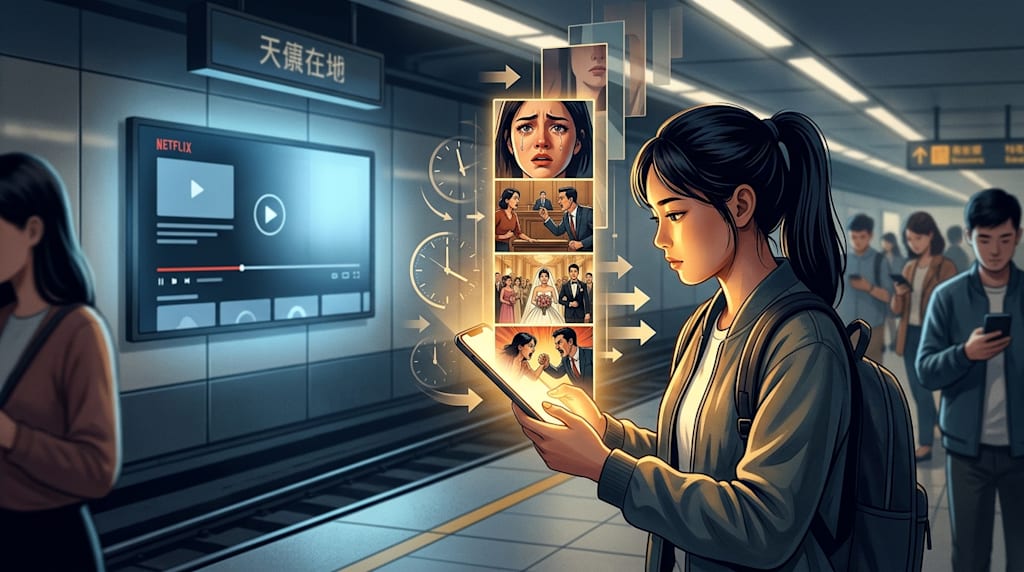
In mid-October, Hongguo Short Drama topped the free app charts on both Taiwan’s App Store and Google Play. Taiwanese social media filled with the same joke: “Before Netflix finishes one episode, Hongguo has already gone through rebirth, revenge, divorce, and flash marriage three times.”
Some viewers watched until dawn. Some cancelled Netflix. Others reported that their parents and grandparents had downloaded the app too.
This is not a small app-store spike. By July, Hongguo had 168 million daily active users in mainland China. That is more than the combined daily active users of Tencent Video, iQIYI, Youku, and Mango TV, which stood at about 155 million over the same period. The app has now carried that momentum across the Taiwan Strait.
To understand why, look at three things: how the app consumes time, how ByteDance produces it, and why paying for Netflix started to feel optional.
Hongguo wins on effort, not prestige
Taiwanese broadcaster TVBS listed three reasons for the app’s popularity: fast pacing, strong emotional payoff, and autoplay with algorithmic recommendations. The service is also free.
Each episode runs one to three minutes. In that time, viewers get misunderstandings, conflict, reversals, and a cliffhanger. The genres are familiar: sweet romance, rebirth and revenge, costume-drama family intrigue, and stories where the oppressed protagonist turns the tables. A Taiwanese doctor explained that this kind of storytelling quickly stimulates the brain’s reward system and triggers dopamine release. For viewers with routine lives, the payoff is immediate.
The bigger advantage is cognitive cost. Netflix asks for a block of uninterrupted time. Hongguo asks for a gap between tasks. Commuting, queuing, lying in bed, waiting for a friend: these are all slots Hongguo can fill. Wu Zhiyun, a young Taipei resident, said she uses almost all her commuting and break time to watch. “The plot doesn’t drag, the twists are satisfying, and after one episode you want the next,” she said.
Once viewers adjust to a reversal every few dozen seconds, the slow setup of long-form television starts to feel like work. The joke about Netflix and Hongguo captures the shift. Long-form video has not become worse. Short drama has reset the audience’s tolerance for waiting.
Free access seals the decision. Hongguo charges viewers nothing. It earns money through advertising, so every extra minute watched becomes another ad impression. When a Netflix subscription becomes a fixed cost that has to justify itself, a free service with a higher emotional return per minute becomes hard to ignore. Taiwanese media noted that users may lose patience with long series and start to question whether the subscription is worth keeping.
ByteDance pushed production costs below the floor
Hongguo is not just a free short-drama app. It sits inside ByteDance’s machine for traffic, IP, production, and distribution.
Traffic comes cheap. More than 60 percent of Hongguo’s early new users came directly from Douyin. Stories come cheap too. Fanqie Novel, another ByteDance property, has 600,000 contracted authors and more than 780,000 works. Hongguo can pull popular IP from that library and adapt it.
AI has pushed costs lower still. Industry data shows that AI-generated short dramas cost 70 to 90 percent less than live-action short dramas. A traditional live-action short drama costs about RMB 8,000 to 12,000 per minute. An AI simulated-human short drama can cut more than 90 percent of that cost, shrink the team to three to five people, and deliver a film in about ten days. In September 2026, nearly 80 percent of the top 99 titles on Hongguo’s hot list were AI dramas.
That changes the economics of failure. One AI short drama, “Huo Qubing,” cost about NT$14,000 and generated 500 million views. Hongguo released 220,000 short dramas in the first half of the year. Traditional film and television cannot match that volume.
Production has changed with it. Traditional film and television runs on projects: development, shooting, post-production, scheduling, then release. Hongguo runs closer to a product cycle. Small teams make films fast. If the data comes back weak, they switch scripts and try again. Algorithms help pick topics from user behavior data. After launch, playback data flows back in real time. Weak projects get dropped. Resources move to content that has found a working model. The library keeps churning, so there is always another title for a viewer to tap.
Cancelling Netflix is a spending decision, not a taste verdict
Taiwanese viewers who cancel Netflix for Hongguo are not saying Hongguo makes better television. The two services fit different moments. Netflix wants a reserved evening. Hongguo wants the ten minutes before a train arrives.
The problem for Netflix is arithmetic. Fragmented time is plentiful. Reserved time is scarce. Once a free app can fill the plentiful slots, paying for the scarce ones starts to feel less urgent.
This is a split in attention spending. Long-form video still owns the deep-watch session. Short drama owns the in-between. When the in-between makes up most of the day, the paid service moves down the priority list. Taiwanese media noted that Netflix is already under pressure from slower viewing growth and creative fatigue. Its stock fell nearly 28 percent during the year, and viewing hours grew only about 2 percent. Some analysts expect Netflix to launch AI short dramas in response. The competition is shifting from who has the best shows to who can deliver the strongest emotional hit per minute.
The cultural shift matters too
Taiwan’s United Daily News offered a wider view. Hongguo’s rise is not just another mainland app finding an audience. It shows that mainland cultural products have become ordinary entertainment in Taiwan. From Bilibili and Xiaohongshu to Hongguo, younger Taiwanese audiences are reshaping their media habits around mainland platforms. The paper argued that the Green camp’s habit of policing mainland language may alienate younger viewers, while the practical result is that “the more they guard against it, the more young people watch.”
This does not mean Taiwanese viewers endorse the values behind Hongguo. It means they no longer use place of origin as a first filter. Rebirth, revenge, and the pleasure of watching a bully get humiliated travel easily. The emotional grammar needs no translation. When content serves the emotion directly, where it came from becomes a secondary question.
The next minute is the one worth winning
Hongguo’s rise in Taiwan does not prove that short drama is better than prestige television. It proves that attention is now priced by density and speed. A plot twist every thirty seconds, a free service, and a production system that can test ideas for the price of a dinner have changed the calculation.
For long-form platforms, the question is no longer whether to make short dramas. The question is why viewers should pay for waiting and focus when a free app can deliver a faster emotional return. For creators, the lesson is simpler. In a fragmented market, the winner is whoever can deliver the most direct emotional service at the lowest cognitive cost.
The next minute is the one everybody is fighting for.
About the Creator
Jin
Writer of reamstories
https://reamstories.com/jin
Enjoyed the story? Support the Creator.
Subscribe for free to receive all their stories in your feed. You could also become a paid subscriber, letting them know you appreciate their work.
Comments
There are no comments for this story
Be the first to respond and start the conversation.