fact or fiction
Is it fact or merely fiction? Fact or Fiction explores the myths and beliefs we hold about cyber safety, artificial intelligence, dystopian futures and our everyday gadgets.
The Power of Small Habits. AI-Generated.
In today’s fast-paced world, the pursuit of better health can feel overwhelming. With endless diets, fitness trends, and wellness advice flooding our feeds, it’s easy to get lost in the noise. But what if the key to lasting health isn’t in drastic changes or extreme measures? What if it’s about the small, consistent habits we build into our daily lives? This article explores how tiny, intentional choices can lead to transformative health outcomes, backed by science and practical tips you can start today.
By Dot Storiesabout a year ago in 01
🎉🎈Happy Birthday wish 🎉🎈
polka dots and a matching hat, and has giant red shoes and a matching nose to go with it. I stare at this clown sitting at the table for what feels like the longest minute of my life. The clown is still, but I see him blink. He blinks, his body can make the smallest shifts of movements, and his breathing…His breathing is heavy, I could almost feel it as he’s across the room from me. Then the clown speaks. “Happy birthday, Michael.” Once I hear the clown’s raspy voice say those words, I turn and run. The clown sounds like he stumbles in his attempt to try and chase after me as I hear the sound of a few squeaks and a hard thump on the wooden floor. I just keep my face forward and run upstairs. “Where are you going? I just want to talk to you!” The clown says as I try to find any possible way to hide. I try to see if any of the doors open, but none of them budge. I frantically pull and tug on each door before I see the bathroom door open at a crack, I rush in, barely squeezing myself through. “You don’t have to be scared, I only want to talk. I noticed that you tried to help your family, that’s a good trait, one of many that I know are in that head of yours.” The clown’s squeaky shoes slowly squeak their way up the stairs. The shoes make the most overdrawn yelps of rubber that I’ve heard, the clown doesn’t rush, but instead takes all the time in the world to make every step. I just try to pick up anything in the bathroom that I can find as a weapon, but everything is staying in place. Not like the clown can come into the door, but I try to fit myself through the gap of the curtains of the bathtub, hiding there and keeping silent. “Doesn’t it feel awful? Knowing that you try to save them, even though your wish is just astronomically rude.” I can hear the clown’s shoes noisily make their way across the hall. Though, I can’t help but to think over the clown’s words. How could he know my wish? He read my mind somehow, can he read it now? Though, I don’t think I was trying to save them…I just didn’t want to be alone. Definitely not now, I wanted their stillness to be gone, but…I think I’d prefer it. “Don’t you think about what they’ve done for you?” The clown’s shoes make their way past the bathroom. Though what has my family done for me? Everything they do is just shallow attempts of trying to make me happy, I can’t really think of a moment when they did something that wasn’t so generic or predictable. They had to support me, they had to celebrate my accomplishments, they had to celebrate every holiday, so…What is this clown talking about? “And you think it’s fair for them to not be upset about you existing? Or even care?” The clown’s shoes stop right in front of the bathroom door. I just didn’t want to exist because they do nothing out of their way for me…I don’t matter, but what is this clown trying to say? I believe he can’t just walk into the bathroom. I’m proven wrong again by the clown’s grunts and squeaks pushes through the door before I hear him stop, his heavy breathing now inside of the bathroom.
By Shams Urahmanabout a year ago in 01
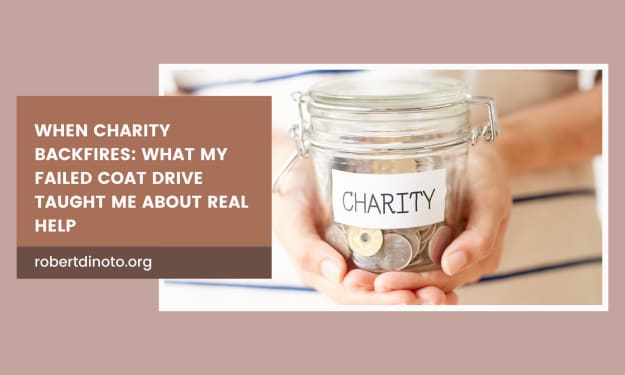
When Charity Backfires: What My Failed Coat Drive Taught Me About Real Help
The boxes were stacked six feet high in my garage. Winter coats in every size, color, and condition imaginable. I felt pretty good about myself—my social media post about the coat drive had gone viral, and donations poured in from friends, neighbors, and complete strangers. We'd collected over 300 coats in two weeks.
By Robert DiNotoabout a year ago in 01
Robot Girlfriends Are Coming: How Advanced AI Is Redefining Companionship Forever
The age of science fiction is rapidly becoming science fact. Once the stuff of futuristic fantasies and dystopian thrillers, robot girlfriends are no longer a distant dream—they're on the cusp of becoming an everyday reality. With advancements in artificial intelligence, robotics, and emotional computing, the world is witnessing a seismic shift in how companionship is understood and experienced.
By Rukka Novaabout a year ago in 01
What is PTSA? Everything You Need to Know About Para-Toluenesulfonic Acid
What Is PTSA? PTSA stands for Para-Toluenesulfonic Acid, a white crystalline organic acid derived from toluene. It belongs to a group of sulfonic acids and is known for its strong acidity and excellent solubility in organic solvents. PTSA is often used in its monohydrate form, making it easier to handle and store.
By Shraddha Mahajanabout a year ago in 01
Whispers Behind the Door
The house had stood silent for years, its presence a haunting silhouette at the end of Elmhurst Lane. No one ever mowed the overgrown lawn. The windows, once lined with lace curtains, were now dusty and blank. The neighbors called it The Stillhouse, not just because it had been abandoned, but because even birds refused to perch on its gutters. Eleanor Kane had never believed in ghost stories. At 32, she was a clinical psychologist who dealt in logic, trauma, and evidence. But when her estranged aunt Lydia passed away and left her the house in her will, Eleanor’s curiosity overcame her skepticism. She arrived just after dusk, suitcase in one hand, the house key in the other, wrapped in brittle yellowed paper with the words: “Don’t open the door upstairs.” She scoffed. Inside, the house was oddly preserved — not dusty as one might expect, but clean, untouched. The wallpaper was faded but intact. The furniture, covered in white sheets, seemed almost poised, as though waiting for someone to sit down. It was quiet. Too quiet. She explored the first floor, opening drawers, checking closets, looking for signs of what her aunt had feared. Nothing. Then she climbed the creaking staircase to the second floor. At the end of the hallway stood a single, black-painted door. Unlike the others, it had no handle, only a keyhole. Eleanor felt a twinge of unease. She knew this was the door. Ignoring the lump rising in her throat, she inserted the key from the envelope. It fit. With a turn, something clicked. Slowly, deliberately, she pushed the door open. Inside was a room barely touched by time. A child’s bed with wooden posts stood under a cracked skylight. Toys were scattered neatly across the floor — too neatly. A wooden rocking horse faced the corner. And on the far wall: drawings. Dozens of them. Crayon images of a door. The same door, drawn over and over. And in every single one, a shadow stood behind it. Eleanor’s breath caught. She stepped forward, crouching to inspect one of the pictures. They weren’t just scribbles — they were detailed. A child’s hand, yes, but with striking consistency. Her phone buzzed in her pocket. A voicemail — from an unknown number. She pressed play. > “You opened it,” a voice rasped. A child’s voice. “You weren’t supposed to. You let it hear you.” Her phone died mid-message. Eleanor stared at the blank screen, her hands suddenly clammy. She heard something then — a faint creak. From inside the room. She turned. The rocking horse had moved. No wind. No footsteps. Just that quiet, deliberate rock. Back. And forth. She backed out of the room and shut the door — but it didn’t close fully. Something resisted. Something on the other side. She didn’t sleep that night. --- The next day, Eleanor went through her aunt’s journals. They were scattered, frantic, filled with phrases like “It speaks when the lights go out” and “He draws to remember who he is”. One entry chilled her: > “I locked the door in 1982. He was only five when it began. He whispered things no child should know. His drawings kept getting darker. I thought it was grief. But then the voices came. From behind the door. They told him to open it. One day, he did. And I never saw my son again.” Her cousin. A boy no one had ever spoken about. That night, Eleanor sat in front of the door. She didn’t open it again — just listened. Hours passed. Nothing. She laughed nervously at herself. But just as she stood to leave— A whisper. Faint. Indistinct. She knelt. "Hello?" A pause. Then: “Eleanor.” Her blood froze. She hadn’t said her name. It wasn’t just a whisper — it was inside her mind, cold and sharp like broken glass. She ran. --- Eleanor packed the next morning. She would leave the house, maybe even sell it. But as she walked down the hallway one last time, the door was open again. This time, the drawings had changed. Now, they showed her. In each crayon sketch, she stood in the hallway, staring at the door. And behind it, something grew darker and larger with every frame — a shape with too-long arms and a twisted, childlike face. She turned to run — but there was something else now. Another door at the end of the hall. One that hadn’t been there before. From behind it came laughter. A child’s giggle, distorted. And then: Tap. Tap. Tap. Like fingers on the wood. Eleanor screamed, backing away — but the house seemed to stretch, the hallway elongating. The whispers rose around her in a spiral of sound. Her mind blurred. And then— Silence. The neighbors say the house is quiet again. The door remains closed. But if you listen closely, you can still hear whispers behind it. And sometimes, in crayon on the walls, a new drawing appears. This time, it’s you.
By SULAIMAN SHAHabout a year ago in 01