
System Integration Market Set to Surpass US$834 Billion by 2034 as Digital Transformation Accelerates Worldwide
Organizations are increasingly connecting cloud platforms, AI systems, IoT devices, and legacy technologies to build smarter, more efficient digital ecosystems.

The modern business world runs on technology. From cloud computing platforms and artificial intelligence systems to connected devices and advanced data analytics tools, organizations rely on an increasingly complex network of digital solutions to remain competitive.
Yet as companies adopt more technologies, a new challenge emerges: making everything work together.
Many organizations use dozens—or even hundreds—of software applications, databases, communication systems, and hardware platforms. Without proper integration, these technologies often operate in isolation, creating inefficiencies, data silos, and operational bottlenecks.
This challenge has transformed system integration into one of the most critical components of modern digital transformation strategies.
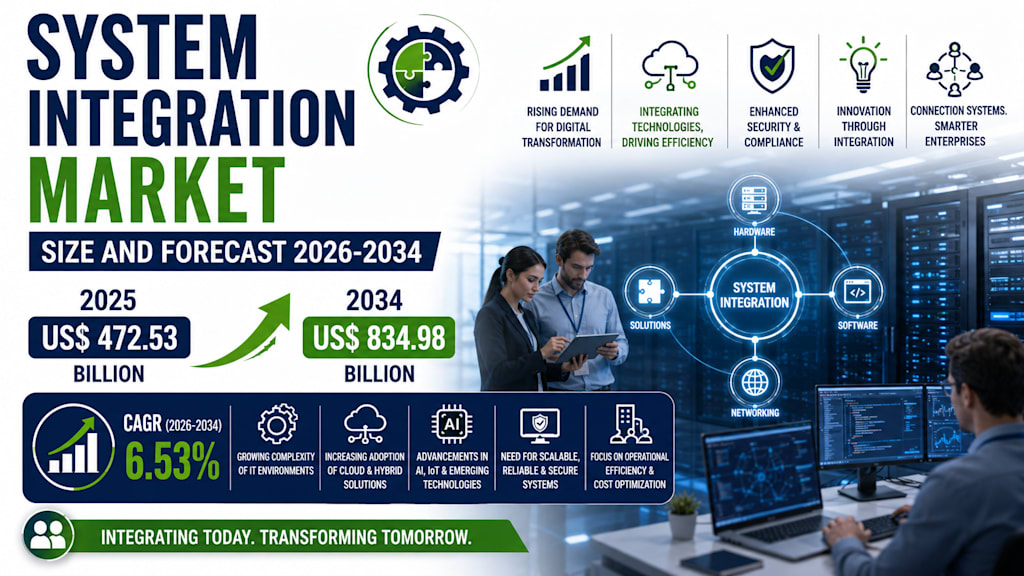
According to Renub Research, the global System Integration Market is projected to grow from US$472.53 billion in 2025 to US$834.98 billion by 2034, expanding at a compound annual growth rate (CAGR) of 6.53% between 2026 and 2034.
The remarkable growth highlights how organizations worldwide are investing heavily in technologies that allow diverse systems to communicate, collaborate, and function as a unified digital ecosystem.
What Is System Integration?
At its core, system integration is the process of connecting separate technologies into a single coordinated system.
Organizations often deploy different solutions for various business functions. Customer relationship management platforms handle sales activities. Enterprise resource planning systems manage operations. Cloud platforms store data. Communication tools facilitate collaboration. Security systems protect networks.
Individually, these technologies perform valuable functions. However, without integration, information may remain fragmented across departments and platforms.
System integration creates pathways that allow these technologies to exchange data, automate workflows, and operate seamlessly together.
The result is a more efficient organization with improved visibility, better decision-making capabilities, and stronger operational performance.
In today's highly connected business environment, integration is no longer optional—it has become essential.
Digital Transformation Is Driving Massive Demand
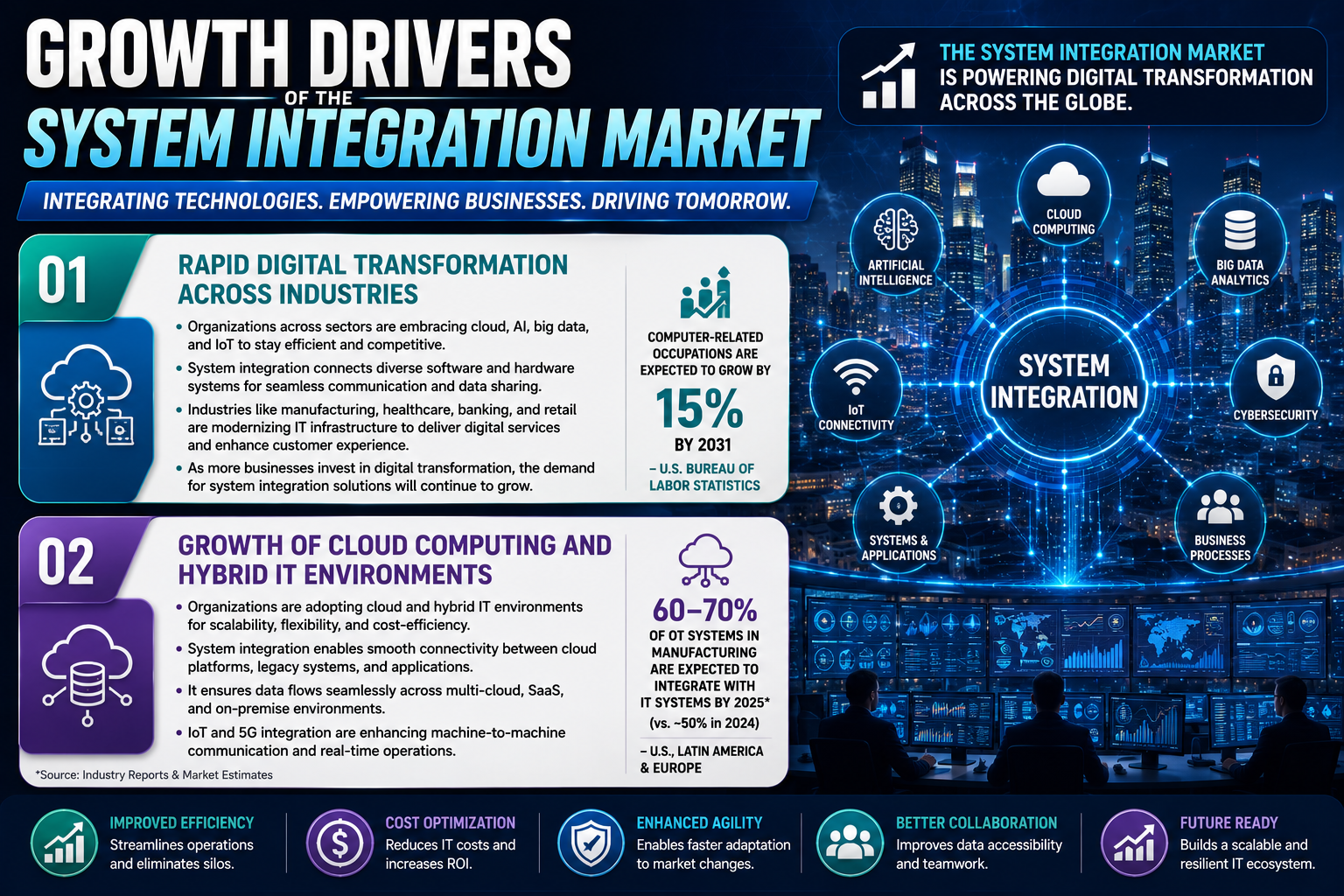
One of the most powerful forces fueling market growth is the rapid pace of digital transformation across industries.
Organizations are increasingly adopting technologies such as cloud computing, artificial intelligence, machine learning, Internet of Things (IoT), robotic process automation, and advanced analytics.
These technologies promise significant benefits, including improved efficiency, enhanced customer experiences, faster decision-making, and greater business agility.
However, implementing multiple technologies creates complexity.
A manufacturing company may operate IoT-enabled equipment, predictive maintenance software, cloud-based analytics platforms, and enterprise management systems simultaneously. Healthcare organizations often manage electronic health records, diagnostic platforms, telemedicine applications, and patient management systems.
Without integration, these systems cannot fully realize their potential.
System integration ensures that information flows seamlessly across technologies, enabling organizations to maximize the value of their digital investments.
As digital transformation initiatives continue expanding globally, demand for integration services is expected to rise steadily.
Cloud Computing Is Reshaping IT Infrastructure
Cloud computing has become one of the most significant drivers of system integration demand.
Businesses increasingly migrate applications, data storage, and computing resources to cloud environments to improve scalability, flexibility, and cost efficiency.
However, few organizations operate entirely in the cloud.
Most companies maintain hybrid IT environments that combine traditional on-premises infrastructure with cloud-based solutions. Some also utilize multiple cloud providers simultaneously.
These hybrid environments create complex technology ecosystems that require careful coordination.
System integration enables organizations to connect cloud platforms with existing applications, databases, and operational systems. It ensures consistent data availability, supports collaboration, and facilitates smooth workflows across multiple environments.
As cloud adoption continues accelerating, integration services will play a central role in helping organizations manage increasingly sophisticated IT infrastructures.
Artificial Intelligence Requires Connected Systems
Artificial intelligence has emerged as a transformative force across virtually every industry.
Businesses are using AI to automate tasks, analyze data, improve customer experiences, optimize operations, and generate actionable insights.
However, AI systems depend heavily on data.
To function effectively, AI platforms require access to information stored across multiple applications, databases, and business processes.
System integration enables AI technologies to access, process, and analyze data from diverse sources.
Without integrated systems, organizations often struggle with fragmented data environments that limit AI effectiveness.
As AI adoption expands globally, businesses are increasingly investing in integration solutions that support data accessibility and interoperability.
This trend is expected to remain a major growth driver throughout the coming decade.
The Internet of Things Is Creating New Complexity
The rise of IoT technology is fundamentally changing how organizations collect and utilize data.
Connected sensors, devices, machines, and equipment generate enormous volumes of real-time information. Industries such as manufacturing, transportation, healthcare, energy, and agriculture increasingly rely on IoT technologies to improve efficiency and operational performance.
However, IoT environments often involve thousands of connected devices operating across multiple platforms.
Managing these systems requires sophisticated integration capabilities.
System integration allows IoT devices to communicate with enterprise applications, analytics platforms, monitoring systems, and decision-making tools.
By connecting these technologies, organizations can gain valuable insights, automate processes, and improve overall operational visibility.
As IoT adoption continues growing, integration services will remain essential for managing increasingly connected environments.
Smart Factories Depend on Integration
Manufacturing represents one of the most significant opportunities within the system integration market.
Modern factories increasingly utilize automation technologies, industrial robots, sensors, predictive maintenance systems, and digital production platforms.
These technologies generate valuable operational data, but their effectiveness depends on seamless communication.
System integration enables machines, sensors, production systems, and enterprise applications to operate together as a coordinated ecosystem.
This connectivity allows manufacturers to optimize production processes, reduce downtime, improve quality control, and enhance supply chain visibility.
Government initiatives such as Germany's Industrie 4.0 and China's Made in China 2025 are further accelerating industrial modernization efforts.
As smart manufacturing continues expanding globally, integration solutions will play an increasingly important role in industrial transformation.
Healthcare Is Becoming More Connected
The healthcare industry has experienced rapid digitalization in recent years.
Hospitals and healthcare providers now utilize electronic health records, laboratory information systems, imaging technologies, telemedicine platforms, patient management systems, and diagnostic tools.
Each of these technologies generates critical information that must be accessible to healthcare professionals.
System integration helps healthcare organizations connect these systems, creating comprehensive patient records and improving clinical decision-making.
Integrated healthcare environments also support telemedicine services, remote patient monitoring, and advanced analytics initiatives.
As healthcare providers continue investing in digital technologies, demand for healthcare system integration solutions is expected to increase significantly.
Retailers Are Building Unified Customer Experiences
Retail businesses operate across an increasingly diverse range of channels.
Physical stores, e-commerce websites, mobile applications, customer relationship management systems, inventory platforms, and payment technologies all contribute to modern retail operations.
Consumers expect seamless experiences regardless of how they interact with brands.
System integration helps retailers synchronize inventory, customer data, order management, and sales information across channels.
This enables businesses to improve customer service, optimize operations, and gain deeper insights into consumer behavior.
As omnichannel retail strategies become standard practice, integration technologies will remain critical to business success.
Infrastructure Integration Remains a Core Market Segment
Infrastructure integration focuses on connecting the foundational components of IT environments.
These components include servers, storage systems, networking equipment, cloud platforms, and data centers.
As organizations modernize infrastructure and adopt hybrid environments, infrastructure integration has become increasingly important.
Effective integration helps improve network performance, streamline operations, enhance security, and support business continuity.
It also provides centralized visibility and control over complex technology environments.
The ongoing modernization of enterprise infrastructure is expected to sustain strong demand for integration services throughout the forecast period.
Consulting Services Are Becoming Increasingly Valuable
The complexity of modern integration projects has created growing demand for consulting expertise.
System integration consultants help organizations evaluate existing technologies, identify challenges, develop strategies, and implement solutions.
Many businesses lack the internal resources required to manage large-scale integration initiatives effectively.
Consultants provide valuable technical knowledge, project management expertise, and strategic guidance throughout the integration process.
As technology ecosystems become increasingly sophisticated, organizations are likely to rely more heavily on specialized consulting services.
This trend is contributing significantly to overall market growth.
Telecommunications and 5G Networks Create Opportunities
The telecommunications sector is undergoing significant transformation driven by 5G deployment, cloud services, and increasing data consumption.
Telecommunications companies manage highly complex infrastructures that include communication networks, data centers, software platforms, and customer management systems.
System integration enables these components to function efficiently together.
The rollout of 5G technology is expected to further increase integration requirements by supporting new IoT applications, smart city initiatives, and advanced communication services.
As connectivity demands continue growing, telecom integration projects are expected to remain a major source of market activity.
Cybersecurity Concerns Are Increasing
Despite strong growth opportunities, the system integration market faces several challenges.
Cybersecurity remains one of the most significant concerns.
Integrated environments often involve extensive data sharing between systems, applications, and networks. While connectivity improves efficiency, it can also create additional security risks.
Cybercriminals increasingly target interconnected systems because they often provide multiple entry points into organizational networks.
System integrators must implement robust security measures that protect sensitive information while enabling seamless connectivity.
Industries such as healthcare, finance, government, and critical infrastructure require especially rigorous cybersecurity standards.
As cyber threats continue evolving, security considerations will remain central to integration projects.
Legacy Systems Continue Creating Obstacles
Another major challenge involves integrating legacy technologies with modern platforms.
Many organizations continue relying on software applications and infrastructure developed years—or even decades—ago.
These legacy systems often remain essential to business operations but may lack compatibility with modern technologies.
Integrating older platforms with cloud services, AI applications, and IoT environments can be technically complex and resource-intensive.
Organizations must balance modernization objectives with operational continuity.
As digital transformation accelerates, overcoming legacy system challenges will remain a key focus area for integration specialists.
Regional Markets Show Strong Growth
The United States remains one of the world's largest and most advanced system integration markets. Strong adoption of cloud computing, AI, healthcare technology, and smart infrastructure continues driving demand.
The United Kingdom is experiencing increased integration activity across finance, healthcare, retail, and telecommunications sectors as organizations modernize operations.
India represents one of the fastest-growing markets due to expanding digital infrastructure, government-led digital initiatives, and a thriving technology sector.
Saudi Arabia is also emerging as an important growth market through investments in smart cities, digital transformation programs, and advanced infrastructure projects aligned with long-term economic development goals.
These regional trends demonstrate the global nature of demand for system integration expertise.
Final Thoughts
The future of business will be increasingly connected, automated, and data-driven.
Organizations are investing heavily in digital technologies to improve efficiency, enhance customer experiences, and remain competitive in rapidly evolving markets. However, the true value of these technologies depends on their ability to work together.
System integration provides the foundation that makes modern digital ecosystems possible.
Whether connecting cloud platforms, integrating AI solutions, enabling IoT environments, supporting smart factories, or modernizing healthcare systems, integration services have become essential to digital transformation success.
With the global System Integration Market expected to grow from US$472.53 billion in 2025 to US$834.98 billion by 2034, the industry is positioned for substantial expansion.
As technology continues advancing, system integration will remain one of the most important enablers of innovation, helping organizations transform complexity into opportunity and disconnected technologies into unified business value.
About the Creator
Enjoyed the story? Support the Creator.
Subscribe for free to receive all their stories in your feed.
Comments
There are no comments for this story
Be the first to respond and start the conversation.