
Starship’s First Orbital Delivery: 26 Satellites, One Engine Glitch, and a Schedule That Finally Exists
Eighteen years after Falcon 1 saved SpaceX, a 124-meter rocket reached low Earth orbit and released 26 Starlink V3 satellites. The mission worked. The hard part is repeating it.
September 28, 2008, central Pacific, Kwajalein Atoll.
A 21-meter rocket lifted off. It was Falcon 1. Liftoff weight: 27 tons. First stage: one Merlin 1C engine. The first three Falcon 1 flights had failed. SpaceX was close to running out of money. The fourth flight passed through the atmosphere and put its second stage into the intended orbit.
SpaceX survived.
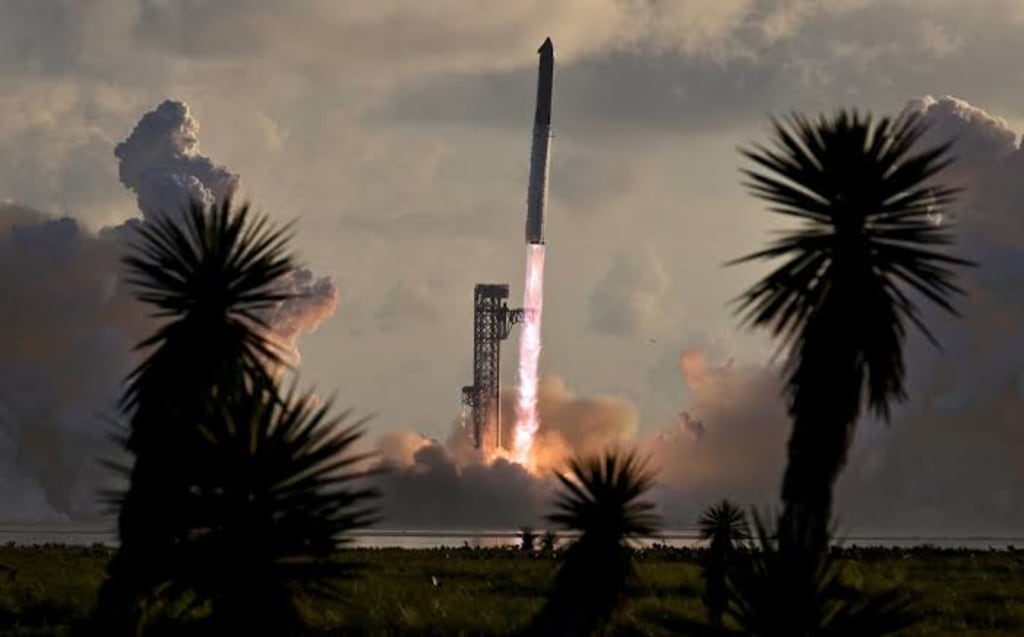
Eighteen years later, on the same date, at 20:49 Beijing time on September 28, 2026, another rocket lifted off from Starbase in Texas.
It stood 124 meters tall. Liftoff weight: about 5,000 tons. First stage: 33 Raptor V3 engines in three rings. This was Starship’s 14th test flight. It was the first aimed at orbit.
About 25 minutes after liftoff, upper stage Ship 41 reignited its Raptor engines from suborbital flight. A 19-second burn pushed it into low Earth orbit at about 275 kilometers. It then released 26 Starlink V3 satellites.
SpaceX confirmed all satellites were communicating.
The first 13 flights reached space altitude and came back. The 14th stayed in orbit.
What changed on flight 14
The first 13 flights were suborbital. Starship reached space altitude and even released a simulated payload during a July test, but SpaceX kept the spacecraft’s orbital perigee inside the atmosphere. If the flight went out of control, gravity would pull the spacecraft back to Earth. It would splash down in a chosen area instead of becoming space debris.
Flight 14 broke that limit.
For safety, SpaceX used a two-step plan for Ship 41. The spacecraft first flew at a safer suborbital altitude. The team checked engines, power, and deorbit systems. After confirming enough safety margin, SpaceX performed one final burn to raise the spacecraft into low Earth orbit.
That step succeeded. The process was not calm.
As the spacecraft separated from the booster and climbed, one vacuum Raptor engine shut down early. SpaceX delayed orbital insertion. Some outlets had already reported failure. The engineering team assessed the situation. Mission control gave permission again:
Go for orbit.
The spacecraft entered low Earth orbit and released 26 Starlink V3 satellites at about one per minute.
The original plan called for six orbits and nearly 10 hours of flight. From the third orbit, the spacecraft would pass over China. Around sunrise, southern China might have seen the spacecraft or its rocket cloud.
After the engine anomaly, SpaceX moved the deorbit burn earlier. The spacecraft flew two orbits and splashed down in the North Pacific under control.
No one on the ground saw Ship 41 in the sky.
The first customer is SpaceX
The 26 Starlink V3 satellites on flight 14 are the next generation of SpaceX’s satellite internet.
Each V3 satellite can add about 1 Tbps of downlink capacity and 160 Gbps of uplink capacity, according to SpaceX. The current V2 Mini satellites offer about one tenth of that downlink and one twenty-second of that uplink.
A Falcon 9 can also carry more than 20 V2 Mini satellites. Starship does not win on satellite count. It wins on satellite class. V3 satellites are larger and each one carries far more capacity.
SpaceX expects a fully loaded Starship to carry 60 V3 satellites. That launch would add about 60 Tbps of Starlink downlink capacity. That is 20 times the capacity added by one Falcon 9 launch today.
Musk has said he wants the Starlink constellation to reach 100,000 V3 satellites. That is 100 times today’s network.
Falcon 9 cannot build that. Starship’s deployment capacity is the prerequisite.
Starship’s first commercial customer is SpaceX itself. The rocket sends up communications capacity, bandwidth, coverage, and network infrastructure. Each launch raises Starlink’s density, redundancy, and commercial value.
The money and hardware move in a circle. Starship launches Starlink. Starlink expands the network. The network earns revenue. The revenue pays for more Starship flights. SpaceX is a rocket company, a satellite company, and a communications operator. It does not need an outside customer to prove Starship’s value. It is its own largest customer.
5,000 tons at liftoff, 52 tons to orbit
Flight 14 delivered 52 tons of payload. By payload mass, that was the third-largest launch in history.
The V3 Starship’s low Earth orbit payload limit is in the 100-ton class.
For scale, the International Space Station weighs a little over 400 tons. Five Starship launches could rebuild a station of that size, ignoring configuration and assembly issues.
SpaceX’s long-term goal goes further. The company wants Starship to launch once per hour and send about 200 tons to orbit each time.
The hourly launch goal is still a stretch. The 200-ton payload goal is closer. V3 Starship already has 100-ton-class capacity. If later versions improve, 200 tons is not impossible.
One number needs to stay clear. 5,000 tons is liftoff weight. It is not payload to orbit. Flight 14 put 52 tons into orbit. V3’s limit is in the 100-ton class.
If that capacity becomes routine, the next problem is not whether payloads can reach orbit. The next problem is what deserves the trip.
The next satellites may be data centers
If Starship only scales up communications satellites, the story is a faster Starlink network.
A larger fairing does more than that. It gives satellites new design options.
Future satellites could carry larger phased array antennas, higher power, stronger inter-satellite lasers, and onboard computing. Those satellites fit the hottest market in tech:
AI computing.
This year, SpaceX announced Starmind, an orbital AI computing program. It includes an orbital computing satellite called AI1.
SpaceX says AI1 will deploy to a 75-meter wingspan and a height of 30 meters. One satellite will carry up to 250 kW of computing load, with an average of 175 kW. Solar panels power the AI chips directly. That bypasses the electricity limits of ground data centers. High-speed laser links send results into Starlink and back to Earth.
Musk claims each ton of satellite could provide about 100 kW of computing power. If SpaceX launched 1 million tons of satellites per year, the company could add about 100 GW of orbital AI compute. That is double SpaceX’s current total compute.
That claim is far from a plan.
Musk has not explained how orbital computing would handle ionizing radiation, repairs, orbital congestion, or heat. Chip lifespan, cooling, power, data transmission, debris avoidance, and regulatory approval are all unsolved.
The claim still explains why SpaceX wants Starship to be so large.
Starship is the prerequisite. Without cheap, frequent, high-mass launches, orbital AI data centers are science fiction. With Starship, they become an engineering problem that can be costed, scheduled, and financed.
Six hard problems after orbit
Flight 14 reached orbit. That matters. Orbit is a threshold, not a finish line.
The harder problems are less dramatic.
First, reuse and refurbishment. Starship must recover, inspect, repair, and fly again as quickly as Falcon 9. Otherwise, its capacity is one-time only.
Second, launch frequency and cost. SpaceX wants one launch per hour. Launch pads, airspace, weather, regulation, fuel, and ground systems all limit frequency. Cost reduction to Musk’s promised level still needs proof.
Third, engine reliability. One vacuum Raptor shut down early on flight 14. With 33 engines in parallel, fault tolerance matters. Any anomaly can change a mission. Routine operation needs higher reliability.
Fourth, orbital propellant transfer. Without refueling in orbit, Starship’s deep-space capability drops. Moon landings, Mars, and orbital data centers depend on it.
Fifth, regulation, debris, and safety. Orbit means long-term presence. Debris avoidance, deorbit control, orbital congestion, and international coordination become daily operations.
Sixth, Starlink V3 production and deployment. SpaceX must build satellites quickly and cheaply. Starship can carry 60 at a time, but only if the factory can keep up.
Flight 14 is a milestone. It is not the end.
It proved Starship can reach orbit, deliver payload, and splash down under control. It has not proved Starship can fly like a cargo aircraft every day, week, and month.
The first packages were 26 satellites
Eighteen years ago, when Falcon 1 reached orbit, few people expected SpaceX to build the largest satellite internet in history with reusable rockets.
It is still hard to know what Starship will send up next.
Starlink satellites and lunar landers are near certain. A commercial space station and AI computing satellites are possible. Unknown technologies may also find a ride.
The September 28, 2026 launch can be written as concrete events:
A 124-meter rocket lifted off from Starbase.
One vacuum Raptor shut down early.
Mission control said, Go for orbit.
Ship 41 burned for 19 seconds and entered low Earth orbit at about 275 kilometers.
Twenty-six Starlink V3 satellites deployed at about one per minute.
The spacecraft circled Earth twice and splashed down in the North Pacific under control.
The first packages were 26 satellites.
That is the start. The schedule is the test.
About the Creator
Jin
Writer of reamstories
https://reamstories.com/jin
Enjoyed the story? Support the Creator.
Subscribe for free to receive all their stories in your feed. You could also become a paid subscriber, letting them know you appreciate their work.
Comments
There are no comments for this story
Be the first to respond and start the conversation.