
Starship Flight 13: From Fragmentation to Flotation
SpaceX’s latest test didn’t just fly—it deployed satellites, relit an engine in vacuum, and for the first time brought the upper stage back in one piece. The booster still hit the water hard, but the vehicle itself crossed a line.
Boca Chica, Texas – July 25, 2026, 6:45 AM Beijing Time. The Starship V3 vehicle, consisting of Booster B20 and upper stage S40, lifted off from the launch mount with 33 Raptor engines at full thrust. This was the 13th integrated flight test of the Starship system.
The mission had been delayed twice before. On July 16, an engine issue in the inner ring triggered an abort during the countdown. B20 was rolled back from the pad, moved to the high bay, and two engines – E12 and E13 – were replaced. Engine R152 was removed, sent to the McGregor test site, and later reinstalled. Then Tropical Storm Bertha's remnants brought heavy rain and wind to southeast Texas, closing the July 24 window. On the morning of the 25th, visibility cleared just in time – ground optical systems needed clear skies to capture thermal shield imagery during ascent. The go‑ahead was given.
T+00:58 – Starship passed Max Q. Compared to Flight 12, this point occurred 13 seconds later, the result of a trajectory optimization designed to reduce structural loads. Camera views from the engine bay showed all 33 nozzle throats, covered in frost from cryogenic propellant, gradually glowing dark red as thrust built. No engine shut down during the ascent.
T+02:46 – Hot staging executed. S40's six Raptor engines ignited in vacuum, pushing the booster away. Cameras on the upper stage captured the plume rolling over the top of B20.
The booster's job ended there. The landing‑burn plan called for reigniting the 13 inner‑ring engines to slow down for a controlled splashdown in the Gulf of Mexico. Telemetry later showed that only 10 engines actually started – three had faults. The flight computer then shut down several more, leaving only five burning. Thrust was insufficient; B20 could not reduce its velocity to the target value before impact – it hit the water hard. SpaceX confirmed that Flight 14 will still not attempt a tower catch with Mechazilla.
The upper stage showed the most progress.
After reaching a suborbital trajectory at roughly 170–200 km altitude, S40 opened its payload bay door. For the first time, Starship deployed real satellites – 20 operational Starlink V3 units. Previous flights had carried only mass simulators. Each V3 satellite has a downlink capacity of 1 Tbps, ten times that of older models. A spring‑loaded dispenser released them at specific intervals; onboard cameras showed them floating out into the vacuum. Because this was a suborbital flight, the satellites were commanded to re‑enter and burn up after about 20 minutes. But before that, they successfully deployed solar arrays and locked signals with ground stations.
Six of the satellites were specially modified with cameras and light sources. After separation, they maneuvered close to S40 and transmitted high‑resolution images of the thermal shield's condition prior to the hypersonic re‑entry – an angle impossible to obtain from ground telescopes.
Once deployment was complete, S40 entered a 27‑minute coast phase. Attitude‑control thrusters fired repeatedly to adjust the vehicle's orientation. Then came the key technical milestone: an in‑flight relight of a single Raptor engine in the vacuum of space. Data displayed in the upper right corner of the live feed showed ignition, stable thrust buildup, and a burn lasting approximately 14 to 15 seconds, followed by a clean shutdown. This satisfied one of the FAA's required technology benchmarks for Starship.
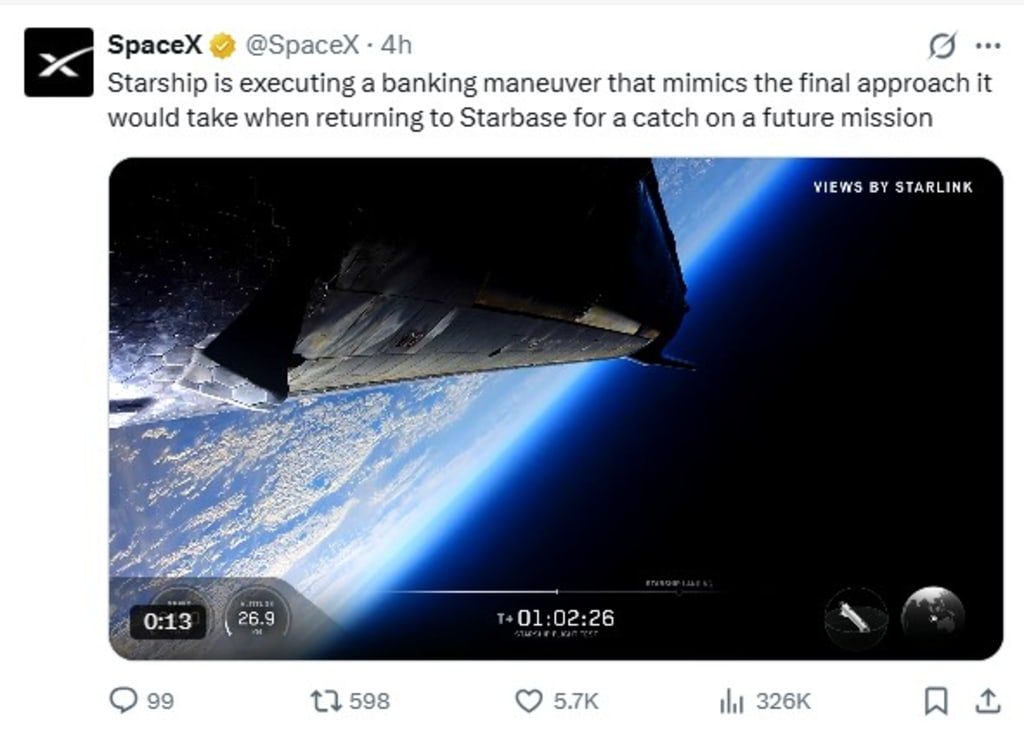
Re‑entry began. S40 plunged into the atmosphere at over Mach 20. A plasma sheath enveloped the vehicle, temporarily interrupting communications – but thanks to the Starlink relay network, ground stations received near‑continuous telemetry and video. Cameras captured the glow of ionized air flowing over the heat shield tiles – a mix of violet and orange‑red hues.
The flip maneuver executed. Attitude‑control engines rotated the vehicle from horizontal to vertical, and S40 performed a powered splashdown in the designated area of the Indian Ocean.
It landed on the water. The vehicle tilted, floated – no explosion, no disintegration. The engine bay and forward flaps remained intact. This was the first time a Starship upper stage had remained structurally complete after a controlled splashdown. Buoy‑mounted cameras nearby relayed footage back: some heat tiles showed localized damage, but the overall condition was far better than in any previous flight. Elon Musk later posted: “We got all the heat shield data we needed, and then some.”
Total mission duration: 1 hour, 5 minutes, and 51 seconds.
Booster landing ignition remains unsolved – engine relight reliability and restart count need further work. The local tile damage will be reviewed and repaired. But Starship achieved all its primary objectives: deploying real satellites, relighting an engine in orbit, and returning the upper stage intact.
The launch window for Flight 14 has not yet been announced. What is known is that S40 will aim for its first true orbital insertion. The gap between Flight 12 and Flight 13 was just under two months. Comparing the splashdown imagery from Flight 13 with the wreckage photos from the previous four tests, the progress is clear – from fragmentation to flotation.
The launch tower at Boca Chica remains unchanged. But Starship itself is moving from a phase of iterative failure into something else – a vehicle that can deliver payloads, relight its engines, and come back in one piece.
About the Creator
Jin
Writer of reamstories
https://reamstories.com/jin
Enjoyed the story? Support the Creator.
Subscribe for free to receive all their stories in your feed. You could also become a paid subscriber, letting them know you appreciate their work.
Comments
There are no comments for this story
Be the first to respond and start the conversation.