
Starship Finally Reached Orbit. Then It Came Home After Two Laps.
After fourteen flights and ten years, SpaceX’s giant rocket left satellites in orbit for the first time. Its engine problems did not go away.
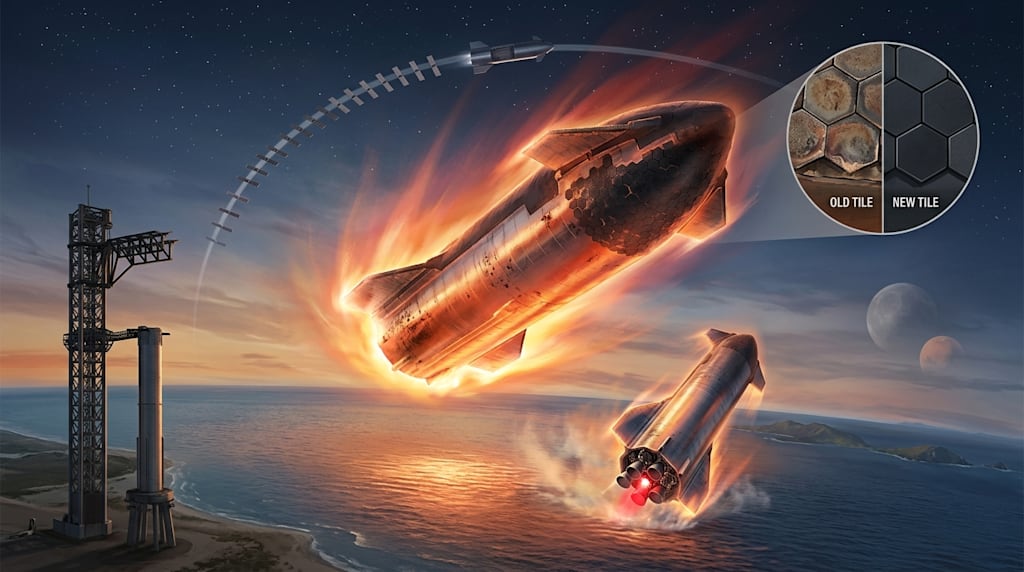
At 23:57 Beijing time, a 52-meter stainless steel ship dropped out of the sky north of Hawaii. It flipped upright, lit one engine, and settled onto the Pacific. Three hours earlier, it had launched from Starbase in Texas. It was supposed to circle Earth six times. It flew less than two.
That ship was Starship S41. On its fourteenth test flight, it became the first Starship to enter orbit, the first to leave a payload there, and the first to perform a deorbit burn and return from orbit. It also became the first to splash down in the Pacific and the first to fly with refurbished heat shield tiles from another ship.
The flight was a milestone. It was not a clean one.
The line SpaceX avoided for thirteen flights
Throw a stone sideways. The harder you throw it, the farther it goes before hitting the ground. Throw it fast enough, and the ground curves away beneath it. The stone keeps falling, but it never lands. It circles Earth.
That is orbit. At a few hundred kilometers up, the required speed is about 7.8 kilometers per second.
Starship’s first thirteen flights never reached that speed. Their perigee, the lowest point of the orbit, stayed inside the dense atmosphere. They could not complete even one full orbit. If the engines failed in space, the ship would fall back into the Indian Ocean about an hour after launch. That was the safety net.
Orbit removes the net. To come home, the ship must relight its engines in space and slow down. If that burn fails, the ship is stuck. At a few hundred kilometers up, the atmosphere is thin, but it still drags. The orbit decays. The ship reenters at a time and place no one can predict. Starship is built to survive reentry heat. It would not burn up like a dead satellite. Large pieces could hit the ground.
This has happened before. Skylab, the first U.S. space station, weighed about 77 tons. It launched in 1973. NASA planned to boost it higher or guide it down once the Space Shuttle was flying. The Shuttle was delayed. Solar activity expanded the upper atmosphere and increased drag. Skylab came down on July 11, 1979. Most of it burned. Some debris landed in Western Australia. No one was hurt. The town of Esperance fined NASA 400 Australian dollars for littering. The fine was paid off in 2009 by an American radio host who raised the money from listeners.
So the real test of flight fourteen was not launch. It was the end. The engines had to relight. The ship had to slow down. It had to survive reentry. It had to land in the sea. It did.
What happened on flight fourteen
Booster B21 lifted off at 20:49 Beijing time, carrying Ship S41. Starship is 9 meters wide and 124.4 meters tall. It has no side boosters. Both stages burn liquid oxygen and liquid methane.
The first stage, Super Heavy, is 72.3 meters tall. It holds 3,650 tons of propellant and has 33 third-generation Raptor engines. Its liftoff thrust is 8,240 tons. The second stage is the Starship spacecraft. It is 52.1 meters tall, holds 1,600 tons of propellant, and uses six third-generation Raptors. Three are sea-level versions. Three are vacuum versions with larger nozzles.
The stages separated about two minutes after liftoff.
Recovering the first stage takes two burns. The boostback burn turns it around. The landing burn slows it down. Older Super Heavy boosters flew back to the launch tower three times and were caught by giant mechanical arms nicknamed “the chopsticks.” The V3 first stage has not managed that yet.
B21 lost one engine during ascent. Two more failed to light during the boostback burn. It still completed the landing burn and splashed down softly in the Gulf of Mexico. That was the first complete splashdown for a V3 booster. Shortly after hitting the water, B21 exploded.
The ship also lost one vacuum Raptor during ascent. The remaining engines burned longer and pushed S41 onto its planned path. At that point, the trajectory was still suborbital, just like the first thirteen flights. Having many engines helped. Starship lost one on each stage and still reached orbit.
But losing engines costs propellant. The ship has less margin for the rest of the mission. Across three V3 flights, the first stage has had an engine fail every time. The ship has had an ascent shutdown twice.
At 25 minutes and 17 seconds after liftoff, S41 lit one Raptor and raised its perigee above the atmosphere. It entered a low Earth orbit about 275 kilometers high. About 34 minutes after liftoff, a long door opened on the side of the ship. Twenty-six flat V3 Starlink satellites slid out one by one. The deployment system is nicknamed the “card dealer.”
This time, the satellites stayed in orbit. They will unfold solar panels and antennas, contact ground stations, run tests, and use electric propulsion to raise themselves to an operating altitude above 300 kilometers. Three of them were modified to turn back and photograph S41, checking its heat shield.
This was the first Starship flight to put payloads in orbit and leave them there.
It was supposed to stay up for six orbits and seven and a half hours of coasting. After the ascent engine shutdown, SpaceX assessed the ship. At 22:29 Beijing time, the company decided to bring it home early. Musk said, “We were extra cautious this time.” He explained that if the ship broke up over land and debris hit someone, SpaceX’s reputation would take a severe hit.
At about 23:00 Beijing time, 2 hours and 12 minutes after liftoff, S41 lit one Raptor and began its deorbit burn. Two secondhand heat shield tiles went with it. The ship reentered belly-first, wrapped in glowing plasma, and slowed over the Pacific. Near the surface, it flipped vertical, lit its engines, and splashed down north of Hawaii.
From liftoff to splashdown, the flight took about three hours. It was nearly seven hours shorter than planned.
Why it only flew two laps
The missing hours were meant to test things the first thirteen flights never could.
Temperature swings come first. One orbit takes about 90 minutes. The ship passes through sunlight and shadow on every lap. Walls and equipment heat up and cool down again and again. Propellant also boils off. Liquid oxygen is kept at minus 183 degrees Celsius. Liquid methane is kept at minus 162 degrees Celsius. Every extra minute in space means more propellant lost. The ship has to manage those tanks and save enough for the deorbit burn. Attitude control and power also have to work for hours without a break.
Starship will eventually spend days or months in space on trips to the Moon and Mars. This flight tested only a small part of that.
The heat shield is the other major question. Starship is covered in about 20,000 black hexagonal tiles. During reentry, the ship hits speeds up to 25 times the speed of sound. The air ahead is compressed violently, and temperatures rise past a thousand degrees Celsius. Most of the heat comes from compression, not friction.
SpaceX wants Starship to fly like a commercial airliner. The heat shield has to be easy to maintain, easy to replace, and reusable. That determines how fast the ship can fly again.
S41’s heat shield was improved using data from S40, the ship that flew on the thirteenth flight. Earlier Starships often tipped over and exploded after splashdown. S40 did not. SpaceX decided to recover it, a process that took 24 days. It was the first complete Starship recovered, and the first chance engineers had to study heat shield tiles that had survived reentry.
S41 changed four things. It added extra fasteners where tiles were most likely to shake loose during ascent. It sealed gaps that let hot plasma reach the back of the tiles. It used curved tiles in some areas to lower temperatures at the gaps. And it carried two tiles removed from S40, refurbished, and stuck onto S41. Two tiles is not much. It is still the first time Starship reused heat shield hardware from another ship.
The business behind the flight
Starlink, lunar landers, Starshield, orbital computing, and Mars missions all depend on Starship. The most urgent customer is Starlink.
By September 2026, Starlink had launched about 13,000 satellites and had about 11,000 in orbit. It served tens of millions of users in more than 160 countries and regions. Before this flight, Falcon 9 launched all of them. Falcon 9 can carry more than 20 second-generation Starlink satellites at a time. Third-generation satellites, V3, are larger, heavier, and more capable. Only Starship can launch them.
One V3 satellite has about 1 Tbps of communications capacity. That is 10¹² bits per second, enough for 10,000 households to run 100-megabit broadband at full speed. The 26 V3 satellites on this flight total about 26 Tbps. SpaceX says that equals ten Falcon 9 launches.
The 26 satellites weigh about 46 tons. SpaceX says they could begin serving users within weeks. Musk has said V2 Starlink cannot meet future demand. V3 needs about 1,000 satellites in orbit to noticeably improve service. A fully loaded Starship can carry about 60 V3 satellites. This flight carried 26. Reaching 1,000 will take at least 17 more successful full loads. SpaceX has asked the FCC for permission to operate up to 100,000 V3 satellites.
Starship’s medium-term goal is one launch per day. In 2025, Falcon 9 launched more than 160 times, about one launch every two days. That was after 15 years of flying. To hit daily launches, SpaceX needs more rockets and more pads.
S41 has just flown. S42 and S43 are built. S44 is waiting in the factory. The fifteenth flight may try to catch the ship with the chopsticks for the first time. Engine problems could delay that plan. Starbase in Texas has one usable pad. Another is being converted. The Starship facilities at Kennedy Space Center’s Pad 39A are nearly ready. If schedules hold, flight sixteen could launch from Florida. SpaceX also plans a Louisiana site called Starbase Louisiana, with up to $100 billion in investment. Construction could start by late 2027, with the first launch possibly in 2029. Musk says the site could eventually have more than 12 launch towers.
The Moon is the next latch
NASA’s Artemis program is another Starship customer. In early 2026, NASA changed its plans. Artemis 3, originally the first crewed lunar landing, became a low Earth orbit docking test around mid-2027. The first crewed landing moved to Artemis 4 in early 2028. Starship is the primary lunar lander. NASA has spent more than $4 billion on the Starship lander and kept Blue Origin’s Blue Moon as a backup. Before this flight, Starship had never reached orbit.
The harder problem is orbital refueling. A Starship reaches low Earth orbit with almost no propellant left. To fly to the Moon, it must refuel in orbit. That requires multiple tanker Starships flying up one after another. SpaceX has never demonstrated this in space. To refuel, the ship must first reach orbit. To wait for tankers, it must prove it can stay in orbit for a long time. This flight reached orbit and came back. It ended its time in space early. Long-duration flight remains untested.
Engine reliability matters even more for a lunar landing. The lander must descend to the surface and take off again. Its engines must light every time. If something fails, no one can go rescue it.
What the fourteenth flight proved
Starship entered orbit. It deployed 26 satellites. It came back. It used two refurbished heat shield tiles. It splashed down in a new ocean. Those are real steps.
The flight also left the hardest work untouched. The third-generation Raptor still has engine shutdowns. Orbital refueling has never been tried. Starlink V3 needs at least 17 more full loads to reach its first service target. The Louisiana base is still a plan.
The fourteenth flight put 26 satellites in orbit. It also showed how much work remains before Starship can fly often, refuel in space, and carry people beyond low Earth orbit.
About the Creator
Jin
Writer of reamstories
https://reamstories.com/jin
Enjoyed the story? Support the Creator.
Subscribe for free to receive all their stories in your feed. You could also become a paid subscriber, letting them know you appreciate their work.
Comments
There are no comments for this story
Be the first to respond and start the conversation.