
Southeast Asia Building Management System Market Grows Rapidly with Smart Infrastructure Demand
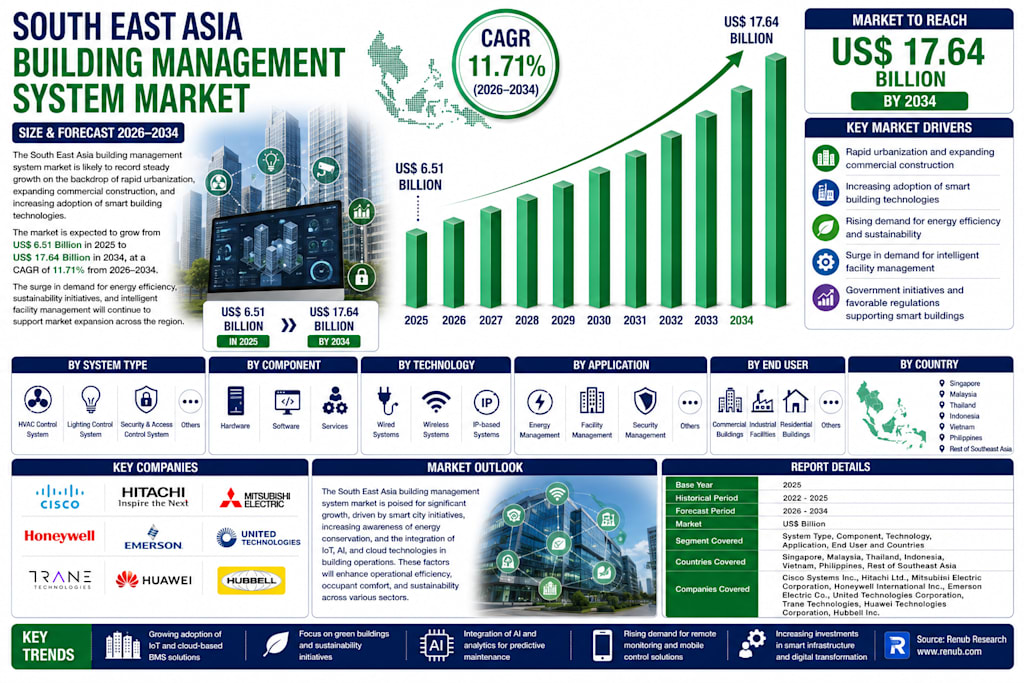
Driven by urbanization, sustainability goals, and smart city initiatives, the Southeast Asia building management system (BMS) market is projected to expand from US$ 6.51 billion in 2025 to US$ 17.64 billion by 2034, at a CAGR of 11.71% from 2026 to 2034.

The Southeast Asia building management system (BMS) market is entering a high-growth phase as the region accelerates its transition toward smart infrastructure and sustainable urban development. With rapid urbanization, rising energy costs, and increasing demand for efficient building operations, BMS solutions are becoming a critical component of modern construction projects.
According to Renub Research, the market is expected to grow from US$ 6.51 billion in 2025 to US$ 17.64 billion by 2034, reflecting a strong compound annual growth rate (CAGR) of 11.71% during the forecast period. This growth highlights the increasing adoption of intelligent building technologies across the region.
A building management system is an integrated digital platform used to monitor and control various building operations, including heating, ventilation, air conditioning (HVAC), lighting, energy usage, fire safety, and security systems. By automating these functions, BMS solutions improve operational efficiency, reduce energy consumption, and enhance safety and comfort within buildings.
Rapid Urbanization and Infrastructure Development
Urbanization is one of the primary drivers of the BMS market in Southeast Asia. The region is experiencing some of the fastest urban growth rates globally, with millions of people moving to cities each year.
Countries such as Indonesia, Vietnam, Thailand, and the Philippines are witnessing significant investments in infrastructure, including commercial buildings, residential complexes, airports, shopping malls, and mixed-use developments. As buildings become larger and more complex, manual management becomes inefficient, increasing the need for automated systems.
BMS solutions enable building owners to monitor and control operations in real time, optimizing performance and reducing operational costs. The integration of these systems during the design phase of new buildings is becoming increasingly common, further driving market growth.
Rising Demand for Energy Efficiency and Sustainability
Energy efficiency is a key factor driving the adoption of BMS solutions. Commercial buildings consume significant amounts of energy, and rising electricity costs are pushing developers and facility managers to adopt energy-saving technologies.
BMS systems provide real-time insights into energy consumption, allowing users to identify inefficiencies and optimize usage. Automated control of HVAC systems, lighting, and other building functions helps reduce energy waste and lower operating costs.
Government policies promoting green building standards and sustainability initiatives are further supporting market growth. Developers are increasingly adopting BMS solutions to meet regulatory requirements and enhance the environmental performance of their buildings.
In tropical climates like Southeast Asia, efficient energy management is particularly important, making BMS systems a valuable tool for maintaining comfort while minimizing energy consumption.
Smart Cities and Digital Transformation
The rise of smart city initiatives is another major driver of the BMS market. Governments across Southeast Asia are investing in digital infrastructure to improve urban living conditions and enhance resource management.
BMS systems play a crucial role in smart city ecosystems by enabling real-time monitoring and control of building operations. Integration with technologies such as the Internet of Things (IoT), cloud computing, and artificial intelligence is enhancing the functionality and efficiency of these systems.
Digital transformation initiatives are also encouraging businesses to adopt advanced technologies for building management. For example, partnerships between technology providers and infrastructure developers are driving innovation in smart building solutions.
As cities become more connected and data-driven, BMS systems are expected to become a fundamental component of urban infrastructure.
Challenges: High Costs and Skill Gaps
Despite its strong growth potential, the Southeast Asia BMS market faces several challenges. One of the primary barriers is the high initial cost of implementing BMS solutions. These systems require significant investment in hardware, software, and integration services.
For small and medium-sized developers, especially in emerging economies, this cost can be a deterrent. Retrofitting existing buildings with BMS systems is also complex and expensive, limiting adoption.
Another challenge is the lack of skilled professionals capable of designing, installing, and maintaining BMS systems. These systems involve the integration of multiple technologies, including HVAC, lighting, security, and energy management, requiring specialized expertise.
Addressing these challenges will be essential for ensuring widespread adoption and maximizing the benefits of BMS technology.
Segment Insights: Expanding Applications
The BMS market in Southeast Asia is highly diverse, with applications spanning multiple segments.
HVAC Systems
HVAC systems are a major component of BMS, particularly in tropical climates where temperature and humidity control are critical. Integration with BMS enables automated temperature regulation and energy optimization.
Security and Access Control
Advanced security systems, including biometric authentication and RFID-based access control, are increasingly integrated with BMS for centralized monitoring and enhanced safety.
Software and Cloud Solutions
BMS software solutions are evolving rapidly, with cloud-based platforms enabling remote monitoring and control. These systems offer scalability, flexibility, and real-time analytics.
Commercial Buildings
Commercial buildings, including offices, malls, hotels, and airports, represent a significant segment of the BMS market. These facilities require efficient management of multiple systems to reduce costs and improve performance.
These segments highlight the versatility of BMS solutions and their importance across various building types and applications.
Regional Insights: Key Markets Driving Growth
Malaysia is experiencing steady growth in the BMS market, driven by infrastructure development and a focus on energy efficiency. Major cities such as Kuala Lumpur and Penang are witnessing increased adoption of smart building technologies.
Indonesia is another key market, supported by rapid urbanization and large-scale infrastructure projects. Government initiatives promoting smart cities and energy efficiency are encouraging BMS adoption.
Singapore stands out as a regional leader, with advanced smart city initiatives and widespread implementation of BMS across commercial and residential buildings. Strong government support and digital infrastructure are driving innovation and adoption.
These regional dynamics highlight the diverse growth patterns across Southeast Asia and the importance of local factors in shaping market development.
Competitive Landscape and Key Players
The Southeast Asia BMS market is highly competitive, with major global and regional players investing in innovation and expansion. Key companies include Honeywell International, Siemens, Mitsubishi Electric, Hitachi, Emerson Electric, and Cisco Systems.
These companies are focusing on advanced technologies such as IoT, AI, and cloud computing to enhance the functionality and efficiency of BMS solutions. Strategic partnerships and collaborations are also driving market growth.
As competition intensifies, companies are increasingly emphasizing energy efficiency, sustainability, and user-friendly solutions to differentiate themselves in the market.
Final Thoughts
The Southeast Asia building management system market is set for strong growth as the region continues to urbanize and embrace smart infrastructure.
Renub Research’s forecast of US$ 17.64 billion by 2034 highlights the market’s significant potential.
While challenges such as high costs and skill shortages remain, ongoing technological advancements and government initiatives are expected to drive widespread adoption.
Ultimately, BMS technology is becoming a cornerstone of modern urban development, enabling smarter, more efficient, and sustainable buildings that support the evolving needs of Southeast Asia’s rapidly growing cities.
About the Creator
Enjoyed the story? Support the Creator.
Subscribe for free to receive all their stories in your feed.
Comments
There are no comments for this story
Be the first to respond and start the conversation.