
South Korea Private Equity Market: Size, Share and Industry Forecast
How Strategic Capital Investment, Digital Transformation, and Corporate Consolidation Are Reshaping South Korea's Private Equity Landscape

Market Overview
South Korea's private equity market represents one of Asia's most dynamic and sophisticated investment sectors, encompassing diverse capital deployment strategies including leveraged buyouts, venture capital investments, real estate acquisitions, and infrastructure development. Private equity firms serve as catalysts for corporate transformation, enabling companies to achieve aggressive growth, operational optimization, strategic acquisitions, and market expansion through expert capital deployment and management expertise.
The sector reflects South Korea's position as a global economic powerhouse with world-class companies, innovative startups, and substantial wealth creation opportunities. Private equity investors target businesses across manufacturing, technology, healthcare, consumer goods, financial services, and emerging sectors, deploying capital to enhance operational efficiency, drive innovation, and execute strategic consolidation. The market encompasses both domestic South Korean firms and international investors recognizing exceptional opportunities within Asia's second-largest economy.
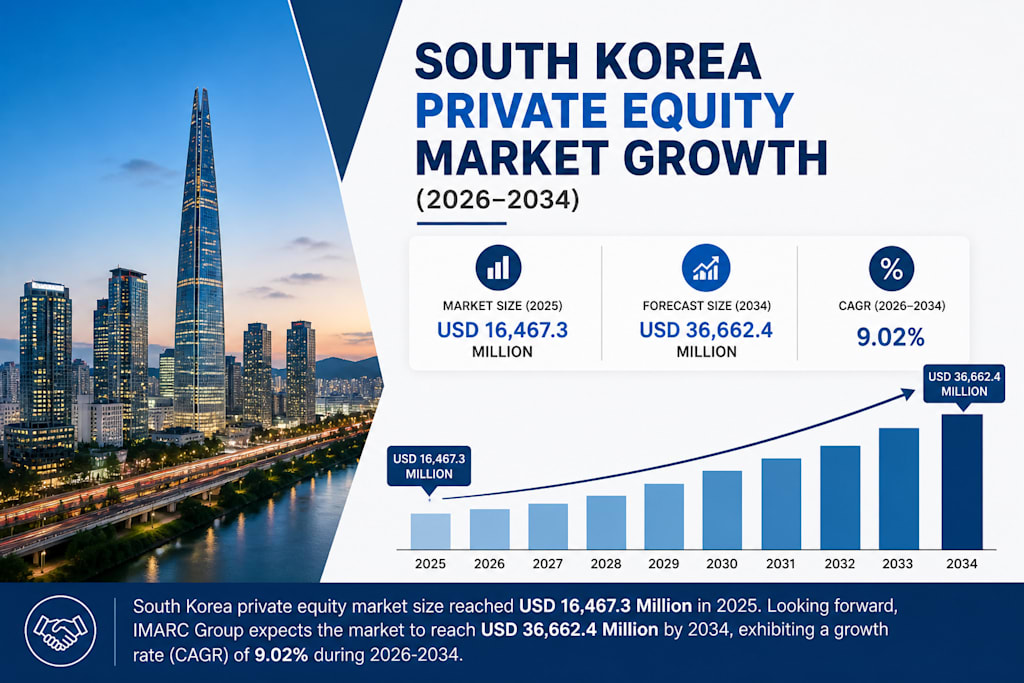
The South Korea private equity market size reached USD 16,467.3 Million in 2025, reflecting substantial capital deployment across diverse investment strategies. Looking forward, the market is projected to reach USD 36,662.4 Million by 2034, exhibiting a growth rate of 9.02% during 2026-2034. Market expansion is driven by increasing institutional investor demand for alternative assets, strong economic fundamentals supporting corporate valuations, digital transformation creating operational improvement opportunities, government support for venture capital and startup ecosystems, and growing consolidation within traditional industries creating acquisition targets.
Request PDF Sample for more detailed market insights:
Role of Innovation in Market Development
• Digital-First Investment Strategies and Technology Integration
South Korea's private equity market increasingly integrates advanced digital technologies into portfolio company operations. PE firms deploy artificial intelligence, machine learning, and data analytics to identify investment opportunities, assess operational efficiency, and optimize performance. Digital transformation initiatives enhance portfolio company competitiveness, reduce operational costs, and enable rapid scaling through technology-enabled business model innovation.
Cloud computing integration, automation, and cybersecurity enhancements represent critical value-creation levers. PE firms with technology expertise accelerate digital transformation in traditional industries, creating substantial value through operational leverage and market share expansion.
• ESG Integration and Sustainable Value Creation
Environmental, social, and governance considerations increasingly influence private equity investment decisions and portfolio company management. Investors recognize that strong ESG practices enhance long-term value creation, reduce operational risks, and align with growing investor preferences. PE firms implement comprehensive ESG frameworks, measure and improve portfolio company sustainability metrics, and position companies for regulatory compliance and stakeholder expectations.
Climate change adaptation, supply chain sustainability, workforce development, and corporate governance improvements represent value-creation opportunities alongside financial returns. ESG-focused PE strategies attract institutional capital while enhancing portfolio company resilience and competitiveness.
• Alternative Exit Strategies and Value Realization
Private equity firms increasingly employ diverse exit strategies beyond traditional IPOs. Secondary acquisitions by larger PE firms, strategic buyer sales, dividend recapitalizations, and continuation funds enable flexible value realization timelines. These strategies provide portfolio companies with extended growth periods, reduced external liquidity pressures, and alignment with company-specific development trajectories.
South Korea Private Equity Market Trends and Drivers
• Increasing Institutional Investor Demand for Alternative Assets
South Korean institutional investors including pension funds, insurance companies, and university endowments increasingly allocate capital to private equity seeking enhanced returns and portfolio diversification. Persistent low interest rates reduce traditional fixed-income returns, making PE's historical risk-adjusted returns increasingly attractive. Demographic shifts toward aging populations create substantial pension capital requiring alternative asset deployment.
Institutional investor sophistication regarding PE risk and return expectations increases, enabling direct PE co-investments alongside fund partnerships. Korean family offices and ultra-high-net-worth individuals deploy substantial capital into PE vehicles, supporting robust capital availability for investment opportunities.
• Digital Transformation and Operational Improvement Opportunities
Traditional South Korean industries including manufacturing, retail, and business services present substantial digital transformation opportunities. PE firms acquire traditional companies, implement digital solutions, and enhance operational efficiency through technology integration. Companies ranging from family-controlled enterprises to publicly traded firms represent acquisition targets for PE investors seeking digital transformation and modernization.
The Korean economic paradigm shift toward technology-enabled business models creates value-creation opportunities for PE investors with digital expertise. PE-backed companies increasingly become industry leaders through technology-driven competitive advantages.
• Venture Capital Growth and Startup Ecosystem Support
South Korea's vibrant startup ecosystem and government support for venture capital create substantial investment opportunities. PE firms establish dedicated venture capital platforms, co-invest alongside traditional VC firms, and provide growth capital enabling portfolio company expansion. The nation's proven ability to develop global technology leaders attracts international PE capital focused on Korean startups.
Government initiatives supporting entrepreneurship, R&D investment incentives, and startup financing create favorable conditions for venture capital deployment. PE-backed startups increasingly achieve unicorn status, generating exceptional returns and supporting market expansion.
• Corporate Consolidation and M&A Activity
South Korea's mature industries including retail, hospitality, and traditional manufacturing experience consolidation as market dynamics and competition intensify. PE investors execute strategic acquisitions consolidating fragmented markets, achieving operational synergies, and building regional or national champions. The Korean economy's exposure to global competition drives consolidation as companies seek scale, efficiency, and market power.
Strategic acquisitions by larger Korean corporations and international buyers create PE exit opportunities while enabling new investment cycles and value creation.
South Korea Private Equity Market Segmentation
By Fund Type
Buyout (Largest Segment - 45% market share):
• Leveraged buyouts of mature companies
• Management buyouts enabling founder transitions
• Secondary acquisitions of portfolio companies
• Platform acquisitions with add-on strategy execution
Buyout funds dominate the private equity market, focusing on acquisition of established businesses offering stable cash flows, operational improvement opportunities, and financial engineering value creation. Korean companies with founder transitions, family business succession challenges, or operational improvement needs represent attractive buyout targets. PE buyout firms leverage EBITDA multiples and operational leverage to achieve target returns.
Venture Capital (VCs) (25% market share):
• Early-stage seed investments
• Growth capital for scaling startups
• Series A through Series D investments
• Technology and innovation-focused investments
Venture capital funds target high-growth startups with exceptional market opportunities and talented founding teams. South Korea's technology sector, including software, semiconductors, biotechnology, and clean energy, attracts substantial VC capital. PE-backed venture capital platforms combine growth capital with operational expertise, accelerating startup development and value creation.
Real Estate (15% market share):
• Commercial property acquisitions
• Residential development projects
• Mixed-use development opportunities
• Alternative real estate investments
Real estate PE funds acquire undervalued properties, implement value-add strategies including repositioning and redevelopment, and exit through sale or refinancing. Korea's urban property markets, including Seoul, Busan, and secondary cities, present acquisition opportunities.
Infrastructure (10% market share):
• Utility and renewable energy investments
• Transportation and logistics infrastructure
• Telecommunications infrastructure
• Social infrastructure projects
Infrastructure PE funds target long-term, stable-cash-flow assets with inflation-protection characteristics. South Korea's commitment to renewable energy transition, 5G deployment, and sustainable infrastructure creates investment opportunities. Infrastructure PE provides government-supported capital for public-private partnerships and essential services infrastructure.
Others (5% market share):
• Mezzanine financing
• Distressed asset investments
• Special situations and opportunistic strategies
South Korea Private Equity Market Drivers and Opportunities
• Strong Economic Fundamentals and Corporate Valuations
South Korea's advanced economy, skilled workforce, technological expertise, and global market presence support robust corporate valuations. PE investors acquire companies with established market positions, operational excellence, and international competitive advantages. The nation's manufacturing strength, technology sector prominence, and financial services sophistication provide diverse investment opportunities.
• Government Support for Venture Capital and Startups
South Korean government initiatives including tax incentives, research funding, and regulatory support facilitate venture capital investment and startup development. Government-backed venture capital funds, accelerator programs, and innovation hubs create favorable conditions for PE-backed startup growth and international expansion.
• Cross-Border Investment Flows
International PE firms increasingly target South Korean investment opportunities, recognizing exceptional companies and market dynamics. Korean PE firms expand internationally, acquiring assets in Southeast Asia, China, and other regions, creating reverse investment flows and capital deployment across multiple geographies.
Competitive Landscape
South Korea's private equity market includes leading global PE firms maintaining Korean offices and funds, domestic Korean PE firms with deep market knowledge, specialist sector-focused PE investors, and emerging platforms targeting niche opportunities. Competition intensifies based on capital availability, sectoral expertise, operational value-creation capability, and management team track records. Firms with Korean market understanding, strong portfolio company operational teams, and sector-specific expertise strengthen competitive positions.
Leading Korean PE firms including major conglomerates' investment arms, standalone PE firms, and emerging platforms vie for deal flow and limited partnership capital. International PE firms compete through global resources, cross-border transaction expertise, and capital scale.
Market Outlook
The South Korea private equity market is expected to witness sustained growth as institutional capital continues flowing into alternative assets and digital transformation opportunities persist across the economy. The market is projected to grow at a compound annual growth rate of 9.02% during 2026-2034. Strategic capital deployment in digital-enabled businesses, venture capital growth supporting startup ecosystems, infrastructure investment supporting sustainability transitions, and corporate consolidation will remain critical market drivers.
South Korea's position as a global technology leader, strong corporate fundamentals, skilled workforce, and government support create compelling PE investment opportunities. The transition toward technology-enabled business models, ESG-conscious investing, and sustainable development will continue driving PE market expansion and value creation.
Key Market Growth Catalysts:
• Increasing institutional capital allocation to alternative assets
• Digital transformation and operational improvement opportunities
• Venture capital growth and startup ecosystem expansion
• Corporate consolidation in mature industries
• Government support for innovation and entrepreneurship
• Renewable energy transition and infrastructure investment
• Cross-border investment flows and international expansion
• ESG integration and sustainable value creation
About the Creator
Yoshio
Market Research Analyst with 5+ years of experience in consumer insights and market segmentation. Skilled in data analysis and qualitative research.
Enjoyed the story? Support the Creator.
Subscribe for free to receive all their stories in your feed.
Comments
There are no comments for this story
Be the first to respond and start the conversation.