
South Korea Fintech Market: Size, Share and Industry Forecast
How Digital Payments, AI Integration, and Blockchain Innovation Are Revolutionizing South Korea's Financial Services Ecosystem

Market Overview
South Korea's fintech market represents one of Asia's most dynamic and sophisticated financial technology sectors, encompassing digital payments, mobile banking, cryptocurrency platforms, robo-advisors, blockchain solutions, and alternative financing mechanisms. Fintech companies leverage advanced technologies including artificial intelligence, machine learning, cloud computing, and blockchain to deliver innovative financial services that enhance efficiency, reduce costs, and improve accessibility. The sector disrupts traditional banking models by offering digital-first solutions tailored to evolving consumer needs and preferences.
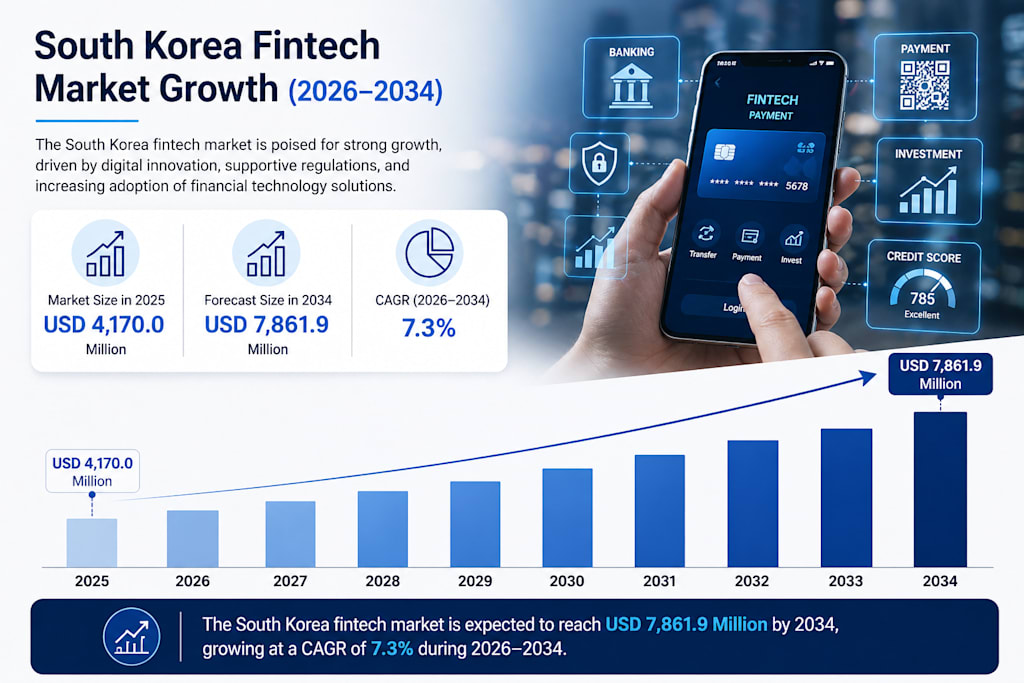
The South Korea fintech market size reached USD 4,170.0 Million in 2025. Looking forward, IMARC Group expects the market to reach USD 7,861.9 Million by 2034, exhibiting a growth rate of 7.3% during 2026-2034. Market growth is being driven by continuous technological advancements in artificial intelligence, blockchain, and cloud computing; widespread adoption of digital payment solutions; regulatory frameworks promoting fintech innovation; and collaborations between traditional financial institutions and fintech startups.
Request PDF Sample for more detailed market insights:
Role of Innovation in Market Development
• Artificial Intelligence and Machine Learning Applications
Advanced AI and machine learning technologies are revolutionizing fintech service delivery through improved risk management, fraud detection, credit assessment, and customer personalization. AI-powered algorithms analyze vast datasets to identify patterns, predict customer behavior, and optimize financial decision-making. Machine learning models continuously improve through experience, becoming increasingly effective at identifying emerging risks and opportunities.
• Blockchain and Cryptocurrency Innovation
Blockchain technology enables secure, transparent, and decentralized financial transactions that reduce intermediaries and settlement time. Cryptocurrency platforms and digital asset management services leverage blockchain to provide innovative alternatives to traditional financial services. Smart contracts automate complex financial agreements while reducing manual intervention and operational costs.
• Cloud Computing and Digital Infrastructure
Cloud-based platforms enable fintech companies to scale rapidly, reduce infrastructure costs, and provide seamless user experiences across devices. Cloud infrastructure supports real-time data processing, advanced analytics, and integration with traditional banking systems, facilitating cooperation between fintech innovators and established financial institutions.
South Korea Fintech Market Trends and Drivers
• Digital Payments Dominance and Mobile-First Adoption
Digital payment solutions, including online purchases and point-of-sale transactions, represent the largest market segment. Widespread smartphone penetration and consumer preference for contactless payments accelerate digital payment adoption. Integration of payment solutions into mobile applications and wearable devices expands accessibility and convenience.
• Alternative Financing and P2P Lending Growth
Alternative financing mechanisms including peer-to-peer lending, small business lending, and crowdfunding provide capital access to underserved borrowers. These platforms utilize data analytics to assess creditworthiness and reduce lending costs, offering competitive rates compared to traditional banking.
• Insurtech Innovation and Digital Insurance
Insurance technology companies are revolutionizing insurance distribution and claims processing through digital platforms. Online life insurance, health insurance, motor insurance, and general insurance products provide consumers with convenient access to insurance solutions with simplified underwriting and claims processes.
• Regulatory Support and Financial Inclusion
Supportive regulatory frameworks that encourage fintech innovation while maintaining consumer protection drive market growth. Government initiatives promoting financial inclusion enable underserved populations to access financial services through fintech platforms. Open banking regulations facilitate data sharing and interoperability between fintech companies and traditional banks.
• Collaborations Between Fintech and Traditional Finance
Strategic partnerships between fintech startups and established financial institutions combine innovation with financial stability and regulatory compliance. These collaborations enable rapid scaling of fintech solutions while leveraging traditional banks' customer bases and operational infrastructure.
South Korea Fintech Market Segmentation
By Service
• Digital Payments (Online Purchases, POS Purchases)
• Personal Finance (Digital Asset Management, Remittance/International Money Transfers)
• Alternative Financing (P2P Lending, SME Lending, Crowdfunding)
• Insurtech (Online Life Insurance, Health Insurance, Motor Insurance, General Insurance)
• B2C Financial Services Marketplaces
• E-Commerce Purchase Financing
• Others
Digital payments represent the largest service segment with strong growth from e-commerce expansion and digital wallet adoption. Personal finance services enable consumers to manage investments, transfer funds internationally, and access wealth management tools. Alternative financing platforms democratize access to capital for individuals and small businesses.
By Region
• Seoul Capital Area
• Yeongnam (Southeastern Region)
• Honam (Southwestern Region)
• Hoseo (Central Region)
• Others
The Seoul Capital Area dominates the fintech market, hosting leading fintech companies, technology talent, and investment capital. Major financial institutions and technology companies concentrate in Seoul, driving innovation and attracting startup ecosystem development. Provincial regions demonstrate growing fintech adoption as digital banking and payment solutions expand beyond metropolitan areas.
Competitive Landscape
The South Korea fintech market includes pure-play fintech companies, digital banking platforms, established financial institutions' fintech divisions, technology giants entering financial services, and specialized solution providers. Competitive positioning is influenced by technological capability, regulatory compliance, customer acquisition strategies, and service quality. Companies offering integrated solutions combining multiple fintech services with superior user experiences are strengthening market positions.
Market Outlook
The South Korea fintech market is expected to witness substantial growth as digital transformation accelerates and consumer preferences shift toward digital-first financial services. The market is projected to grow at a compound annual growth rate of 7.3% during 2026-2034. Investments in AI-powered financial services, blockchain-based solutions, digital payment infrastructure, and regulatory compliance technology will remain critical for competitive success. Fintech will continue to reshape South Korea's financial landscape, improving accessibility, efficiency, and innovation in financial services delivery.
About the Creator
Yoshio
Market Research Analyst with 5+ years of experience in consumer insights and market segmentation. Skilled in data analysis and qualitative research.
Enjoyed the story? Support the Creator.
Subscribe for free to receive all their stories in your feed.
Comments
There are no comments for this story
Be the first to respond and start the conversation.