
South Korea Autonomous Forklifts Market Is Reshaping the Future of Smart Warehousing
AI-driven material handling, warehouse automation, and Industry 4.0 adoption are accelerating market growth

Market Overview
Autonomous forklifts are advanced material handling vehicles equipped with artificial intelligence (AI), sensors, cameras, and navigation systems that allow them to operate with minimal human intervention. These forklifts are designed to automate tasks such as transporting goods, loading pallets, and warehouse inventory management, improving operational efficiency and workplace safety.
In South Korea, the autonomous forklifts market is growing rapidly as industries increasingly adopt smart manufacturing and warehouse automation technologies. The country’s strong industrial infrastructure, advanced robotics ecosystem, and focus on digital transformation are supporting the deployment of autonomous material handling systems across logistics centers, factories, and distribution hubs.
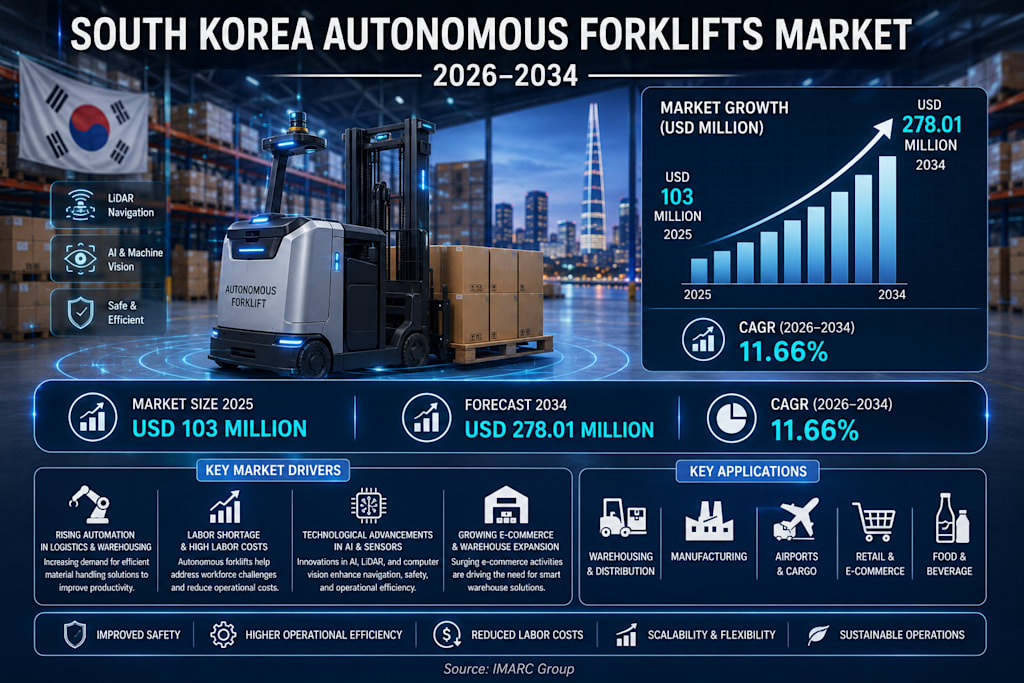
The South Korea autonomous forklifts market reached approximately USD 103 million in 2025. Looking ahead, the market is projected to grow significantly and reach around USD 278.01 million by 2034, exhibiting a compound annual growth rate (CAGR) of 11.66% during 2026–2034. Growth is driven by rising demand for warehouse automation, labor optimization, and advancements in AI-powered industrial equipment.
Download a Sample PDF of This Report
Role of Innovation in Market Development
- AI and Sensor-Based Navigation Systems
Autonomous forklifts use advanced AI algorithms, LiDAR sensors, and computer vision technologies to navigate warehouses safely and efficiently. These systems improve accuracy while reducing operational errors.
- Integration with Smart Warehouse Platforms
Modern forklifts are increasingly connected with warehouse management systems (WMS) and Internet of Things (IoT) platforms, enabling real-time tracking, inventory optimization, and automated workflows.
- Development of Energy-Efficient Electric Forklifts
Manufacturers are focusing on electric autonomous forklifts that offer lower emissions, reduced maintenance costs, and improved energy efficiency for industrial operations.
South Korea Autonomous Forklifts Industry Trends and Drivers
- Growing Demand for Warehouse Automation
The rapid expansion of e-commerce and logistics industries is increasing the need for automated material handling systems that improve speed and operational efficiency.
- Rising Labor Costs and Workforce Challenges
Businesses are adopting autonomous forklifts to address labor shortages, improve productivity, and reduce dependency on manual operations.
- Expansion of Smart Manufacturing and Industry 4.0
South Korea’s focus on smart factories and digital industrial transformation is encouraging the adoption of AI-driven warehouse and logistics solutions.
South Korea Autonomous Forklifts Market Segmentation
By Product Type
• Pallet movers
• Counterbalance forklifts
• Reach trucks
• Others
By Navigation Technology
• Laser guidance
• Vision guidance
• Magnetic guidance
• Others
By Power Source
• Electric
• Internal combustion engine
By End Use Industry
• Logistics and warehousing
• Manufacturing
• Automotive
• Retail and e-commerce
• Others
By Region
• Seoul Metropolitan Area
• Busan
• Daegu
• Incheon
• Others
This segmentation highlights how autonomous forklifts are being adopted across industries, technologies, and industrial applications throughout South Korea.
Competitive Landscape
The South Korea autonomous forklifts market includes robotics companies, industrial automation providers, forklift manufacturers, and warehouse technology firms. Competition is driven by innovation, navigation accuracy, operational efficiency, and integration capabilities.
Companies are focusing on developing AI-powered automation systems, enhancing warehouse connectivity, and improving safety features. Strategic partnerships and investments in robotics and industrial AI technologies are strengthening market competitiveness.
Market Outlook
The outlook for South Korea’s autonomous forklifts market remains highly positive as warehouse automation and smart logistics continue expanding. Advancements in AI, IoT, and robotics technologies, combined with increasing demand for efficient supply chain operations, are expected to support strong market growth.
As industries continue transitioning toward intelligent and automated operations, autonomous forklifts are likely to play a key role in shaping the future of logistics and material handling in South Korea.
About the Creator
David Michel
David Michel brings precision and depth to the world of market research. By uncovering trends, analyzing data, and delivering meaningful insights, he helps businesses navigate opportunities with confidence.
Enjoyed the story? Support the Creator.
Subscribe for free to receive all their stories in your feed.
Comments
There are no comments for this story
Be the first to respond and start the conversation.