
South Korea Automotive HMI Market Is Driving the Future of Connected Mobility
Smart dashboards, touch interfaces, and AI-powered in-car experiences are transforming the driving ecosystem

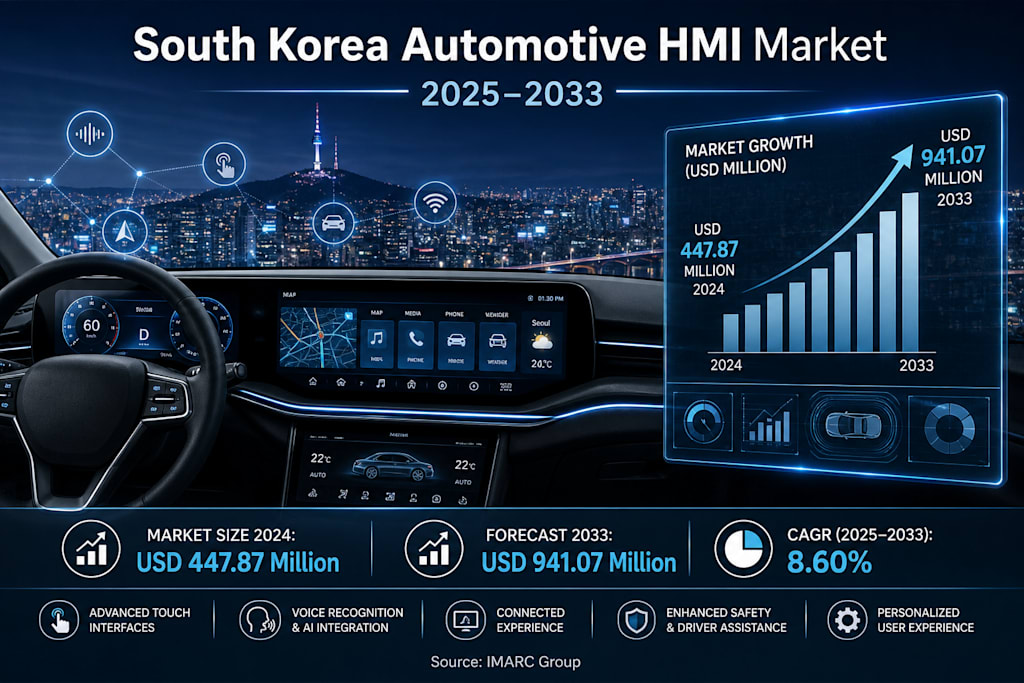
Market Overview
Automotive human-machine interface (HMI) refers to the systems and technologies that enable interaction between drivers, passengers, and vehicles. These interfaces include touchscreens, voice controls, digital instrument clusters, head-up displays (HUDs), and infotainment systems that provide information, entertainment, and control functionalities within a vehicle.
In South Korea, the automotive HMI market is rapidly evolving as vehicles become more connected, intelligent, and user-centric. The country’s strong automotive manufacturing base and technological innovation capabilities are driving the adoption of advanced in-car interfaces. Consumers are increasingly expecting seamless digital experiences inside vehicles, similar to those provided by smartphones and smart devices.
The South Korea automotive HMI market reached approximately USD 447.87 million in 2024. Looking ahead, the market is projected to grow significantly and reach around USD 941.07 million by 2033, exhibiting a compound annual growth rate (CAGR) of 8.60% during 2025–2033. Growth is driven by rising demand for connected vehicles, advancements in display technologies, and increasing integration of AI and voice-based systems.
Download a Sample PDF of This Report
Role of Innovation in Market Development
- Digital Cockpit and Touchscreen Interfaces
Modern vehicles are equipped with digital cockpits that integrate multiple displays into a unified interface. Touchscreen controls and customizable dashboards are enhancing user experience and accessibility.
- Voice Recognition and AI Integration
Voice assistants and AI-powered systems are enabling hands-free control of vehicle functions such as navigation, climate control, and entertainment. These technologies improve safety and convenience.
- Augmented Reality and Head-Up Displays
Advanced HMI systems are incorporating augmented reality (AR) and head-up displays that project critical information directly onto the windshield. This reduces driver distraction and enhances situational awareness.
South Korea Automotive HMI Industry Trends and Drivers
- Growth of Connected and Smart Vehicles
The increasing adoption of connected vehicles is driving demand for advanced HMI systems that support real-time data, navigation, and communication features.
- Rising Consumer Demand for Enhanced User Experience
Consumers expect intuitive and user-friendly interfaces in vehicles. Automakers are focusing on improving design, usability, and personalization of in-car systems.
- Expansion of Electric and Autonomous Vehicles
Electric and autonomous vehicles require sophisticated HMI systems to manage complex functionalities and provide seamless interaction between the driver and the vehicle.
South Korea Automotive HMI Market Segmentation
By Product Type
• Instrument clusters
• Head-up displays (HUDs)
• Infotainment systems
• Steering-mounted controls
• Others
By Technology
• Touch-based interfaces
• Voice-based interfaces
• Gesture-based interfaces
By Vehicle Type
• Passenger vehicles
• Commercial vehicles
By Application
• Navigation
• Entertainment
• Driver assistance
• Others
By Region
• Seoul Metropolitan Area
• Busan
• Daegu
• Incheon
• Others
This segmentation highlights how automotive HMI solutions are applied across different technologies, vehicle types, and user functionalities in South Korea.
Competitive Landscape
The South Korea automotive HMI market includes automotive manufacturers, electronics companies, software developers, and technology providers. Competition is driven by innovation, system integration, user experience, and technological capabilities.
Companies are focusing on developing advanced digital interfaces, integrating AI and connectivity features, and collaborating with automotive OEMs to deliver next-generation in-car experiences.
Market Outlook
The outlook for South Korea’s automotive HMI market remains highly positive as vehicles continue to evolve into connected and intelligent systems. Advancements in AI, display technologies, and user interface design are expected to support sustained market growth.
As automotive technology becomes more sophisticated, HMI systems will play a crucial role in enhancing safety, comfort, and user experience, shaping the future of mobility in South Korea.
About the Creator
David Michel
David Michel brings precision and depth to the world of market research. By uncovering trends, analyzing data, and delivering meaningful insights, he helps businesses navigate opportunities with confidence.
Enjoyed the story? Support the Creator.
Subscribe for free to receive all their stories in your feed.
Comments
There are no comments for this story
Be the first to respond and start the conversation.