
Smart Parenting Meets Smart Technology: Why the Global Baby Monitor Market Is Growing Faster Than Ever
From Simple Audio Devices to AI-Powered Nursery Monitoring, Baby Monitors Are Becoming Essential for Modern Families

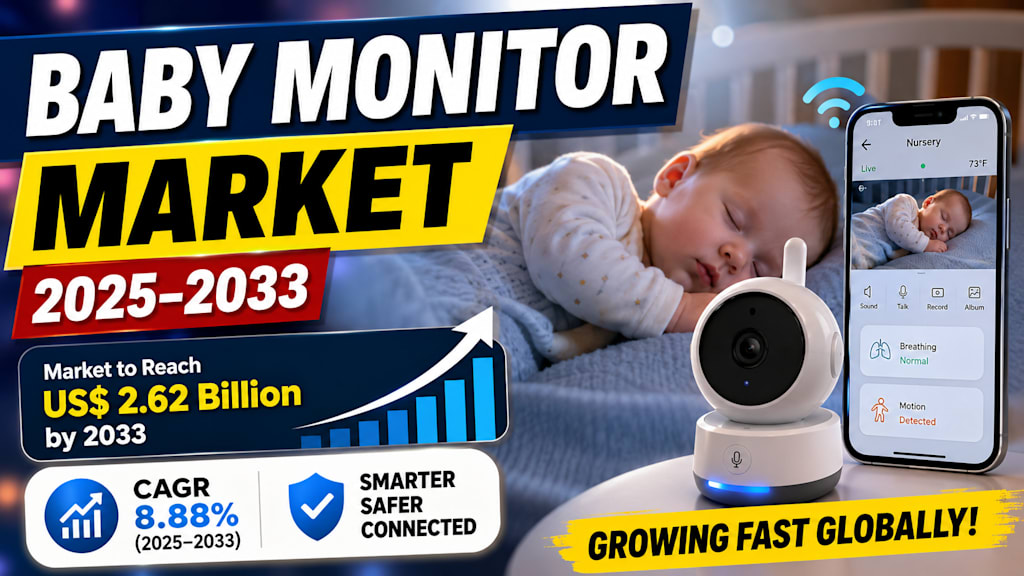
The global baby monitor market is entering a powerful growth phase as parents increasingly prioritize infant safety, convenience, and real-time monitoring. Once considered a luxury product for a small segment of households, baby monitors are now becoming a standard part of modern parenting across both developed and emerging economies.
According to Renub Research, the global baby monitor market is projected to rise from US$ 1.22 billion in 2024 to US$ 2.62 billion by 2033, growing at a CAGR of 8.88% between 2025 and 2033.
This remarkable expansion reflects broader shifts in family structures, digital lifestyles, and smart-home adoption. Parents today are looking beyond traditional baby-care products and embracing intelligent monitoring solutions that provide security, comfort, and connectivity around the clock.
The Evolution of Baby Monitors in the Digital Era
Baby monitors have transformed dramatically over the past decade. Earlier generations of monitors were limited to basic audio transmission. Today’s products feature high-definition video streaming, motion detection, temperature tracking, AI-powered crying alerts, two-way communication, cloud storage, and smartphone integration.
Modern parents want the ability to monitor their babies remotely while working, traveling, or simply managing household tasks. This demand has encouraged manufacturers to integrate Wi-Fi, Bluetooth, and artificial intelligence technologies into monitoring systems.
One major innovation highlighted in the industry is the launch of the Owlet Cam 2 in 2022, which uses machine learning and artificial intelligence to identify crying, movement, and sound patterns inside a nursery. Parents receive real-time notifications through connected mobile applications, improving responsiveness and peace of mind.
The shift toward connected parenting solutions is no longer temporary. It represents a larger movement toward smart family ecosystems where devices communicate seamlessly to support childcare and home management.
Working Parents Are Driving Strong Market Demand
One of the biggest growth drivers in the baby monitor industry is the rise of dual-income households and nuclear families.
As more parents return to work shortly after childbirth, the need for remote monitoring tools has increased substantially. Parents want reassurance that their children remain safe while being cared for by grandparents, babysitters, or daycare professionals.
Baby monitors allow parents to:
Watch live video feeds remotely
Communicate through two-way audio
Receive alerts for unusual movement or crying
Track nursery temperature and humidity
Monitor sleep patterns and routines
These features help reduce parental anxiety while improving convenience.
The increasing number of urban nuclear families is also contributing to stronger adoption. In many cities, parents live away from extended family support systems, making technological assistance even more important.
In countries such as the United States, Canada, the United Kingdom, India, and the United Arab Emirates, smart parenting devices are becoming increasingly mainstream among middle-class and upper-middle-class consumers.
Smart Home Integration Is Expanding the Industry
The baby monitor market is benefiting significantly from the growth of the global smart-home ecosystem.
Consumers today expect connected devices that can interact with smartphones, smart speakers, home security systems, and voice assistants. As a result, manufacturers are designing baby monitors that integrate with platforms like Amazon Alexa and Google Assistant.
Parents can now:
Check nursery activity through mobile apps
Use voice commands for monitoring
Receive AI-generated alerts
Store recordings in the cloud
Access monitoring systems from anywhere
This integration improves usability while creating new premium product categories.
Technology companies are investing heavily in research and development to create smarter, safer, and more user-friendly products. Competition among manufacturers is accelerating innovation, which is helping the industry attract new consumers across global markets.
Video Baby Monitors Continue to Dominate
Among all product categories, video baby monitors are expected to maintain strong market leadership.
Parents increasingly prefer visual monitoring over audio-only systems because it provides greater reassurance and more detailed observation. High-definition cameras, night vision, zoom capabilities, and motion tracking have become highly desirable features.
The demand for motion sensor baby monitors is also growing rapidly. These systems help parents monitor breathing patterns, body movement, and sleep behavior, especially during infancy.
Meanwhile, wireless and Wi-Fi-enabled baby monitors are replacing traditional wired systems because they offer greater flexibility and remote accessibility.
Online retail platforms are further boosting market expansion by making advanced products more accessible to consumers worldwide.
North America Remains a Leading Market
North America continues to dominate the global baby monitor industry due to high technology adoption and strong consumer spending on childcare products.
The United States, in particular, remains one of the most mature markets for smart parenting technologies. Growing awareness regarding infant safety, combined with strong purchasing power, is encouraging parents to invest in premium monitoring systems.
The region also benefits from:
Early adoption of AI-enabled products
Strong smart-home penetration
Rapid innovation by technology companies
High internet and smartphone usage
Increasing demand for connected family devices
According to the report, growing investment in electronics innovation and strong competition among manufacturers are helping North America maintain its market leadership position.
India Emerges as a Fast-Growing Opportunity
India is becoming one of the most promising growth markets for baby monitors.
Several factors are contributing to this expansion:
Rising disposable incomes
Growth in urban middle-class households
Increasing awareness about infant safety
Expansion of e-commerce platforms
Higher smartphone penetration
Rapid adoption of smart-home devices
Young Indian parents are becoming increasingly technology-oriented and are more willing to spend on childcare convenience products than previous generations.
The expansion of online marketplaces has also made international baby monitor brands more accessible across Indian cities and smaller towns.
As digital parenting trends continue to grow, India is expected to become a major revenue contributor for global manufacturers over the next decade.
Privacy and Cybersecurity Remain Key Challenges
Despite strong market growth, privacy and security concerns remain significant obstacles for the industry.
Since many baby monitors now operate through internet-connected platforms, they can become targets for cybersecurity threats. Reports of unauthorized access to connected cameras have raised consumer concerns regarding data protection and household privacy.
Manufacturers are therefore focusing on:
End-to-end encryption
Secure cloud storage
Multi-factor authentication
Improved software security updates
Stronger network protection systems
Consumer trust has become a critical factor in purchasing decisions. Companies that prioritize cybersecurity and transparent privacy policies are likely to gain competitive advantages in the years ahead.
Product Reliability Is Crucial for Consumer Trust
Reliability is another important challenge facing the industry.
Parents expect uninterrupted monitoring, especially during nighttime hours. Problems such as weak connectivity, battery failure, poor signal strength, or app crashes can quickly reduce consumer confidence.
Manufacturers are therefore working to improve:
Battery performance
Wi-Fi stability
Video clarity
Device durability
Real-time notification accuracy
Long-term brand success in the baby monitor market will depend heavily on delivering consistent performance and dependable functionality.
10 Recent Developments by Major Baby Monitor Companies
1. Lenovo
Lenovo has expanded its smart-home ecosystem with advanced AI-powered monitoring devices designed for remote parenting convenience and mobile integration.
2. Samsung
Samsung continues enhancing IoT connectivity across home monitoring products, improving smart-device synchronization and video quality features.
3. Hanwha Vision
Hanwha has focused on high-definition surveillance technologies and AI-enabled monitoring systems that improve infant tracking accuracy.
4. Panasonic Holdings Corporation
Panasonic has strengthened its wireless baby monitoring portfolio with improved long-range communication and night-vision capabilities.
5. Philips Avent
Philips continues expanding its smart baby-care product ecosystem with connected monitoring solutions offering temperature sensing and smartphone integration.
6. Infant Optics
Infant Optics has enhanced its DXR-series baby monitors with improved video quality and modular camera functionality.
7. Dorel Industries
Dorel is investing in next-generation childcare products that combine safety monitoring with modern nursery convenience features.
8. VTech Communications
VTech continues introducing affordable smart baby monitors equipped with HD cameras, lullaby functions, and two-way communication systems.
9. Anker Innovations
Anker’s smart-home division has expanded into AI-enhanced baby monitoring technologies featuring mobile app integration and smart alerts.
10. Owlet Baby Care
Owlet introduced advanced AI-powered nursery monitoring solutions capable of detecting crying patterns and movement through machine learning integration.
Online Retail Is Reshaping Consumer Purchasing Behavior
E-commerce has become one of the strongest distribution channels for baby monitors globally.
Parents increasingly prefer online shopping because it allows them to:
Compare features and prices
Read customer reviews
Access global brands
Watch demonstration videos
Receive home delivery convenience
Online platforms also help smaller brands reach wider audiences without relying heavily on traditional retail infrastructure.
As digital commerce expands further across Asia-Pacific, Latin America, and the Middle East, online sales are expected to contribute significantly to future market growth.
AI and Predictive Monitoring Could Define the Future
The future of the baby monitor industry may extend far beyond simple observation.
Artificial intelligence and predictive analytics are expected to play a major role in next-generation products. Future devices may offer:
Sleep quality analysis
Breathing irregularity alerts
Predictive crying detection
Health-pattern tracking
Behavioral monitoring insights
These innovations could transform baby monitors into comprehensive infant wellness systems rather than standalone surveillance tools.
Manufacturers investing in AI, machine learning, and cloud-based analytics are likely to shape the next phase of industry competition.
Final Thoughts
The global baby monitor market is rapidly evolving into one of the most dynamic segments within smart childcare technology. Rising concerns about infant safety, growing adoption of smart-home ecosystems, and increasing numbers of working parents are collectively driving market expansion worldwide.
As technology becomes more intelligent and connected, baby monitors are shifting from optional convenience products to essential parenting tools.
While cybersecurity and product reliability remain critical challenges, continuous innovation is helping manufacturers create safer, smarter, and more dependable solutions for modern families.
With the market expected to surpass US$ 2.62 billion by 2033, the industry appears well positioned for sustained long-term growth.
About the Creator
Enjoyed the story? Support the Creator.
Subscribe for free to receive all their stories in your feed.
Comments
There are no comments for this story
Be the first to respond and start the conversation.