
Smart Lock Market Set to Reach US$8.77 Billion by 2034 as Smart Homes, Advanced Security, and Urbanization Drive Global Adoption
Growing demand for connected home technologies, rising security concerns, and the expansion of smart city infrastructure are fueling rapid growth across the global smart lock industry.

Introduction: The Future of Security Is Keyless
The way people secure their homes, offices, hotels, and commercial buildings is changing rapidly. Traditional mechanical locks that have been used for centuries are increasingly being replaced by smart lock systems that offer greater convenience, enhanced security, and seamless integration with connected devices.
As smart homes become more common and consumers demand better control over their living environments, smart locks have emerged as one of the fastest-growing categories within the home automation industry. These advanced devices allow users to lock and unlock doors using smartphones, fingerprints, PIN codes, Bluetooth, Wi-Fi, and even facial recognition technology.
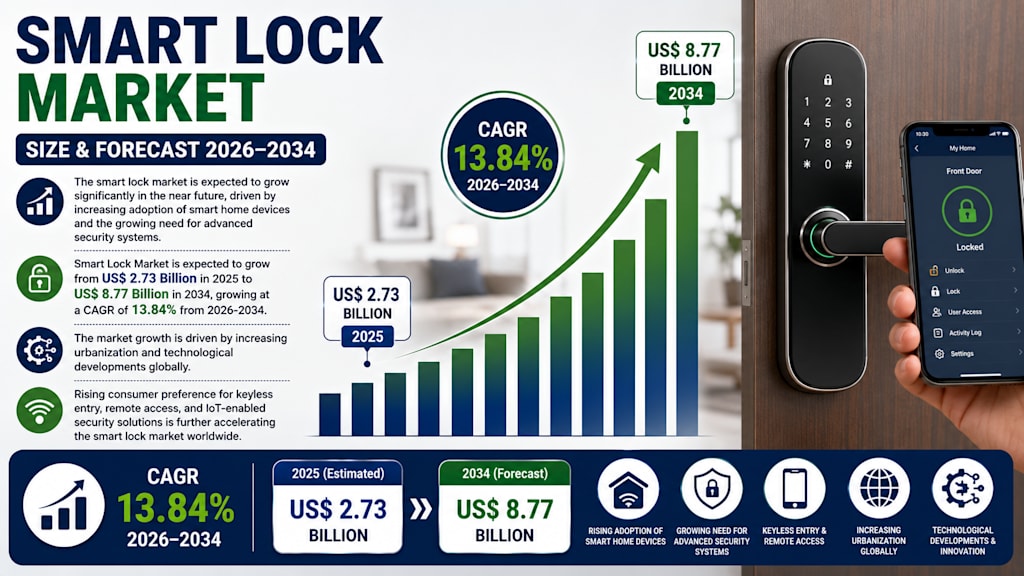
According to Renub Research, the Global Smart Lock Market is expected to grow from US$ 2.73 billion in 2025 to US$ 8.77 billion by 2034, expanding at a compound annual growth rate (CAGR) of 13.84% between 2026 and 2034. Rising urbanization, growing adoption of smart home technologies, and increasing demand for advanced security solutions are among the key factors driving market expansion.
As consumers continue embracing connected lifestyles and intelligent security systems, smart locks are expected to become an essential component of modern living.
Understanding Smart Locks and Their Growing Appeal
A smart lock is an electronic locking system that allows users to secure and access properties without relying on traditional physical keys. Instead, these devices utilize technologies such as smartphone applications, biometric authentication, PIN codes, Bluetooth connectivity, Wi-Fi networks, and facial recognition systems.
Unlike conventional locks, smart locks enable remote access management, real-time monitoring, and customized permissions for family members, guests, employees, and service providers. These capabilities make them particularly attractive for residential homes, commercial offices, hotels, and rental properties.
Consumers increasingly value the convenience of keyless entry and the ability to manage security remotely.
As digital lifestyles continue evolving, smart locks are becoming a practical solution for enhancing both convenience and safety.
Smart Home Adoption Continues to Accelerate Market Growth
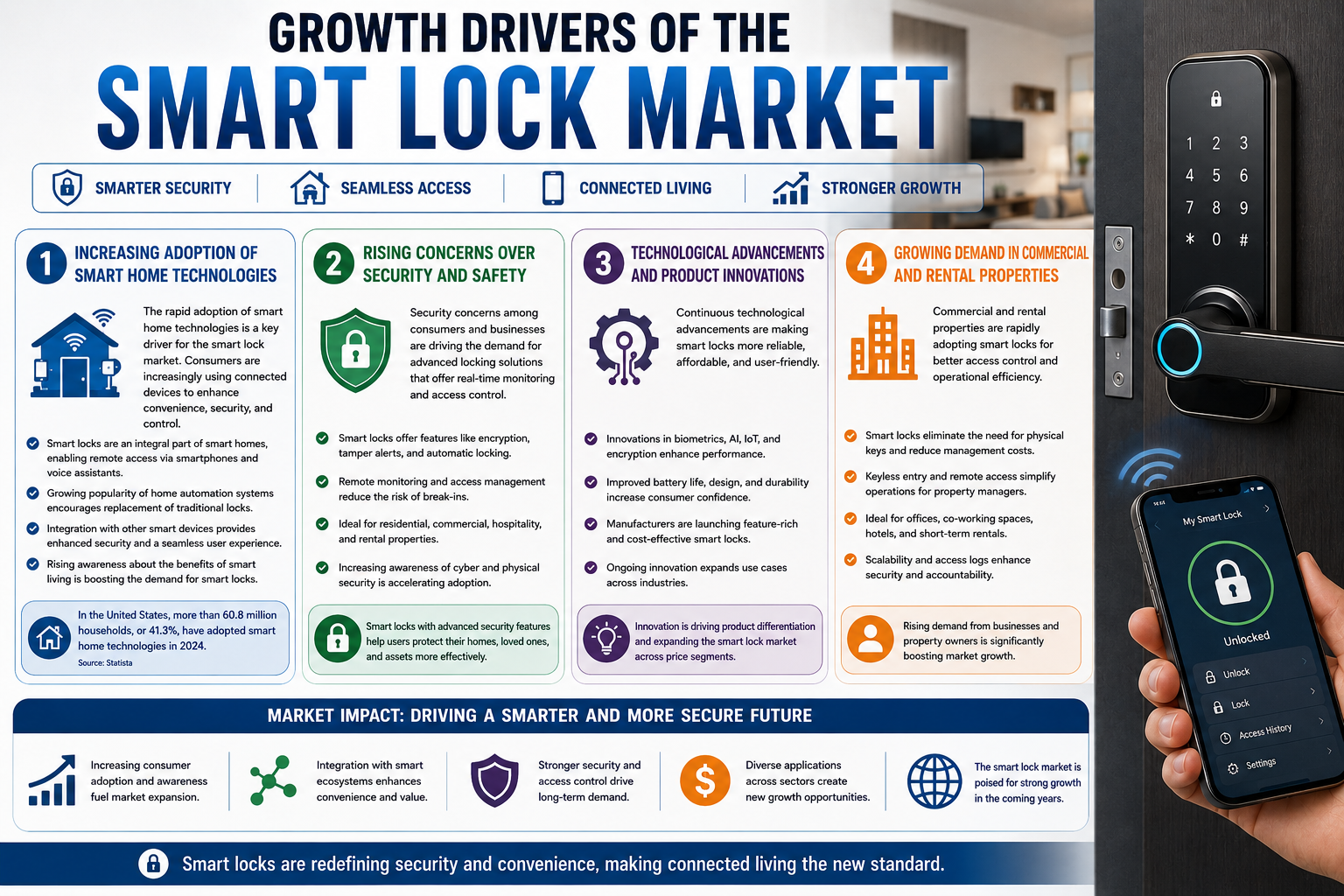
One of the most significant growth drivers for the smart lock industry is the rapid expansion of smart home technology worldwide.
Consumers are increasingly integrating devices such as smart lighting systems, voice assistants, surveillance cameras, thermostats, and connected appliances into their homes. Smart locks fit naturally within these ecosystems by providing secure and convenient access control.
The report notes that more than 60.8 million households in the United States had adopted smart home technologies in 2024, representing approximately 41.3% of all households. This widespread adoption reflects growing consumer confidence in connected technologies.
Smart locks can be integrated with voice assistants and mobile applications, allowing users to control entry points remotely and automate security routines.
As smart home ecosystems continue expanding globally, demand for smart locks is expected to increase significantly.
Security Concerns Are Driving Consumer Interest
Growing concerns about home and property security have become another major factor supporting market growth.
Traditional locks are vulnerable to key duplication, lock picking, and unauthorized access. Smart locks address many of these concerns by offering advanced authentication methods such as biometric verification, encrypted digital credentials, and real-time access monitoring.
Consumers can receive notifications whenever doors are accessed and can grant temporary entry permissions without distributing physical keys.
These capabilities are particularly valuable for homeowners, landlords, business operators, and property managers seeking greater control over property access.
The report highlights the introduction of new smart lock solutions by Yale and Master Lock for multifamily housing and commercial properties, reflecting growing demand for professional-grade access control systems.
As security concerns continue increasing, advanced smart locking technologies are expected to gain wider acceptance.
Urbanization and Smart City Development Support Expansion
Rapid urbanization is creating favorable conditions for the growth of the smart lock market.
As populations continue shifting toward urban centers, demand for apartments, residential complexes, office buildings, hotels, and mixed-use developments is increasing. These modern environments increasingly incorporate digital infrastructure and connected technologies designed to improve efficiency and convenience.
Governments and developers are investing heavily in smart city initiatives that emphasize automation, digital connectivity, and intelligent building management.
Smart locks play a critical role in these environments by providing secure, scalable, and remotely manageable access control solutions.
The rise of short-term rental platforms has also increased demand for smart locks that allow property owners to manage guest access remotely.
As urban development continues accelerating worldwide, smart lock adoption is expected to expand alongside smart infrastructure projects.
Smart Deadbolt Locks Lead Residential Security Solutions
Smart deadbolt locks remain one of the most popular product categories within the market.
Designed to replace traditional deadbolt systems, these locks provide enhanced security while incorporating modern features such as keyless entry, mobile access, biometric authentication, and remote management capabilities.
Homeowners increasingly prefer smart deadbolts because they combine familiar security mechanisms with advanced digital functionality.
Manufacturers continue introducing features such as voice control, automatic locking, and enhanced encryption technologies to improve usability and protection.
As residential consumers prioritize both convenience and security, smart deadbolt locks are expected to maintain strong market demand.
Wi-Fi Smart Locks Continue to Gain Popularity
The Wi-Fi smart lock segment is experiencing rapid growth due to increasing demand for internet-connected devices.
Wi-Fi-enabled locks allow users to control and monitor access from virtually anywhere using smartphones, tablets, or computers. This capability provides unparalleled convenience for homeowners, property managers, and business operators.
Remote management features allow users to grant temporary access, receive activity alerts, and track entry logs in real time.
Wi-Fi smart locks are particularly popular within smart home ecosystems because they can integrate seamlessly with other connected devices.
As internet connectivity becomes increasingly widespread, demand for Wi-Fi-enabled smart security solutions is expected to remain strong.
App-Based Smart Locks Enhance User Convenience
Mobile applications have become central to the functionality of many smart lock systems.
App-based smart locks allow users to lock and unlock doors remotely, monitor activity, create digital keys, and manage access permissions directly from their smartphones. These features eliminate the need for physical keys while offering greater flexibility and control.
Property owners can easily provide temporary access to guests, family members, maintenance personnel, or delivery services without compromising security.
The growing dependence on smartphones for everyday activities continues supporting adoption of app-controlled security solutions.
As mobile technology advances, app-based smart locks are expected to become even more sophisticated and user-friendly.
Residential Applications Dominate Market Demand
The residential sector represents the largest application segment within the smart lock market.
Homeowners increasingly view smart locks as an important investment in both convenience and security. Features such as keyless entry, remote access, biometric authentication, and activity monitoring appeal strongly to consumers seeking modern home security solutions.
The growth of gated communities, smart apartments, and connected residential developments has further accelerated adoption.
Manufacturers are also introducing more affordable and easier-to-install products that make smart lock technology accessible to broader consumer segments.
As awareness of smart home security continues growing, residential applications are expected to remain the primary driver of market growth.
Hospitality Industry Embraces Digital Access Solutions
Hotels and resorts are increasingly adopting smart locks to improve guest experiences and operational efficiency.
Smart lock systems allow guests to access rooms using mobile applications, digital credentials, or key cards, reducing the need for traditional keys and simplifying check-in processes. These technologies also enhance security while enabling hotel operators to manage room access more effectively.
Hospitality businesses benefit from improved monitoring capabilities, reduced administrative burdens, and enhanced guest satisfaction.
As digital transformation continues reshaping the hospitality industry, smart lock adoption is expected to increase steadily.
Regional Markets Continue to Expand
United States
The United States remains one of the most advanced smart lock markets globally due to widespread smart home adoption, strong technological infrastructure, and high consumer awareness regarding digital security solutions.
The report highlights the launch of Nuki Smart Lock in the U.S. market, providing consumers with additional options for keyless home security.
United Kingdom
The United Kingdom continues experiencing strong growth driven by increasing awareness of home security technologies and growing adoption of smart home systems.
The launch of Yale's Linus Smart Lock L2 Lite featuring KeySense™ technology reflects ongoing innovation within the UK market.
India
India represents one of the fastest-growing smart lock markets due to rapid urbanization, rising smartphone adoption, and increasing consumer awareness regarding home security.
The report highlights Mygate's entry into the smart lock segment through app-controlled access solutions designed for modern residential environments.
Saudi Arabia
Saudi Arabia's market is expanding due to growing investments in smart cities, modern residential infrastructure, and advanced security technologies.
The report highlights EZVIZ's Y3000FVP Plus smart lock featuring facial recognition and palm vein recognition capabilities, demonstrating the country's growing appetite for cutting-edge security solutions.
Challenges Continue to Affect Market Adoption
Despite strong growth prospects, the smart lock market faces several challenges.
One of the primary barriers is the relatively high upfront cost associated with smart lock systems. Advanced hardware, connectivity features, and professional installation requirements often make smart locks more expensive than traditional alternatives. Battery replacement and maintenance expenses can also add to total ownership costs.
Cybersecurity concerns represent another important challenge. Because smart locks rely on internet connectivity and mobile applications, they may be vulnerable to hacking attempts, unauthorized access, or software vulnerabilities if not properly secured.
Manufacturers must continue investing in encryption technologies, software updates, and system reliability to maintain consumer trust and confidence.
Leading Companies Driving Innovation
The global smart lock market includes several major technology and security companies focused on innovation, product development, and expanding smart security ecosystems.
Key players highlighted in the report include Allegion plc, Avent, Assa Abloy, Dormakaba Holding AG, Samsung, Zhejiang Dahua Technology Co. Ltd., Spectrum Brands Holdings Inc., and Panasonic Corporation. These organizations continue investing in advanced authentication technologies, connectivity solutions, and intelligent access management systems.
Their innovations are helping shape the future of digital security worldwide.
Final Thoughts
The global smart lock market is entering a period of rapid expansion driven by smart home adoption, rising security concerns, urbanization, and technological innovation.
With the market projected to grow from US$ 2.73 billion in 2025 to US$ 8.77 billion by 2034, smart locks are becoming an increasingly important component of modern residential, commercial, and hospitality environments. Growing consumer demand for convenience, remote access, and advanced security features is creating significant opportunities for manufacturers and technology providers.
Although challenges related to cost and cybersecurity remain, the industry's long-term outlook remains highly positive. As connected living continues becoming the global standard, smart locks are expected to play a central role in the future of intelligent security and access management.
About the Creator
Enjoyed the story? Support the Creator.
Subscribe for free to receive all their stories in your feed.
Comments
There are no comments for this story
Be the first to respond and start the conversation.