
Smart Lock Market Set for Massive Growth as Smart Homes and Digital Security Become the New Standard
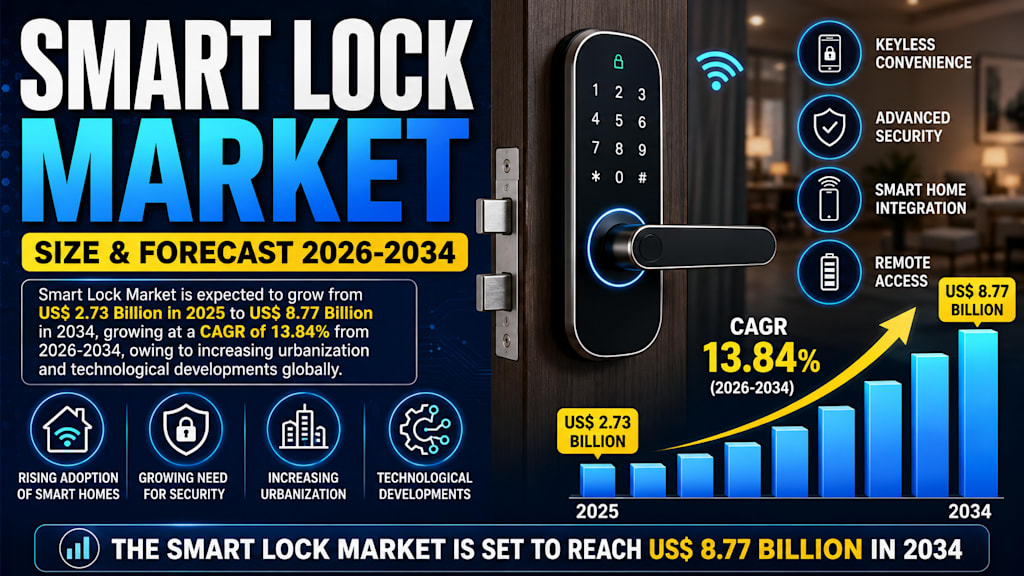
Renub Research forecasts the global smart lock market to expand from US$ 2.73 billion in 2025 to US$ 8.77 billion by 2034, fueled by rising smart home adoption, urbanization, and growing security concerns.

Smart Locks Are Redefining Home and Business Security
The way people secure their homes, offices, hotels, and commercial properties is changing rapidly. Traditional keys and mechanical locks are steadily being replaced by smarter, more connected solutions that offer convenience, remote access, and stronger protection. At the center of this transformation is the growing smart lock market, a sector that is benefiting from the rapid rise of smart homes, connected devices, and digital lifestyles across the world.
According to Renub Research, the global smart lock market is projected to grow from US$ 2.73 billion in 2025 to US$ 8.77 billion by 2034, registering a strong CAGR of 13.84% during 2026–2034. The numbers reflect more than just increasing sales of digital door locks. They point toward a much larger shift in how consumers think about security, convenience, and modern living.
Smart locks are no longer viewed as luxury technology reserved for high-end homes. They are increasingly becoming mainstream products adopted by homeowners, apartment residents, businesses, hospitality providers, and property managers. As urbanization accelerates and consumers become more comfortable with connected technologies, smart locks are moving into the center of the global smart security ecosystem.
Why Smart Locks Are Becoming So Popular
A smart lock is an advanced electronic locking system that enables users to lock and unlock doors without using traditional physical keys. Instead, smart locks rely on technologies such as smartphones, PIN codes, Wi-Fi, Bluetooth, fingerprints, facial recognition, and mobile applications for access control. These features provide flexibility and convenience that traditional locking systems simply cannot offer.
Consumers are increasingly attracted to smart locks because they solve multiple everyday problems at once. Losing keys, duplicating keys, and managing access for family members or guests are common frustrations with traditional systems. Smart locks eliminate many of these issues by allowing users to manage access digitally. A homeowner can unlock a door remotely, provide temporary access to a visitor, or monitor activity directly from a mobile phone. This level of control is one of the key reasons adoption continues to rise globally.
The technology also aligns perfectly with modern lifestyles. Consumers are already using smartphones to manage banking, entertainment, shopping, and communication. Extending that convenience to home security feels like a natural progression. As more people adopt connected living solutions, smart locks are becoming one of the most practical and desirable components of the smart home ecosystem.
Smart Home Expansion Is Fueling Market Growth
One of the strongest growth drivers for the smart lock industry is the increasing adoption of smart home technologies worldwide. Smart homes are no longer futuristic concepts; they are becoming standard in many urban residential developments. Devices such as smart lighting systems, voice assistants, surveillance cameras, and automated thermostats are now common in modern households. Smart locks integrate seamlessly into these ecosystems, allowing homeowners to manage security alongside other connected devices.
The file highlights that in the United States alone, more than 60.8 million households, representing 41.3% of homes, had adopted smart home technologies in 2024. This widespread acceptance of connected devices is creating a strong foundation for the smart lock market.
Consumers increasingly want homes that are automated, secure, and digitally manageable. Smart locks help deliver that experience. Voice-controlled locking systems connected to smart assistants, mobile-controlled access systems, and remote monitoring capabilities are becoming highly attractive features for both homeowners and renters. As awareness of home automation grows, the demand for smart locks is expected to continue accelerating.
Rising Security Concerns Are Changing Consumer Behavior
Security concerns are another major reason behind the rapid growth of the smart lock market. Traditional locks can be picked, duplicated, or accessed without authorization. Smart locks, however, offer more advanced security mechanisms such as biometric authentication, encrypted digital access, and real-time monitoring. These features provide an additional layer of protection that appeals to both residential and commercial users.
Modern consumers are also becoming more security-conscious. Rising concerns related to theft, unauthorized access, and property protection are encouraging households and businesses to invest in more advanced access control systems. Smart locks allow users to track entry attempts, receive security alerts, and manage access permissions remotely, giving them a greater sense of control over their property.
Commercial properties are also contributing to market growth. Offices, apartment complexes, hotels, and shared living spaces increasingly require digital access systems that are easier to manage and more secure than traditional key systems. Companies are responding to this demand by launching solutions tailored specifically for commercial and multi-family housing environments. The file references Yale and Master Lock introducing new smart lock solutions aimed at professional and commercial customers, showing how the market is evolving beyond residential use.
Urbanization and Smart Cities Are Creating New Opportunities
Rapid urbanization is another major factor shaping the future of the smart lock industry. As cities expand and more people move into urban residential developments, the demand for modern security infrastructure is increasing. Apartments, gated communities, office spaces, and rental properties all require efficient access management systems, and smart locks are becoming a preferred solution.
Governments around the world are also investing heavily in smart city projects that incorporate connected technologies into infrastructure and residential environments. Smart locks fit naturally into these initiatives because they support digital living, energy-efficient systems, and centralized security management. The growing popularity of short-term rentals and app-based accommodation services is also increasing the need for flexible remote-access solutions.
For property owners and rental managers, smart locks simplify operations significantly. Temporary digital access codes eliminate the need for physical key handovers, improving convenience while reducing operational complexity. This flexibility is becoming increasingly valuable in modern urban environments where mobility, automation, and digital management are essential.
Smart Deadbolt Locks Are Becoming a Preferred Choice
Among the various product categories, smart deadbolt locks are witnessing particularly strong demand. These locks replace traditional deadbolt systems while adding advanced capabilities such as remote access, encrypted digital authentication, fingerprint scanning, and voice control. Consumers are increasingly choosing these systems because they combine strong physical security with modern digital convenience.
Manufacturers are continuously adding new features to improve user experience. Auto-lock systems, mobile app integration, and compatibility with voice assistants are making smart deadbolt locks more attractive to a broader consumer base. As awareness of home security continues to grow, these locks are expected to remain one of the most important segments within the smart lock industry.
Wi-Fi and App-Based Smart Locks Are Driving Connectivity
Wi-Fi smart locks are becoming increasingly popular because they allow users to control access remotely through smartphones or computers. Unlike conventional locks, these systems enable real-time monitoring and remote operation from virtually anywhere with internet access. This level of flexibility is particularly useful for homeowners, office managers, and rental property operators.
App-based smart locks are also seeing rapid adoption. Mobile applications allow users to manage access permissions, monitor activities, and unlock doors remotely. These capabilities make smart locks highly convenient for families, property owners, and hospitality providers. As mobile applications continue to dominate daily consumer interactions, app-controlled access systems are becoming increasingly natural for users.
The growth of internet connectivity worldwide further supports this trend. As internet infrastructure improves and smartphone penetration rises, the market for connected smart lock systems is expected to expand significantly across both developed and emerging economies.
Residential Applications Continue to Lead the Market
The residential segment currently accounts for one of the largest shares of the smart lock market. Homeowners are increasingly replacing traditional locks with digital systems that offer convenience, remote access, biometric authentication, and real-time monitoring. The broader trend toward smart home living is strongly supporting this transition.
Modern apartments, gated communities, and urban housing developments increasingly integrate smart security systems as part of their infrastructure. Consumers now view connected security features as essential rather than optional. Companies are also introducing more affordable and user-friendly smart lock systems, helping expand adoption among middle-income households.
As awareness of home automation and digital security grows, the residential smart lock market is likely to remain one of the industry's most important revenue contributors over the coming decade.
Hospitality Industry Is Rapidly Adopting Smart Locks
Hotels and resorts are also emerging as major adopters of smart lock systems. Hospitality businesses increasingly rely on keyless entry systems that use mobile apps, digital codes, or key cards to improve guest convenience and operational efficiency. These systems eliminate the need for physical keys while reducing security risks and simplifying room access management.
Smart locks allow hotels to manage room availability more efficiently, track access activity, and enhance the overall guest experience. As the hospitality sector continues embracing digital transformation and automation, smart lock solutions are expected to become standard across many hotel chains and rental properties worldwide.
Regional Markets Are Expanding at Different Speeds
The United States remains one of the most advanced smart lock markets globally due to strong smart home adoption, widespread smartphone usage, and high consumer awareness about connected security technologies. The availability of advanced products and strong distribution networks further supports market growth in the country.
The United Kingdom is also witnessing steady growth driven by rising awareness of smart home security solutions and increasing urbanization. Meanwhile, India is emerging as a fast-growing market because of rapid urban development, rising internet penetration, growing smartphone adoption, and increasing awareness of home security systems.
Saudi Arabia is another promising market where smart city development, modern residential infrastructure, and growing adoption of digital security systems are creating strong demand for smart locks. These regional trends indicate that the market opportunity is becoming increasingly global rather than concentrated only in developed economies.
Challenges Still Exist for the Industry
Despite its strong outlook, the smart lock market still faces several important challenges. Cost remains one of the biggest barriers to adoption. Smart locks are significantly more expensive than traditional mechanical locks because they rely on advanced electronic components, internet connectivity, and sophisticated security technologies. Professional installation costs can also increase the overall expense for consumers.
Cybersecurity concerns are another challenge. Since smart locks are connected to mobile applications and internet networks, they can potentially become targets for hacking or unauthorized digital access if not properly secured. Consumers also worry about data privacy, system reliability, and dependence on batteries or internet connectivity. Manufacturers must continue improving encryption, reliability, and cybersecurity protections to maintain consumer trust.
Final Thoughts
The global smart lock market is entering a powerful growth phase driven by smart home adoption, urbanization, digital lifestyles, and rising security awareness. Consumers are increasingly looking for solutions that combine convenience with stronger protection, and smart locks deliver both. What was once considered premium technology is quickly becoming a mainstream feature in homes, offices, hotels, and commercial properties worldwide.
Renub Research’s forecast of the market growing from US$ 2.73 billion in 2025 to US$ 8.77 billion by 2034 reflects how rapidly the industry is evolving. As smart infrastructure expands and connected living becomes more common, smart locks are expected to become a standard part of modern security systems rather than an optional upgrade. The future of access control is increasingly digital, mobile, and intelligent, and smart locks are positioned at the center of that transformation.
About the Creator
Enjoyed the story? Support the Creator.
Subscribe for free to receive all their stories in your feed.
Comments
There are no comments for this story
Be the first to respond and start the conversation.